Table of Contents
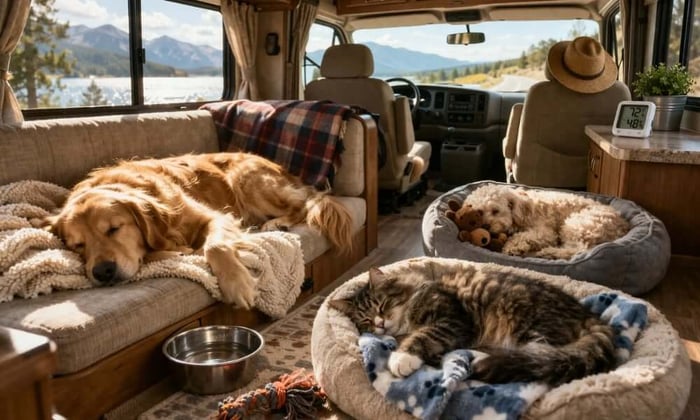
The campsite is set, the doors are locked, and the trail is calling. Two hours later, you're still out there, and somewhere in the back of your mind, a quiet question won't go away: is the AC still running? That low-grade worry is something every RV traveler with animals knows well, and it doesn't go away on its own. RV pet monitoring is the practical answer to that question, not because it removes the responsibility of caring for your animals, but because it replaces guesswork with real information.
Why RV Environments Create Unique Risks for Pets
A house holds temperature reasonably well. An RV does not. The walls are thin, the windows are large relative to the interior space, and the whole structure sits in direct sun without the shade a building's roof overhang or nearby trees usually provide. When conditions outside shift, conditions inside follow almost immediately.
Veterinary data puts the danger threshold for dogs and cats at around 104°F, and a parked vehicle can reach that temperature in well under 30 minutes on a warm day, even with the windows cracked. Humidity makes it worse. High moisture in the air reduces a pet's ability to cool down through panting, so a humid 85°F can feel closer to 95°F from an animal's perspective.
Power failures add a separate layer of risk. When shore power cuts out at a campground, the AC stops instantly. There's no gradual warning and no alarm built into most rigs. The fans stop, the vents go still, and the interior starts warming. If the pet owner is two miles down a hiking trail with no way to know any of this is happening, that's a serious problem.
What RV Pet Monitoring Actually Does
At its core, RV pet monitoring means placing a device inside the rig that tracks temperature, humidity, and power status continuously, then sends alerts to the owner's phone the moment a reading crosses a preset limit. It is not a camera feed, though camera systems exist separately. The focus is on the temperature inside the RV, and what are the actual conditions the pet is living in right now?
The cellular vs. WiFi distinction matters more than most people realize when they first start looking into this. Campground WiFi is notoriously unreliable. Congested networks, dead zones, and systems that simply go offline overnight mean a WiFi-dependent monitor can go silent exactly when it's needed most. A cellular-based system runs through 4G LTE, the same network a smartphone uses - so it works in remote areas, rural campgrounds, and even through a power outage if the device carries its own backup battery.
The basic workflow is simple: the device reads conditions constantly, compares them to the thresholds the owner has set, and fires off an alert through the app, by text, or by email when something is off. No one has to check an app every 15 minutes. The device does the watching.
The Situations Where This Earns Its Keep
Consider a quick grocery run on a summer afternoon. Temperatures outside are in the mid-80s, the rig is parked with partial shade, and the AC is running. That all sounds fine. The sun shifts, the shade disappears, and the interior temperature starts climbing. An active monitoring system catches the rise early and sends an alert while the owner is still in the store. That's a manageable situation, not a crisis.
The overnight scenario is harder to shrug off. Shore power fails at 2 AM due to a voltage issue at the campground pedestal. The AC cuts out. Inside the RV, temperatures begin rising while everyone sleeps. Without monitoring, no one knows until morning, and by then, a small dog or a cat in an enclosed space may be in serious distress. With monitoring, an alert reaches someone's phone in time to fix it.
Unexpected weather changes catch travelers off guard, too. A desert campground that was comfortable at sunset can be stifling by mid-morning when the clouds clear and the sun hits the rig at full strength. Temperature monitoring is the only reliable way to know what's actually happening inside versus what it feels like outside.
Interestingly enough, the most valuable alerts are often not the dramatic ones. An early warning, say, the interior has climbed to 78°F and is trending upward, gives time to act before the situation becomes an emergency. That head start is worth a great deal.
Tips for Setting Up Pet Monitoring in an RV
Placement affects accuracy more than most people expect. The monitor should sit at roughly the same height as where the pet rests, away from AC vents that would artificially cool the reading and away from windows where direct sunlight can skew it upward. The goal is the actual ambient temperature the animal is experiencing.
Alert thresholds should be set conservatively. If a dog handles up to 78°F without issue, setting the upper alert at 75°F gives a response window before conditions become dangerous. Alerting at the danger threshold means there's no margin left.
Test the system before the first real trip. Set the alert artificially low, walk away from the rig, and confirm the notification actually arrives. Know what it sounds like and make sure the phone won't silently block it.
Physical backup measures still matter alongside monitoring. A battery-powered fan on its own circuit, reflective window shades, and a windshield cover all slow the rate of temperature rise if the AC fails. Monitoring catches the problem, backup ventilation buys the time to solve it.
What to Look for in an RV Pet Monitor
Cellular connectivity tops the list. A system that depends on campground WiFi is only as reliable as that WiFi, which is often not very reliable at all. Cellular coverage across major carriers gives consistent performance regardless of where the rig is parked.
Backup battery life should be measured in days, not minutes. Necto Temperature Monitor has a 72-hour rechargeable battery. A power outage is one of the most common scenarios a pet monitor needs to handle, and a device that shuts off when the power goes out offers no protection during the exact event it was meant to cover.
Multi-channel alerts reduce the chance of missing a notification. App push notifications, text messages, and email each reach a phone differently. A system that uses all three is less likely to go unnoticed when the phone is set to Do Not Disturb, or a notification gets buried.
Accuracy and a clearly stated operating range matter more than extra features. A temperature reading that's several degrees off creates false confidence, which is worse than no reading at all. Look for devices with published specifications and a manufacturer's warranty that reflects confidence in the hardware.
Worth Every Mile of Peace of Mind
RV travel with pets is genuinely one of the better ways to see the country. Bringing a dog or cat along changes the whole feel of a trip, with more stops, more lingering, and more time spent outside instead of rushing between destinations. That said, there's a real tension that comes with it, and it doesn't fully go away by telling yourself everything will be fine.
Effective RV pet monitoring shifts that tension into something manageable. Owners who use it consistently say they explore more freely and stay out longer because they're not carrying a constant background worry about what they can't see. That's the actual value, not just safety in emergencies, but the steady confidence that comes with knowing.
If you're ready to travel with your pets and actually enjoy it, contact Necto today. The team can walk you through exactly what setup makes sense for your rig and your travel style.
FAQs
What is RV pet monitoring and how does it work?
RV pet monitoring involves using a device that tracks temperature, humidity, and power status inside your RV and sends alerts to your phone if conditions become unsafe. It helps replace guesswork with real-time information.
Why are RVs more dangerous for pets compared to houses?
RVs heat up and cool down much faster than traditional homes due to thin walls, large windows, and direct sun exposure. This makes temperature changes more extreme and potentially dangerous for pets in a short amount of time.
What happens if the RV loses power while pets are inside?
If shore power fails, the air conditioning stops immediately, causing the interior temperature to rise quickly. Without monitoring, owners may not realize the issue until it becomes dangerous for their pets.
Is cellular pet monitoring better than WiFi-based systems?
Yes, cellular-based systems are generally more reliable because campground WiFi can be unstable or unavailable. Cellular monitoring continues working in remote areas and even during power outages if the device has a backup battery.
What temperature is considered unsafe for pets in an RV?
Temperatures around 104°F are considered dangerous for dogs and cats. However, it's recommended to set alert thresholds much lower (around 75–78°F) to allow time to respond before conditions become critical.
What features should you look for in an RV pet monitoring device?
Key features include cellular connectivity, long battery backup (such as 72 hours), multi-channel alerts (app, SMS, email), and accurate temperature readings to ensure reliable monitoring and timely alerts.