Table of Contents
- Why Temperature Is Everything for Vaccines
- The Actual Temperature Ranges
- Refrigerator Type Makes a Real Difference
- Where Manual Logs Fall Short
- What Happens When Something Goes Wrong
- Common Habits That Lead to Problems
- What Auditors Are Actually Looking For
- Setting Up a Storage Program That Actually Works
- When the Stakes Feel Abstract Until They Are Not
- Ready to Protect Your Vaccine Inventory?
- FAQs
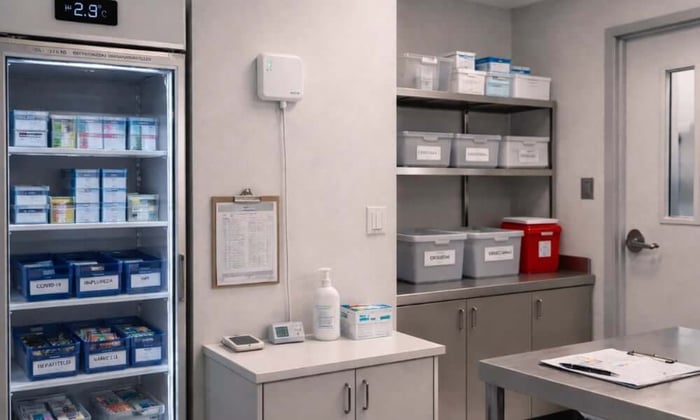
You walk in on a Monday morning, and the vaccine storage temperature looks fine. The vaccine refrigerator is humming, the vials are lined up neatly, and the paper log from Friday says the temperature was 4°C. But what happened Saturday night when the compressor cycled unevenly for three hours? Or Sunday afternoon, when a staff member propped the door open during a restock?
These guidelines exist precisely because those quiet, unwitnessed moments are where most problems actually begin. This article walks through what those guidelines say, why they matter, and what clinics need to do to stay ahead of an excursion before it becomes a costly write-off.
Why Temperature Is Everything for Vaccines
Vaccines are biological. They are not shelf-stable medications you can leave in a cabinet. Their active components, proteins, live organisms, and adjuvants depend on a specific thermal environment to stay intact. Once heat or cold breaks that structure down, there is no fixing it. You cannot re-stabilize a degraded antigen, and you cannot tell just by looking at the vial that anything went wrong.
That is what makes this genuinely tricky. A compromised vaccine looks exactly like a healthy one. The same color, the same volume, the same packaging. The only way to know it has been affected is to track the conditions it was exposed to, and that requires consistent, accurate temperature data over time, not a twice-daily manual check.
The downstream effects are serious. Patients who receive a degraded vaccine may not develop full immunity, which defeats the purpose of vaccination entirely. From a clinic operations standpoint, the financial hit from discarded inventory can reach thousands of dollars in a single incident. And from a compliance angle, regulators expect documented proof that proper conditions were maintained.
The Actual Temperature Ranges
Most standard vaccines require refrigeration between 2°C and 8°C (36°F to 46°F). That is not a wide window. It is about the difference between the coldest part of a household fridge and the warmest shelf near the door.
Frozen vaccines, including certain live-attenuated products, require temperatures between -50°C and -15°C depending on the manufacturer's specifications. Some newer mRNA products have even more specific requirements, and those specs should always be confirmed directly with the product insert or the manufacturer.
What gets clinics into trouble is not usually ignorance of these ranges, but it is assuming that "mostly in range" is good enough. A unit that averages 5°C over 24 hours can still expose vaccines to a spike above 8°C for 90 minutes in the early morning when no one is watching. That spike is a reportable excursion. The average does not erase it.
Refrigerator Type Makes a Real Difference
Not all refrigerators handle this well. Household units were designed for food, not pharmaceuticals. The temperature inside a typical kitchen refrigerator varies significantly depending on where you place items. Near the back coils, it may dip below freezing, while the door shelves routinely sit a few degrees warmer than the center.
Purpose-built pharmaceutical refrigerators are designed to circulate air evenly, recover quickly after the door opens, and maintain consistent temperatures throughout the cabinet. They are a meaningful investment, but for clinics storing any volume of vaccines, they are the right baseline.
Regardless of unit type, storage placement within the unit matters. Vaccines should be kept away from vents, away from the walls, and never in the door. They need airflow around them, and they should not be packed so tightly that air cannot circulate. These are small details that are easy to overlook when a clinic gets busy, and that is precisely when they tend to matter most.
Where Manual Logs Fall Short
Checking the temperature twice a day is better than not checking at all, but it leaves a lot of hours unaccounted for. Temperature excursions happen during power interruptions, after-hours door openings, compressor failures, and HVAC disruptions, most of which occur outside of business hours.
Manual logs also introduce human error. A staff member might record the temperature from memory, round to the nearest degree, or skip a check during a hectic afternoon. None of that is negligence, just the practical reality of a busy clinic. The log looks complete, but the data has gaps.
Continuous electronic monitoring removes those gaps. A good monitoring setup records temperature at regular intervals around the clock, stores that data automatically, and sends an alert the moment conditions fall outside the set range. That kind of real-time awareness is what separates a clinic that catches an excursion at 11 PM from one that discovers a problem Monday morning after the vaccines have been sitting out of range for 36 hours.
That is where reliable environmental monitoring earns its place. Tools like the Necto temperature monitor are built specifically for this, continuous cellular-connected tracking that alerts you instantly, even during a power outage, so your team can act before the situation becomes irreversible.
What Happens When Something Goes Wrong
Every clinic should have a documented excursion response plan before it is needed. When temperatures go out of range, the standard response involves isolating the affected vaccines immediately and labeling them "do not use," then pulling the full temperature log to determine how long the excursion lasted and how far outside the range the product went.
From there, the manufacturer or local health authority should be contacted for guidance on whether the vaccines can be salvaged or need to be discarded. In practice, most clinics end up discarding the affected inventory out of caution, and that is usually the right call.
The documentation of that entire process matters just as much as the vaccines themselves, at least from a compliance standpoint. Regulators want to see that the clinic identified the problem, responded according to protocol, and recorded every step. A missing log or an undocumented incident raises questions that are difficult to answer after the fact.
Common Habits That Lead to Problems
Most vaccine storage failures trace back to routine behaviors, not catastrophic equipment malfunctions. Overcrowding the refrigerator is one of the most common issues when the unit is packed full, airflow is restricted, and temperatures become uneven. Vaccines stored near the vents or pressed against the back wall are at higher risk of freezing or overheating.
Frequent door openings during peak hours are another factor. Every time the door opens, warm air enters, and the unit has to work to recover. A well-designed pharmaceutical refrigerator does this quickly, but a household unit or an aging commercial fridge may not. During a busy vaccination clinic, that door might open dozens of times in an hour.
Ignoring or missing alarm notifications is where things can go quietly wrong over time. An alert that fires frequently, because of a door that does not close fully, or a unit that runs slightly warm, can train staff to dismiss alerts without investigating. That desensitization to alarms is one of the more underappreciated risks in vaccine storage management.
What Auditors Are Actually Looking For
Compliance inspections for vaccine storage typically focus on documentation more than anything else. Auditors want to see complete temperature logs with no gaps, records of any excursions and how they were handled, equipment calibration records, and evidence that staff have been trained on proper storage procedures.
A clinic that maintains continuous electronic records is in a fundamentally stronger position during an inspection than one relying on handwritten logs. The data is timestamped, unambiguous, and complete. There is no question about whether a check was done at 8 AM because the system recorded it automatically.
Calibration is another area that often gets overlooked. Thermometers and monitoring sensors drift over time. Even a device that reads accurately out of the box may be off by a degree or more after a year of use. Regular calibration checks with documentation are part of a defensible storage program.
Setting Up a Storage Program That Actually Works
A reliable vaccine storage program comes down to a few consistent practices. The right equipment is the foundation of a purpose-built refrigerator with a calibrated thermometer and a continuous monitoring system that does not depend on someone remembering to check a log.
Beyond equipment, staff training matters. Everyone who handles vaccines should know the acceptable temperature ranges, how to respond to an alarm, and where the excursion response protocol is kept. That knowledge should be refreshed regularly, not just covered once during onboarding.
Internal audits, monthly or quarterly, depending on volume, help catch small problems before they become compliance issues. A refrigerator that is running slightly warm, a door seal that is starting to degrade, a monitoring sensor that has not been calibrated in 18 months: these are the kinds of things that routine checks will surface.
When the Stakes Feel Abstract Until They Are Not
It is easy to think of vaccine storage temperature guidelines as bureaucratic requirements until there is an incident that makes them concrete. A freezer unit that failed overnight. A power outage that no one knew about until the morning crew arrived. A batch of vaccines had to be discarded two days before a scheduled community vaccination event.
Those situations happen to real clinics, and the difference between a minor operational disruption and a serious compliance incident often comes down to whether the clinic had monitoring in place that caught the problem early. That is not a cautionary tale - it is just the math. Better data, earlier response, smaller damage.
Ready to Protect Your Vaccine Inventory?
Contact Necto today to find out how continuous, cellular-connected temperature monitoring can protect your clinic's inventory, simplify compliance documentation, and give your team the visibility they need around the clock, every day of the year.
FAQs
What are the recommended vaccine storage temperature guidelines?
Most vaccines must be stored between 2°C and 8°C (36°F to 46°F). Some vaccines require freezing temperatures between -50°C and -15°C depending on the manufacturer. Always follow the product-specific guidelines for accuracy.
Why is temperature control so critical for vaccines?
Vaccines are sensitive biological products. Exposure to temperatures outside the recommended range can permanently reduce their effectiveness, even if the vial looks normal.
Can vaccines recover after a temperature excursion?
No. Once a vaccine has been exposed to improper temperatures, its potency may be compromised permanently. There is no way to restore it, which is why prevention and monitoring are essential.
What is a temperature excursion?
A temperature excursion occurs when vaccines are exposed to temperatures outside the recommended range, even briefly. This includes short spikes or drops that may happen overnight or during power interruptions.
Are manual temperature logs enough for vaccine storage compliance?
Manual logs are helpful but not sufficient on their own. They only capture snapshots of temperature and can miss excursions that happen between checks. Continuous monitoring provides complete, real-time data.
What type of refrigerator is best for storing vaccines?
Purpose-built pharmaceutical refrigerators are ideal because they maintain consistent temperatures and recover quickly after door openings. Household refrigerators often have uneven temperature zones and are less reliable.