Table of Contents
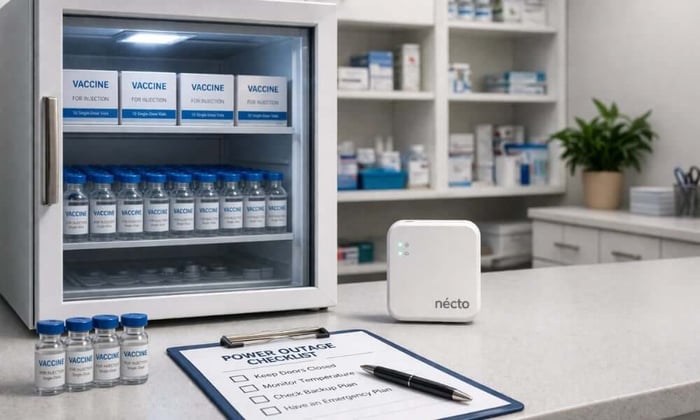
If your clinic stores vaccines, you already know how much rides on a working refrigerator. One power outage, a few degrees of temperature drift, and an entire inventory is gone. That's not a hypothetical, it happens. And the facilities that handle it best are the ones that invested in a reliable vaccine temperature monitoring system before the lights ever went out.
The Real Problem With Power Outages in Multi-Site Healthcare
For a multi-location community health system in North County, San Diego, California, power instability was not a rare inconvenience. It was a recurring operational challenge. Clinics spread across multiple service areas faced outages that struck without warning, sometimes affecting just one location, sometimes several at once.
The frustrating part was not the outages themselves. It was the uncertainty that followed. When something went wrong, staff had to work through a mental checklist: Was the power out? Was it the internet? Was the monitoring equipment offline? Each question added precious minutes to the response window. Come to think of it, those minutes are exactly what separate a recoverable situation from a total loss.
Before deploying a modern solution, the team was essentially reacting in the dark.
Why Vaccine Storage Has No Margin for Error
Vaccines must stay within a strict temperature range, typically between 2°C and 8°C (36°F to 46°F). That window does not flex. A brief excursion outside those bounds can degrade a vaccine's effectiveness, and in many cases, the doses cannot be salvaged or redistributed. They have to be discarded.
The downstream effects go further than wasted product. There are compliance obligations tied to vaccine storage, documentation requirements, and the real-world consequences of patients not receiving the care they came in for. Honestly, most healthcare teams understand this conceptually. The gap tends to be in the monitoring infrastructure, not the intention.
Temperature monitoring in healthcare settings is not just a best practice, but a direct line between preparation and patient safety. The difference between a facility with real-time visibility and one relying on manual checks is the difference between catching an issue at the two-minute mark or the two-hour mark.
What Changed When Necto Came In
The health system deployed Necto devices across its clinic locations. The setup was fast, within minutes, each site had active monitoring tracking temperature, humidity, and power status simultaneously.
One of the standout features was cellular connectivity. Unlike systems that depend on a local WiFi network, Necto continues operating when the internet goes down. That matters enormously in a power outage scenario, because the two events often happen together. If a monitoring system goes dark the moment it is needed most, it is not a monitoring system.
From the moment Necto was active, the team had a centralized view across all locations. No more phone calls to check on individual clinics. No more wondering which site was affected. The dashboard told them exactly what was happening and where.
The Mechanics of a Faster Response
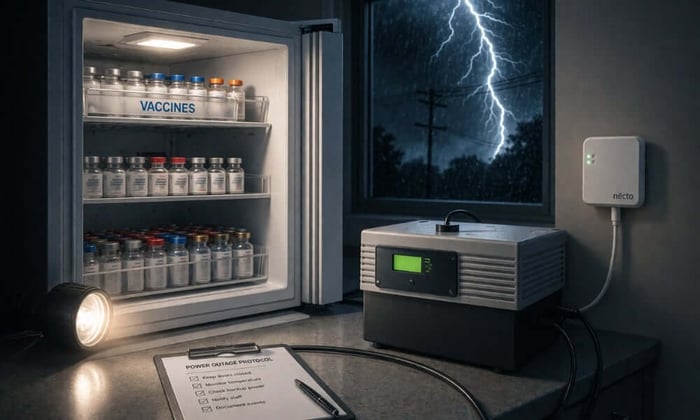
When a power outage strikes now, the sequence looks completely different. An alert goes out the moment power drops. Staff know which clinic is affected. Refrigerators get switched to generator power before any significant temperature change occurs.
That shift, from reactive to proactive, is what a good vaccine temperature monitoring system actually delivers. The technology is not the point. The outcome is. And the outcome here is measurable: response time dropped from a window of minutes or hours down to seconds.
Refrigerators do not hold temperature indefinitely without power. Every minute of delay carries risk. The speed of awareness directly determines whether the inventory survives.
The Broader Case for Environmental Monitoring
Vaccine refrigerators are the most visible use case, but the same principle applies across a wide range of healthcare environments. Lab storage, pharmaceutical refrigeration, biologics, all of it depends on stable conditions that no one can monitor by walking around with a thermometer.
Reliable environmental monitoring gives facilities the kind of oversight that manual processes simply cannot provide at scale. A single staff member cannot watch every refrigerator across multiple locations in real time. A properly configured monitoring system can, and it does not take breaks.
The North County San Diego system's experience is a clean example of what that kind of coverage actually looks like in practice. What used to be a stressful and uncertain process became clear, fast, and controllable.
Protecting Every Dose, Every Time
The clinics in this case study no longer have to wonder whether power is out at a satellite location. They know immediately, and they can act. That clarity is what keeps vaccines safe and patients served.
If your facility stores temperature-sensitive products and you are still relying on manual checks or WiFi-dependent systems, the risk profile is higher than it needs to be. The tools to close that gap exist, and they are not complicated to deploy.
Necto builds environmental monitoring devices designed for healthcare teams that cannot afford to lose visibility when conditions change. From power outage detection to temperature and humidity tracking across multiple locations, Necto gives facilities the situational awareness that makes fast, confident responses possible. For the North County San Diego team, that meant no more guessing, just clear data and immediate action when it counted most.
Ready to protect your vaccine inventory before the next outage? Contact Necto today and find out how real-time monitoring can work for your specific setup.
FAQs
What is a vaccine temperature monitoring system?
A vaccine temperature monitoring system is a device or platform that tracks temperature conditions in real time to ensure vaccines stay within the required safe range and remain effective.
Why is temperature monitoring important for vaccine storage?
Vaccines must stay between 2°C and 8°C. Even short exposure outside this range can reduce effectiveness, leading to wasted doses and potential risks to patient health.
How do power outages affect vaccine storage?
Power outages can quickly cause refrigerator temperatures to rise, putting stored vaccines at risk. Without immediate action, entire inventories can be lost.
What makes a monitoring system reliable during outages?
A reliable system uses cellular connectivity instead of WiFi, ensuring it continues sending alerts even when internet service is down during a power outage.
How does real-time alerting help healthcare teams?
Real-time alerts notify staff instantly when temperature or power issues occur, allowing them to act within seconds instead of discovering problems too late.