Table of Contents
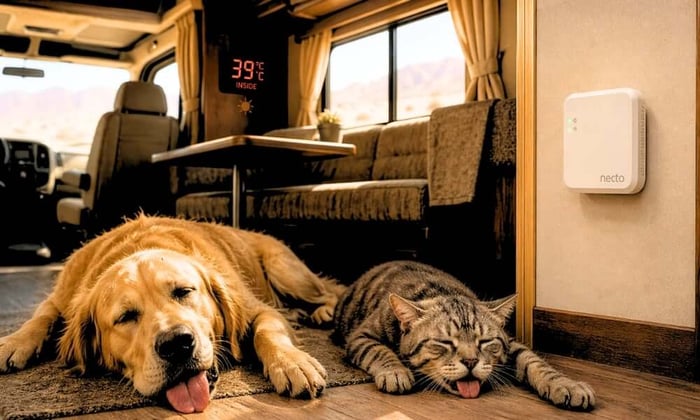
How fast does an RV heat up? Faster than most people think. A parked RV can climb from a comfortable 72 degrees Fahrenheit to over 100 degrees in under 20 minutes when the air conditioning stops. On a day above 85 degrees outside, the interior can push past 120 degrees within an hour. For a dog or cat left inside, those numbers are not just uncomfortable. They signal a medical emergency.
You’ve probably seen the warnings. Never leave a pet in a hot RV. RVs heat up fast. Check on your animals.
But “fast” is vague. Without real numbers, it is easy to underestimate what is actually happening inside your rig when you step away.
The line between mild discomfort and a life-threatening situation can be as short as 20 minutes. That margin is thinner than most expect, and the data behind it makes the risk impossible to ignore.
The Temperature Timeline: What the Research Actually Shows
A study published by veterinary and public health researchers found that a vehicle parked in direct sunlight on a 72-degree day hit 93 degrees inside within 10 minutes and 116 degrees within 60 minutes. That is not a worst-case scenario. That is a moderate spring day.
RVs behave similarly to cars in terms of solar heat gain, though the dynamics shift slightly based on size and construction. A larger rig takes a few extra minutes to reach peak temperatures, but it also retains that heat longer once it gets there. The insulation that keeps an RV warm in winter becomes the same reason a hot RV stays hot long after the sun moves.
Here's a rough timeline for what happens inside a parked RV on a day when the outside temperature is 80 degrees Fahrenheit, assuming the AC has stopped running:
- 10 minutes in: interior is around 99 degrees
20 minutes in: interior is approaching 109 degrees
30 minutes in: interior is around 114 degrees
60 minutes in: interior can reach or exceed 123 degrees
On a 90-degree day, those numbers hit even faster and climb higher. The interior of a parked vehicle in direct sun can run 40 to 60 degrees above the outside temperature during peak heating conditions.
What Makes an RV Different From a Standard Car
Cars have more passenger weight per square foot of glass surface. RVs, on the other hand, often have large windshields, skylights, and multiple windows running the length of the coach. That glass surface area accelerates solar heat gain in ways a small sedan simply cannot match.
Dark-colored RVs absorb solar radiation faster than white or silver ones, and the roof of an RV gets direct sun exposure across a much larger area than the roof of a car. A black or charcoal-colored fifth wheel sitting in a campsite with full afternoon sun is operating under some of the worst-case heating conditions possible.
The other factor that matters here is that many pet owners rely on the RV's generator or shore power connection to keep the AC running while they're away. That is a reasonable plan until it isn't. Shore power can trip a breaker. A generator can run out of propane or fail to start automatically after a power interruption. When the AC stops, the RV starts gaining heat immediately, and the process above kicks in without any further warning.
The AC Failure Problem Nobody Talks About
Most conversations about RV heat focus on "don't leave your pet in the RV when it's hot." That framing misses the more common scenario: an owner who left the AC running, assumed it would stay on, and had no way to know when it stopped.
RV air conditioners draw between 1,200 and 1,800 watts of power. If campground shore power dips or drops entirely, the AC cuts off. The RV interior then starts climbing. Depending on the outside temperature and sun exposure, the animal inside could be at serious risk within 20 to 30 minutes.
There's no alarm built into most RVs for this. The owner is on a hiking trail with no campground Wi-Fi signal. By the time they get back, the math is bad.
This is the scenario that doesn't make the generic "RVs heat up fast" article. It should.
At What Temperature Is a Dog Actually in Danger?
Dogs regulate body temperature through panting. It works, but only up to a point. When the surrounding air temperature gets close to or exceeds the dog's own body temperature (around 101 to 102.5 degrees Fahrenheit), panting becomes increasingly ineffective because the incoming air is no longer cooler than the dog's body.
Heat stress begins when a dog's internal temperature reaches about 103 degrees. Heat stroke, which is an actual medical emergency with a real risk of organ damage and death, occurs at 106 degrees and above. A dog in an RV that is already 109 degrees inside will reach a dangerous internal temperature in a matter of minutes.
Brachycephalic breeds, meaning bulldogs, pugs, boxers, and similar dogs with shortened airways, are at risk even faster. So are older dogs, overweight dogs, and any dog with a respiratory condition. For those animals, the window is shorter and the outcomes are worse.
Cats face similar risks. Though they tend to be less active than dogs in stressful situations, cats still pant as a cooling mechanism, and they're just as vulnerable to heat stroke in an enclosed space.
The Cracked Window Myth
Cracking a window in a parked RV does almost nothing useful. Studies on vehicle heating consistently show that a few inches of window opening reduces interior temperature by only 2 to 4 degrees, at best, and only when there's meaningful airflow outside. In a campsite surrounded by trees, or in a campground with low wind, cracked windows are effectively decorative.
The only thing that actually controls interior temperature is active cooling: air conditioning powered by a reliable electrical source, or a diesel or gasoline generator that is being actively monitored.
What Monitoring Actually Looks Like in Practice
Knowing what's happening inside an RV from a mile down a trail is the part most owners haven't figured out. Campground Wi-Fi is notorious for being unreliable, with dead zones throughout many parks and connectivity that drops entirely outside of peak hours.
Necto cellular temperature monitor solves this directly. Rather than depending on campground Wi-Fi, it connects over 4G cell service, the same network a phone uses. That means the device sends real-time alerts to an owner's phone regardless of whether the campground network is functioning. If the interior hits 85 degrees, a text and app alert goes out before conditions become critical. If power drops and the AC stops, another alert fires immediately.
The difference between knowing the AC failed at 2:15 PM and finding out when you return at 5:00 PM is the difference between an interrupted hike and a tragedy.
The Numbers Worth Setting as Alerts
For pet owners using any kind of RV temperature monitor, these are the thresholds that matter most based on veterinary guidance:
- Set a high-temperature alert at 80 degrees Fahrenheit inside the RV. That gives enough time to act before conditions become dangerous.
- Set a low-temperature alert at 50 degrees Fahrenheit for cold-weather travel if a pet is left in a rig with limited heat retention.
- Enable power-outage alerts. A notification the moment shore power fails is more useful than a temperature alert that comes 15 minutes later, after the interior has already started climbing.
Early warning is the only kind of warning that helps with this particular problem.
Where This Leaves Pet Owners Heading Out on the Trail
The data on RV heating is not comforting, and it shouldn't be. The margin between "the dog is fine" and "the dog is in crisis" is measured in minutes on a hot day. Most owners leave the AC running and assume that covers it, and usually it does. The problem is the "usually" part.
Shore power fails. Generators quit. Breakers trip. And when any of those things happen in an RV where a pet is waiting, time matters in a way that "RVs heat up fast" fails to communicate.
Knowing the actual numbers, 109 degrees in 20 minutes, heat stroke at 106 degrees internal temperature, cracked windows doing almost nothing, puts the risk in a frame that's hard to ignore. Getting a text alert the moment conditions change puts an owner back in control, even when they're a mile from the campsite.
If you leave a pet in your RV and want real-time alerts that don't depend on campground Wi-Fi, Necto was built for that exact situation. It monitors temperature, humidity, and power status over 4G cellular, no internet connection needed, and sends alerts directly to your phone the moment conditions change. Contact Necto today to get more information.
FAQs
How fast does an RV heat up with no AC running?
On a day with an outside temperature of 80 degrees Fahrenheit, a parked RV with no air conditioning running can reach 109 degrees inside within 20 minutes and above 120 degrees within an hour. On hotter days, those temperatures arrive faster.
What temperature is dangerous for a dog left in an RV?
Dogs begin experiencing heat stress when their internal body temperature hits 103 degrees Fahrenheit. Heat stroke, which carries serious risk of organ damage, occurs at 106 degrees and above. An RV interior already at 109 degrees can push a dog to that threshold within minutes.
Does cracking a window in an RV help keep it cool for a pet?
Minimally. Research on vehicle heating shows that cracked windows reduce interior temperature by only 2 to 4 degrees under most conditions. Active air conditioning connected to a reliable power source is the only effective way to control RV interior temperature.
Does a cellular temperature monitor work without campground Wi-Fi?
Yes. A cellular monitor connects over 4G cell service, the same network a phone uses to make calls and send texts. It does not depend on campground Wi-Fi at all. As long as there is a cell signal in the area, alerts go through.
What should I set my RV temperature alert at for a pet?
Set the high-temperature alert at 80 degrees Fahrenheit. That threshold gives enough time to return to the rig and address the problem before conditions become dangerous for most dogs and cats. Also enable power-outage alerts so that any interruption in shore power triggers an immediate notification, before interior temperatures have time to climb.