Table of Contents
- How Fast an RV Heats Up (and Why It Happens Faster Than You Think)
- What Temperature Is Actually Safe for Pets Left in an RV
- The Shore Power Problem Every RV Pet Owner Needs to Understand
- Ventilation: What Works and What Gives a False Sense of Security
- Setting Up Your RV for Safe Pet-Alone Time: A Practical Checklist
- Why Campground Wi-Fi Cannot Be Trusted for Pet Safety Monitoring
- How to Monitor Your RV Remotely While You're on the Trail
- FAQs
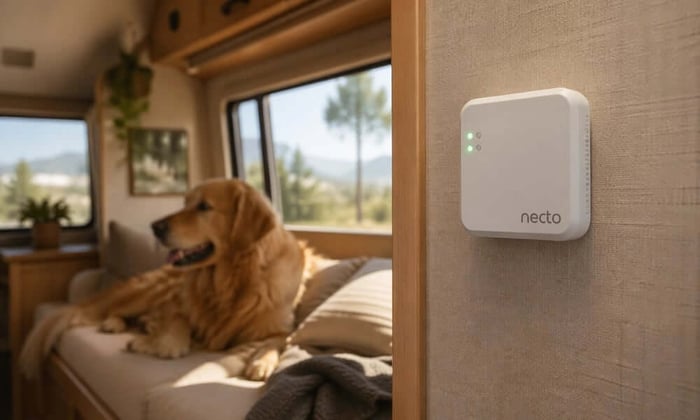
Leaving a pet in RV safely requires keeping interior temperatures between 65 and 80 degrees Fahrenheit, maintaining reliable air conditioning or ventilation, monitoring for power outages that could shut the AC off without warning, and having a way to receive real-time alerts even when campground Wi-Fi is unavailable. The risks are real, and the window between comfortable and dangerous is short.
You love your dog. You also love hiking. And at some point, those two things are going to conflict, because that trail does not allow pets, and your dog cannot sit outside in 90-degree heat any more than they can sit inside a parked RV without climate control. So you leave them in the rig, crank the AC, and head out, hoping everything holds.
That hope is the problem.
Most RV owners do not find out their AC failed until they come back to a lethargic or distressed animal. Some find out worse. The good news is that this situation is entirely manageable with the right setup and a clear understanding of what actually happens inside a rig when conditions shift. This guide covers all of it.
How Fast an RV Heats Up (and Why It Happens Faster Than You Think)
Most people underestimate how quickly an RV interior can turn dangerous. A study from the American Veterinary Medical Association found that a vehicle parked on a 70-degree day can reach over 100 degrees inside within 20 minutes. An RV, with its larger interior, takes slightly longer to heat up than a car, but the ceiling is just as high once the AC stops.
The variables that accelerate heat buildup include direct sun exposure, dark-colored exterior finishes, poor roof insulation, and high ambient humidity. An RV parked in full sun on an 85-degree day with no working AC can reach 115 to 120 degrees Fahrenheit inside within 45 to 60 minutes. At those temperatures, a dog or cat can suffer organ failure.
What makes this especially dangerous for RV owners is shore power dependency. If the campground power pedestal trips a breaker, loses power during a storm, or if the RV's AC draws too much load and kicks a breaker internally, the cooling stops. The AC might be set to 72 degrees, but without power, it is just a box sitting in the sun. The interior temperature starts climbing immediately, and the pet inside has no way to tell anyone.
What Temperature Is Actually Safe for Pets Left in an RV
Dogs and cats regulate body temperature differently from humans. Dogs primarily cool themselves through panting, and that process depends on the ambient air being cooler than their body temperature of around 101 to 102.5 degrees Fahrenheit. When the air temperature inside the RV climbs above 80 degrees, panting becomes less effective. Above 85 degrees, a dog is already at risk of heat stress. Above 95 degrees, heat stroke is a real possibility for most breeds.
Short-nosed breeds like bulldogs, pugs, and French bulldogs are at risk even earlier. Their restricted airways make panting less effective, and they can show signs of heat stress at temperatures that a Labrador might handle for a short period.
Cats are somewhat more heat-tolerant than dogs but face similar risks above 90 degrees Fahrenheit. Senior cats, kittens, and cats with respiratory conditions face those risks at lower thresholds.
A reasonable target range to maintain inside an RV while a pet is alone is 65 to 78 degrees Fahrenheit. Setting the RV thermostat to 72 degrees provides a reasonable buffer. The bigger concern is what happens if the thermostat loses the power to do its job.
The Shore Power Problem Every RV Pet Owner Needs to Understand
Shore power outages at campgrounds are common. Weather events, overloaded pedestals, faulty connections, and simple maintenance windows can cut power to an entire row of sites without warning. A 2022 survey of full-time RVers found that more than 60 percent had experienced at least one unexpected shore power loss during a trip.
When shore power drops, an RV air conditioner stops. Most rooftop ACs do not have battery backup. The generator might not kick in automatically unless the owner has set up that system intentionally. And if the pet owner is three miles up a hiking trail, they have no idea any of this happened.
This is where the monitoring gap becomes life-threatening. A pet owner might have excellent intentions, a reliable AC unit, and a well-insulated rig, but none of that matters if there is no way to know when conditions inside change.
Some RV owners rely on connected cameras or smart home devices to keep an eye on their pets remotely. Those systems work, but only as long as the campground Wi-Fi does. Campground Wi-Fi is notoriously unreliable, and it is also the first thing that goes down during a grid event. Trusting a Wi-Fi-dependent monitoring system for a situation where power loss is exactly what you are trying to detect is a circular problem.
Ventilation: What Works and What Gives a False Sense of Security
Some RV owners leave windows cracked, Fantastic fans running, or roof vents open as a backup to the AC. In mild weather with good airflow, ventilation can help maintain a reasonable temperature. In hot weather with high humidity or direct sun, it does not come close to offsetting heat gain.
A Fantastic Fan moving air through an RV when the outside temperature is 90 degrees Fahrenheit is moving 90-degree air. If the humidity is 70 percent, the effective heat index inside the rig will climb above 100 degrees quickly, regardless of airflow. Fans do not cool the air, they just move it. For pets left alone in summer heat, a running fan without AC is not an adequate backup plan.
Roof vents do help with moisture control and can make a real difference in shoulder-season temperatures where the ambient temperature stays below 75 degrees. They are not a substitute for climate control when temperatures climb above that.
The one ventilation setup that can genuinely help is a properly sized rooftop fan with a thermostat-controlled function, combined with reflective window covers to reduce solar heat gain. But even that combination has meaningful limits when ambient temperatures exceed 85 degrees.
Setting Up Your RV for Safe Pet-Alone Time: A Practical Checklist
Before heading out and leaving a pet alone in the rig, there are several things worth doing every single time.
Confirm the AC is running and set to a specific temperature, not just "on." A thermostat set to 72 degrees gives a defined target. "On" just means the AC is running without a defined goal, and it may cycle off when the interior cools to whatever the default setting was at the factory.
Check the shore power connection at the pedestal before leaving. A loose connection that works in the morning might not survive a midday thunderstorm. Pedestal connections should be snug, with no visible corrosion at the plug.
Close window shades or use reflective covers on any windows facing direct sun. A single sun-facing window can add meaningful heat load to a small interior.
Make sure fresh water is available for the pet and that it is accessible. A dog that is warming up will drink far more water than usual.
Leave the pet in the coolest part of the rig. In most RVs, that is the rear bedroom or the lowest point in the vehicle, where cooler air settles. Avoid leaving pets in front cab areas, which tend to absorb more radiant heat from the windshield.
And this is the step most owners skip, set up a monitoring system that will alert you if the temperature inside rises above a set threshold or if shore power is lost, and make sure that system does not depend on campground Wi-Fi to reach you.
Why Campground Wi-Fi Cannot Be Trusted for Pet Safety Monitoring
This is worth addressing directly because a lot of RV pet owners are relying on cameras, smart plugs, or app-connected thermostats that route their alerts through Wi-Fi. Those systems work beautifully in a home. In a campground, they are unreliable in exactly the moments when reliability matters most.
Campground Wi-Fi typically runs on shared consumer-grade equipment servicing dozens to hundreds of RVs simultaneously. Signal quality varies by site. During peak hours or bad weather, many campground networks either drop connectivity or become too slow to push a real-time alert. And in a power event, campground Wi-Fi infrastructure often goes down with the power, taking any Wi-Fi-dependent monitoring with it.
The only monitoring approach that does not have this weakness is one that runs on cellular, independent of the campground network. Cellular coverage exists at the vast majority of campgrounds across the United States, even in remote areas, and it operates independently of the campground's power and internet infrastructure.
How to Monitor Your RV Remotely While You're on the Trail
A cellular temperature like Necto and power monitor installed inside the RV gives owners something genuinely useful: the ability to know the exact interior temperature and power status from anywhere, without relying on the campground's internet.
The setup is straightforward. The monitor plugs into a wall outlet inside the rig, connects to the cellular network on its own built-in SIM, and sends temperature and humidity readings at regular intervals to an app on the owner's phone. Thresholds get set in the app, for example, an alert if the temperature rises above 80 degrees or if the power goes out. When either of those conditions is met, the device sends a text and an email to up to five contacts immediately.
The backup battery component matters as much as the cellular connectivity. If shore power drops, a monitor with a 72-hour backup battery keeps running and keeps sending alerts even after the power fails. That is the scenario a pet owner actually needs coverage for.
This kind of setup means a pet owner hiking three miles from the campground can get a text the moment shore power drops, not an hour later when they get back to find a hot rig. That 45-minute gap is the difference between a scare and a tragedy in summer heat.
The Rig Is Ready. Now You Can Actually Enjoy the Trail.
Leaving a pet in an RV safely comes down to three things: reliable climate control, a power setup that holds, and a way to know the moment either one fails. The preparation takes maybe 10 minutes before you head out. The peace of mind lasts the whole hike.
If you leave a pet in your RV and want real-time alerts that do not depend on campground Wi-Fi, Necto was built for that exact situation. It monitors temperature, humidity, and power status over 4G cellular, no internet connection needed, and sends alerts directly to your phone the moment conditions change. Check it out at getnecto.com, or call 888-405-2107.
FAQs
How do I know if my RV is getting too hot for my dog?
Without a monitor inside the rig, there is no way to know remotely. The most reliable approach is a cellular temperature monitor that sends an alert when the interior exceeds a set threshold, such as 80 degrees Fahrenheit. Checking an interior thermometer only works when physically present, which defeats the purpose for owners who leave the rig to go hiking or exploring.
What temperature is dangerous for a dog left in an RV?
Dogs begin experiencing heat stress above 80 to 85 degrees Fahrenheit, especially in humid conditions. Heat stroke can occur above 95 degrees. Short-nosed breeds face those risks at lower temperatures. Maintaining the interior below 78 degrees provides a reasonable buffer, and setting a monitor alert at 80 degrees gives enough lead time to respond before conditions become critical.
Does a temperature monitor work without campground Wi-Fi?
A cellular-based monitor does. Wi-Fi-dependent devices only work as long as the campground network stays up, which is not guaranteed during power events or periods of high network congestion. A monitor with a built-in SIM card connects directly to the cellular network, independent of the campground's infrastructure.
How quickly does an RV heat up when the AC stops?
On an 85-degree day in direct sun, an RV interior can climb 20 to 30 degrees in under an hour after the AC stops. The rate depends on insulation quality, solar exposure, and ambient humidity. In extreme heat with full sun, dangerous temperatures can be reached within 30 to 45 minutes.
Can I leave a fan running instead of the AC to keep my pet cool?
In temperatures below 75 degrees Fahrenheit, a running fan can maintain a safe interior temperature in a well-ventilated rig. Above that, especially in direct sun or high humidity, a fan alone is not sufficient. Fans move air but do not cool it, so in hot weather they are a supplement to climate control, not a replacement for it.