Table of Contents
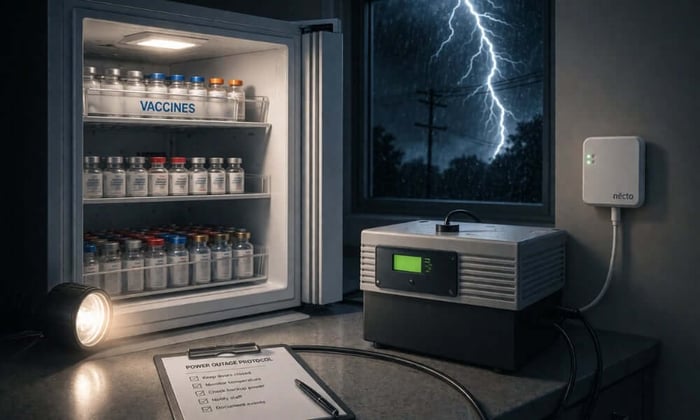
Summer is the season most healthcare facilities dread, and it has less to do with the heat itself than what the heat does to the electrical grid. If you run a clinic, pharmacy, or any facility that stores vaccines, you already know that a vaccine storage power outage is one of the most disruptive events you can face. One outage, even a short one, can put an entire inventory at risk. We're talking vaccines that must stay within a strict temperature range to remain effective, and once that window closes, there's no walking it back.
This article breaks down what actually happens when the power goes out, what to do in the moment, and how to build a plan that protects your inventory before the next outage catches you off guard.
Why Summer Outages Hit Differently
Summer is the peak demand season for the electrical grid. Air conditioning systems across entire cities run nonstop, and that sustained draw puts enormous pressure on aging infrastructure. Utility companies routinely issue warnings during heat waves for exactly this reason, the system is stretched thin.
On top of that, summer brings severe weather. Thunderstorms, high winds, and lightning take down power lines on a regular basis throughout the warmer months. Floods, accidents, and road hazards that damage utility poles add to the risk. The result is a season where outages are more frequent, sometimes longer, and harder to predict.
For vaccine storage, the timing of an outage matters as much as its length. A 30-minute outage at 2 a.m., when no one is watching, can quietly push a refrigerator out of the safe zone before anyone even notices.
What Actually Happens to Vaccines When Power Fails
Refrigerators and freezers are designed to maintain temperature, not to create it indefinitely. The moment power is cut, the clock starts. How fast temperatures rise depends on the unit's insulation quality, how full it is, whether the door stays closed, and the ambient temperature of the room.
Most vaccines need to stay between 2°C and 8°C (36°F and 46°F). Others, like varicella and zoster vaccines, require frozen storage at much colder temperatures. Once those thresholds are crossed, the vaccines may become completely ineffective - often with no visible change in appearance. There's no way to tell by looking at a vial whether it's been compromised.
The financial loss can be severe. A single refrigerator of vaccines can represent thousands of dollars of inventory. Facilities also face regulatory consequences for breaking the cold chain, and the patient safety implications are serious. Someone who receives a compromised vaccine may not be protected against the disease it was meant to prevent.
In many cases, the damage is already done by the time anyone finds out.
What to Do the Moment the Power Goes Out
The first minutes matter. The immediate priority is keeping refrigerator and freezer doors closed. Every time a door opens, cold air escapes and warm air enters. If the outage is brief, a sealed unit can often maintain safe temperatures for two hours or more, depending on its insulation and ambient conditions.
While the doors stay closed, someone should immediately check how long the outage is expected to last. Your local utility's outage map or automated phone system can usually give an estimate. That window of information drives every decision that follows.
If a backup generator is available, this is when it needs to come on, fast. Every minute without power is a minute of thermal drift. Backup power that takes 20 minutes to activate is far less effective than one that kicks in within seconds.
Document everything as you go. Time of outage, temperature readings at regular intervals, and any actions taken all need to be recorded for compliance reporting. Regulators and health departments often require this documentation when assessing whether vaccines are still safe to use.
If the outage looks like it will outlast what the equipment can handle, activating an emergency relocation plan is the next step. Know in advance where alternative storage is available, such as a nearby hospital, another clinic, or a facility with generator-backed refrigeration.
Building a Preparation Plan That Actually Works
Good outage response starts weeks or months before any outage happens. Preparation is what separates a facility that loses inventory from one that doesn't.
Backup Power
A generator or UPS (uninterruptible power supply) is the most direct protection available. Generators run on fuel and can power refrigerators for extended periods, but they need fuel on hand, regular maintenance, and someone to start them. UPS systems switch on instantly but typically have shorter runtimes. For many facilities, a combination of both makes sense, the UPS buys time while the generator starts up.
Test these systems on a set schedule. A backup generator that hasn't been run in two years may not start when you need it. Battery backup systems have a shelf life. UPS batteries typically need replacement every three to four years. If backup power has never been tested under actual load, there's no reliable way to know whether it will perform.
A Written Emergency Response Plan
A plan written down and shared with staff performs far better under pressure than one that exists only in someone's head. The plan should include emergency contacts for utilities and suppliers, step-by-step procedures for who does what, criteria for when vaccines need to be relocated, and the name of the person who makes that call.
Run through it at least once a year. Staff turnover means new people may never have seen the plan. A short drill or tabletop exercise can reveal gaps before an actual outage does.
Staff Training
Staff are the ones who will respond in the first minutes of an outage. They need to know exactly what to do and feel confident doing it under pressure. That means training, not just policies. Walk them through the plan, explain why each step matters, and make sure they know who to contact if something goes wrong.
Temperature Monitoring
A facility can have excellent backup systems and still lose vaccines if no one knows the power went out. That's the gap that temperature monitoring fills.
Manual temperature checks twice a day, which many facilities still rely on, have an obvious limitation, they only capture conditions at the moment someone checked. Everything that happened between checks goes undetected.
Real-time temperature monitoring closes that gap. A continuous monitoring system tracks conditions around the clock and sends an alert the moment temperatures move outside the safe range, or the moment power is lost. That alert can go to multiple people at once, including staff who are off-site or asleep.
Cellular-based monitoring adds a layer of reliability that WiFi-dependent devices can't match. Most monitoring devices go offline the moment the internet connection drops, which often happens during the same event that caused the power outage. A device that runs over cellular keeps sending alerts regardless of whether the facility's internet is working. That distinction matters most during exactly the kind of scenario where monitoring is needed most.
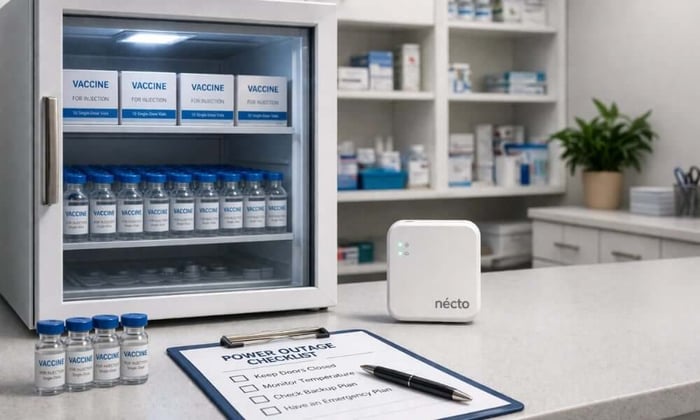
Necto's temperature monitor was built with this in mind. It runs on 4G LTE, operates on a 72-hour backup battery during outages, and delivers alerts via app, text, and email, whether or not WiFi is available. For healthcare facilities managing vaccine storage, that combination of cellular connectivity and battery backup is a meaningful upgrade over standard WiFi-dependent monitors. Reliable environmental monitoring doesn't just protect inventory, it gives facilities the documentation and response time needed to stay compliant and protect patients.
Record-Keeping and Compliance
Regulatory requirements around vaccine storage documentation are not optional. Health departments, accreditation bodies, and vaccine manufacturers all have standards for how temperature data should be recorded and how excursions should be reported.
When an outage or temperature excursion occurs, the records need to show what happened, when it happened, and how the facility responded. Automated monitoring systems generate this log automatically, with timestamped data that holds up to regulatory review. Manual logs are subject to human error and gaps. The more automated the documentation, the easier compliance reporting becomes.
When to Discard and When to Keep
Not every power outage results in vaccine loss. Whether vaccines are still viable after a temperature excursion depends on the specific vaccine, the duration of the excursion, and how far temperatures strayed from the recommended range.
Don't make this determination based on guesswork. Contact your state or local health department's immunization program or the vaccine manufacturer directly. They have protocols for exactly this situation and can advise whether the affected vaccines are still usable. Document the consultation and the outcome. Using vaccines that were improperly stored, even unknowingly, poses real risks to patients.
Your Vaccines Are Worth Protecting
Summer power outages are going to happen. It's a pattern that repeats every year. The question is whether a facility has the systems in place to respond before the damage is done.
Backup power, a documented emergency plan, trained staff, and real-time temperature monitoring are the four components of a preparation strategy that holds up when it counts. None of them is complicated. All of them need to be in place before the next outage, not after.
Contact Necto today to find out how real-time, cellular-based temperature and power monitoring can protect your vaccine storage this summer, and every season after.
FAQs
Why is a vaccine storage power outage such a serious risk?
A power outage can quickly push vaccine storage units outside the required temperature range, making vaccines ineffective. Even short outages can compromise inventory, leading to financial loss, regulatory issues, and risks to patient safety.
Why are power outages more common during summer?
Summer increases strain on the electrical grid due to heavy air conditioning use, while storms and extreme weather can damage power infrastructure. This combination makes outages more frequent and less predictable during warmer months.
What temperature range must most vaccines stay within?
Most vaccines must be stored between 2°C and 8°C (36°F to 46°F). Some vaccines require even colder, frozen conditions. Any deviation from these ranges can reduce or eliminate their effectiveness.
What happens to vaccines when the power goes out?
Once power is lost, refrigerators stop maintaining temperature and begin to warm up. The rate depends on insulation, room temperature, and how often doors are opened. Vaccines may become unusable without any visible signs of damage.
What should staff do immediately during a power outage?
Staff should keep refrigerator and freezer doors closed, check outage duration, activate backup power if available, and begin documenting temperatures and actions taken. Quick response helps preserve safe storage conditions.