Table of Contents
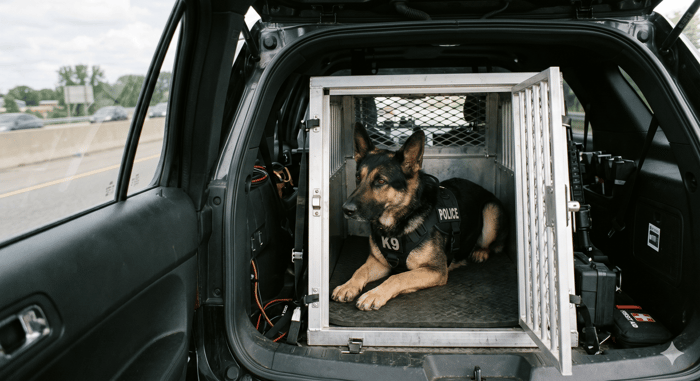
Your K9 partner logs as many miles as you do, sometimes more. Transporting a police dog means managing long hauls between training facilities, multi-county deployments, and patrol shifts that stretch deep into the hottest part of the afternoon. The vehicle environment matters more than most handlers plan for, and the risks are highest exactly when you are most focused on the mission itself. This K9 unit travel checklist covers the environmental and logistical factors that actually make a difference between a safe transport and a crisis.
A K9 unit travel checklist should cover temperature monitoring, hydration, kennel condition, power status, and emergency contacts. The most overlooked item is real-time temperature tracking inside the vehicle. Police K9 dogs face heat stress above 85 degrees Fahrenheit and are at serious risk above 104 degrees. A cellular monitor that alerts you when vehicle cooling fails closes the gap most standard protocols leave open.
Why Temperature Tops Any K9 Unit Travel Checklist
Law enforcement vehicles are not designed with K9 comfort as a primary consideration. The kennel compartment in a patrol SUV or dedicated transport vehicle heats up faster than the passenger cabin because it sits closer to the metal body panels and receives different airflow than the front seats. On a 90-degree day, an enclosed vehicle interior can gain 20 degrees or more within ten minutes of the engine shutting off. The kennel compartment can be worse.
German Shepherds, Belgian Malinois, and Dutch Shepherds are the three breeds most common in U.S. law enforcement K9 programs, are medium-to-large dogs with thick double coats. They regulate body temperature through panting, which works well in moderate conditions and falls apart when ambient heat climbs. The ASPCA notes that heat exhaustion in dogs begins around 104 degrees Fahrenheit. At 107 to 109 degrees, the situation is life-threatening within minutes, not hours.
Humidity compounds this. High relative humidity slows the evaporation that makes panting effective as a cooling mechanism. A vehicle parked in coastal Georgia or South Texas in August is not simply hot, the humidity pushes the felt temperature well beyond what the thermometer reading shows. Tracking both temperature and humidity together gives handlers a more accurate picture of what the dog is actually experiencing.
Pre-Departure: The Full K9 Checklist Before You Roll
Most handlers run some version of this mentally. Writing it down removes the margin for error on high-pressure deployments when the tendency is to move fast and skip steps.
Verify the vehicle's AC is cooling the kennel compartment specifically, not just the cab. Run it for ten minutes before loading the dog.
Confirm water supply. A working dog under stress needs more water than one at rest - bring more than seems sufficient.
Inspect the kennel for secure latching, no sharp hardware edges, and adequate ventilation panels.
Confirm your temperature monitor is charged, connected, and pushing live readings to your phone.
Set alert thresholds: 85 degrees Fahrenheit as a caution level, 95 degrees as an immediate action threshold.
Note the nearest animal emergency clinic along your route before you leave, not after something goes wrong.
Make sure at least one other team member knows the emergency plan if you cannot be reached.
The Power Failure Problem Most K9 Travel Guides Skip
Vehicle AC systems fail. Alternators go. A K9-specific climate control unit can trip a breaker or develop a fault with no warning light appearing on the dashboard. If you are driving and the cooling system in the back stops working, there is typically no immediate alarm, just a dog heating up in a compartment you cannot see while you are focused on the road.
The issue is the detection gap. When a handler finally stops, opens the rear compartment, and realizes the kennel has been heating up for twenty minutes, the dog is already in a compromised state. The window for an easy intervention has already closed.
Power monitoring changes that timeline. A device that tracks temperature and sends an alert the moment conditions move outside a safe range gives you time to act. Pulling over and getting the dog into shade with water are real options when you have a five-minute warning. They are not options when you find out forty minutes later.
Monitoring the Vehicle When You Cannot Watch It
K9 handlers regularly park the vehicle and leave the dog inside. Court appearances and post-shift decontamination routines are routine enough that the handler is out of visual range, sometimes inside a building where stepping out quickly is not an option.
Necto cellular temperature monitoring handles this reliably in ways Wi-Fi-dependent systems cannot. Law enforcement facilities, courthouse parking lots, and rural staging areas do not have consistent Wi-Fi coverage. A monitor running on 4G LTE operates regardless of local network conditions, no building password to find, no dropped connection to worry about.
The power outage alert matters here too. If a vehicle's dedicated K9 climate unit loses power from a fuse failure or a charging issue, a monitor with power loss detection sends an alert immediately. That warning comes before the temperature has time to climb into dangerous territory.
Necto gives K9 handlers that kind of continuous coverage without requiring Wi-Fi or a complicated installation. It uses 4G LTE cellular connectivity and connects automatically to AT&T, T-Mobile, or Cellular One, wherever coverage exists. It tracks temperature, humidity, and power status, sending readings every ten minutes under normal conditions and real-time alerts the moment a threshold is crossed. The 72-hour rechargeable backup battery keeps the monitor running through a vehicle power failure and sends an alert the moment it happens. Up to five contacts receive those alerts via text and email. For handlers managing vehicle environments, staging areas, or transport kennels, it is a practical tool worth having. Details at getnecto.com.
Before Your Next Deployment
A K9 partner is a trained professional, a working asset, and often the closest bond a handler carries on shift. The environmental risks during transport are documented, well-understood, and almost entirely preventable when the right protocols are in place. Running a thorough pre-departure checklist and maintaining continuous temperature monitoring in the vehicle takes the guesswork out of transport entirely. The goal is to arrive focused on the work, not managing a situation that could have been caught three stops earlier.
If you transport a K9 and do not yet have a cellular monitoring system covering the vehicle's temperature and power status, that is the next gap to close. Contact Necto today to find the right setup for your vehicle, your deployment patterns, and your dog.
FAQs
What temperature is dangerous for a police K9 dog in a vehicle?
Dogs begin showing heat exhaustion signs around 104 degrees Fahrenheit. At 107 to 109 degrees, the condition is life-threatening within minutes. For thick-coated breeds like German Shepherds and Belgian Malinois, risk accumulates once conditions pass 85 degrees, particularly in high-humidity environments.
How fast can a law enforcement vehicle heat up when the AC stops?
A parked vehicle's interior can gain 20 degrees or more within ten minutes on a warm day. The kennel compartment in a patrol vehicle often heats faster than the front cab because it receives less direct airflow and sits closer to metal body panels that absorb and radiate heat.
Do I need Wi-Fi for a K9 temperature monitor to work?
Not with a cellular-based monitor. Cellular monitors use 4G LTE to send alerts regardless of local network conditions. That matters in courthouse parking structures, rural staging areas, and any location where building Wi-Fi is unavailable or unreliable.
What is the difference between a K9 climate control unit and a temperature monitor?
A K9 climate control unit actively manages compartment temperature - it heats or cools the space. A temperature monitor is a sensor that tracks conditions and sends alerts. They serve different purposes, and a temperature monitor is what tells you when the climate control unit stops working.
What alert thresholds should I set for a K9 vehicle monitor?
A practical starting point is 85 degrees Fahrenheit as a caution alert and 95 degrees as an immediate action threshold. Power outage alerts should always be active, since a power failure is often the first sign that the AC system has stopped - and it gives you the earliest possible warning.