Table of Contents
- Why the Danger Zone Is More Than a Food Safety Talking Point
- What Manual Temperature Logs Actually Miss
- The Cold Storage Temperature Thresholds Every Restaurant Should Know
- Power Loss Is the Scenario Most Restaurants Are Not Ready For
- The Gap Between Manual Checks and Real Events
- Before the Next Health Inspection
- FAQs
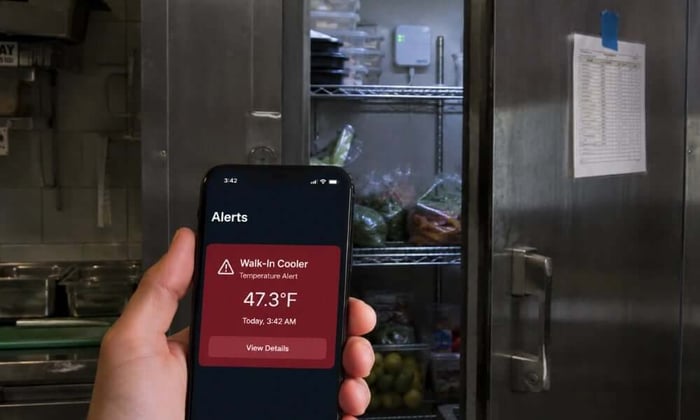
You already know the rules. Your staff has been trained. Your walk-in is set to 38 degrees and your hot holding line is supposed to stay above 140. But restaurant food poisoning prevention does not fail because people forget the rules. It fails because the monitoring system cannot tell you when something goes wrong at 3 a.m., or when the walk-in compressor starts struggling on a Saturday afternoon before the dinner rush.
Restaurant food poisoning prevention depends on keeping cold food below 41 degrees Fahrenheit and hot food above 140 degrees at all times. The FDA Food Code defines the temperature danger zone as 41 to 135 degrees Fahrenheit, where bacteria like Salmonella and Listeria can double in as little as 20 minutes. Manual temperature checks, typically every two to four hours, leave gaps that automated alerts close.
Why the Danger Zone Is More Than a Food Safety Talking Point
The temperature range between 41 and 135 degrees Fahrenheit is where bacterial growth accelerates enough to make food unsafe for consumption. Most restaurant operators know that range. What matters more is understanding how fast conditions inside refrigeration units or hot holding equipment can drift into it without anyone noticing.
A walk-in cooler running at 38 degrees at 10 p.m. can climb above 41 degrees before midnight if the door seal is failing or the compressor is working harder than usual on a hot evening. When a staff member opens that door at 6 a.m. for prep, the unit may have been holding food at 45 degrees for six hours. That is not a food safety audit concern. That is a liability event.
What Manual Temperature Logs Actually Miss
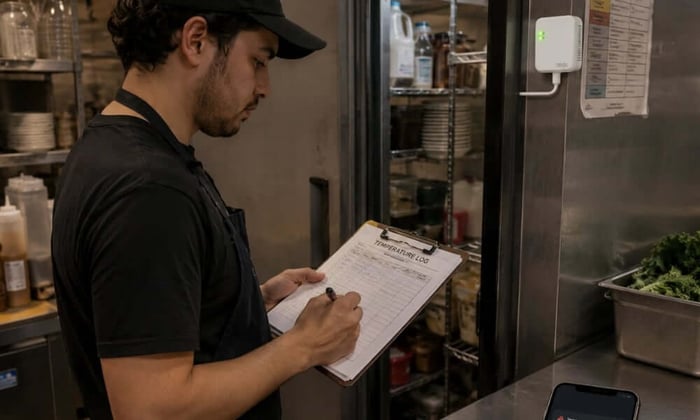
Manual checks, done correctly, happen every two to four hours during operating hours. That is a best-case schedule, and it still leaves gaps. It also does not cover the overnight window, which is when refrigeration failures are most likely to go undetected for the longest stretch of time.
The FDA Food Code requires accurate temperature records, but a paper log filled out twice per shift does not capture what happens between entries. An employee who checks the walk-in at 8 p.m. and records 38 degrees has no way of knowing that the compressor cycled off at 9:15 p.m. and the unit climbed to 48 degrees by 11 p.m. That two-and-a-half-hour drift is exactly the kind of gap that appears in food poisoning investigations after the fact.
Automated temperature monitoring does not replace training or process. It fills the gaps that process cannot cover by design.
The Cold Storage Temperature Thresholds Every Restaurant Should Know
Different products require different cold storage temperatures, and a single walk-in set to one default temperature may not protect all of them equally well.
Food Type | Safe Storage Temperature |
Raw poultry and ground meat | 41 degrees F or below |
Fresh seafood | 41 degrees F or below (32-38 preferred) |
Dairy and eggs | 41 degrees F or below |
Fresh produce (most) | 41-45 degrees F depending on type |
Frozen foods | 0 degrees F or below |
The gap between 38 degrees and 45 degrees may look small on a thermometer. In terms of bacterial growth rate on raw poultry, it is not small at all. A unit drifting five degrees above its target during an overnight window creates a compounding risk that a morning check will not fully reveal.
Power Loss Is the Scenario Most Restaurants Are Not Ready For
A refrigeration failure triggered by a power outage is one situation where the standard monitoring approach breaks down completely. If the power goes out, the same circuit that powers the walk-in cooler also powers any Wi-Fi-dependent monitoring equipment in the building. A sensor that reports over the local network goes silent at exactly the moment it needs to be loudest.
This is the failure pattern that causes the most damage: the monitoring system and the equipment it monitors go down together, and no one finds out until the power comes back on and staff arrives the next morning. At that point, a walk-in full of protein may have been sitting in the danger zone for eight hours.
Restaurants that operate across multiple locations face this risk on a larger scale. A power event at one unit may not be reported to management until the opening manager arrives, often too late to prevent food loss or make informed decisions about what can be served and what cannot.
The Gap Between Manual Checks and Real Events
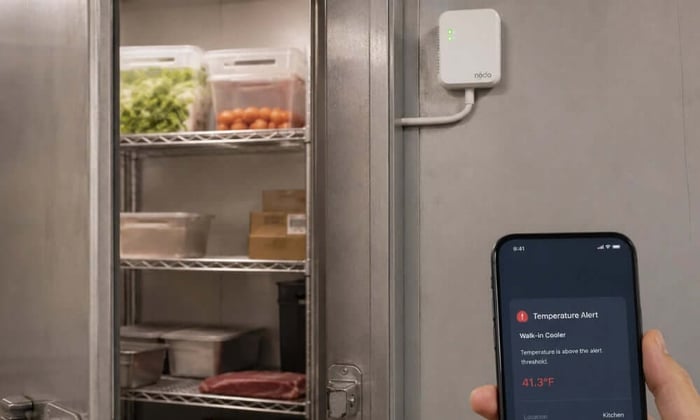
Necto was built around the specific problem that monitoring systems often share infrastructure with the equipment they are supposed to watch. It operates over 4G cellular, not the restaurant's Wi-Fi network, so a power event does not cut off the alert path. The moment the temperature in a walk-in climbs above the threshold you set, or the moment power to a unit is interrupted, Necto sends a text and email alert to up to five contacts.
The 72-hour rechargeable battery means Necto keeps reporting through a full power outage without any gap in coverage. It monitors temperature in the range of -4 to 140 degrees Fahrenheit and humidity between 0 and 95 percent, so it covers cold storage, hot holding environments, and dry storage spaces where humidity affects product quality. Alert contacts receive notifications both when conditions go outside the safe range and when they return to normal, so there is no guessing about whether a problem resolved itself overnight. That combination covers the core gap in manual temperature monitoring programs: the hours when nobody is in the building.
Before the Next Health Inspection
A health inspector who pulls your temperature logs is looking for consistent, documented evidence that food stayed in safe ranges. A paper log with entries every four hours gives them data points. An automated monitoring system with a full year of downloadable CSV records gives them a continuous picture. The difference matters when something has gone wrong and you need to show that your monitoring caught it, and when.
Restaurant food poisoning prevention is not a one-time training event. It is an ongoing system, and a temperature alert sent at 2 a.m. is worth more than a morning log entry that shows everything was fine at 10 p.m.
If your walk-in or hot holding equipment fails overnight and nobody finds out until the morning shift, contact Necto today and set up a cellular temperature monitor that alerts the right people the moment conditions change, no matter what time it is.
FAQs
What is the temperature danger zone for restaurants?
The FDA Food Code defines the danger zone as 41 to 135 degrees Fahrenheit. Bacteria like Salmonella and Listeria can multiply rapidly within this range, in some conditions doubling in as little as 20 minutes. Keeping cold food below 41 degrees and hot food above 135 degrees is the core standard for safe food holding temperatures.
How often should restaurant walk-in temperatures be checked?
Most food safety programs require temperature checks every two to four hours during operating hours. Overnight gaps are the most common window where undetected failures occur, which is why automated monitoring that alerts in real time is a meaningful addition to any manual logging program.
What happens if a restaurant refrigerator fails overnight?
If a walk-in cooler loses power or the compressor fails overnight, food can spend several hours in the temperature danger zone before staff arrive in the morning. The total time in the danger zone determines whether product can be safely served. Automated alerts sent at the moment of failure give operators the chance to respond before food loss or a health code violation occurs.
Can a temperature sensor work during a power outage?
Most Wi-Fi-based sensors go offline when power is lost because they depend on the same circuit as the router. A cellular temperature monitor with a built-in backup battery keeps operating and sending alerts through a power outage. Necto runs on 4G cellular with a 72-hour battery, so it continues reporting even when building power is out.
Does Necto meet HACCP monitoring requirements?
Necto stores up to one year of temperature readings, downloadable as a CSV file, which supports HACCP record-keeping requirements. Consult your local health department for specific documentation standards that apply to your operation.