Table of Contents
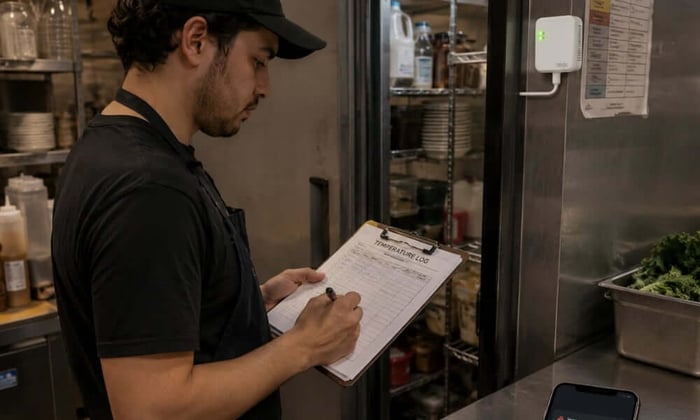
You probably have a clipboard somewhere in the kitchen with two checkmarks a day on it. That log might satisfy a health inspector glancing at it during a visit, but it tells you almost nothing about the eighteen or twenty hours between those checks. Most food safety temperature monitoring in restaurants still runs on someone walking over to a cooler, glancing at a dial, and writing down a number, and that approach has a structural blind spot that no amount of staff diligence can fix.
Manual temperature checks only capture a single moment, twice a shift at best, while equipment can drift out of safe range for hours in between. Food safety temperature monitoring needs continuous, automated readings to catch a slow compressor failure or a door left ajar before spoilage sets in, not a snapshot taken once every several hours.
Why Twice a Shift Is Not Real Food Safety Temperature Monitoring
A typical kitchen logs cooler and freezer temperatures at the start and end of a shift, sometimes once more around a mid-shift prep window. That schedule was built around what a busy line cook can realistically manage, not around how fast equipment actually fails. A reach-in cooler with a failing door seal can climb from 38°F to the mid-50s over six or seven hours, which fits entirely inside the gap between a morning check and a closing check. The unit may have already spent most of the day outside a safe range before anyone writes down the closing number, and the entry on the log will show nothing unusual.
The problem compounds overnight and on closed days. A restaurant that closes Sunday night and reopens Tuesday morning has roughly thirty-six hours where nobody is checking anything. If a compressor fails Sunday at 11 p.m., the first person to know is whoever opens up Tuesday, and by then everything in that unit has been in the danger zone long enough to be a total loss, not a partial one. The same gap applies to walk-ins serving a kitchen that runs a single closed day each week, since a Tuesday-night failure with a Wednesday reopen still leaves a full overnight stretch unaccounted for.
What a Single Reading Cannot Tell You
A number on a clipboard says where the temperature was at the moment someone looked. It does not say whether that reading was the high point of a slow climb or a brief dip in an otherwise stable unit. Two coolers can show identical 38°F readings at checkout time, one of which has been rock steady all day and one of which spiked to 48°F three hours earlier and just happened to recover before anyone checked again. From the log alone, those two units look exactly the same, even though one of them just put a full shift of inventory at risk.
That gap matters for more than spoilage. Health departments are increasingly asking for evidence of consistent control, not just a snapshot at the moment of inspection. A log with two numbers a day shows that someone looked twice. It does not show what happened the rest of the time, and an inspector who asks a pointed question about an unusual entry has no record to point to either way. A handwritten log also cannot distinguish between a reading that was taken on time and one that was filled in from memory at the end of a long shift, which happens more often than most managers would guess.
The Staffing Reality Behind Most Missed Checks
Manual logging depends on a specific person remembering to do it during the busiest parts of a shift, and that is exactly when it gets skipped. A line cook running four tickets at once is not stopping to walk to the walk-in and write down a number, and a manager covering a call-out has bigger problems than the 2 p.m. log entry. Turnover makes it worse, since a new hire who has not been drilled on the habit is an easy gap in the routine, and most kitchens do not realize that gap exists until a temperature record comes up missing during an inspection or an insurance claim.
None of this reflects poorly on the staff doing the checking. It reflects a system that asks busy people to remember something with no backup if they cannot. A kitchen running on manual checks alone is betting that the person responsible never gets pulled away at the wrong moment, and most kitchens lose that bet eventually.
What Continuous Monitoring Actually Changes
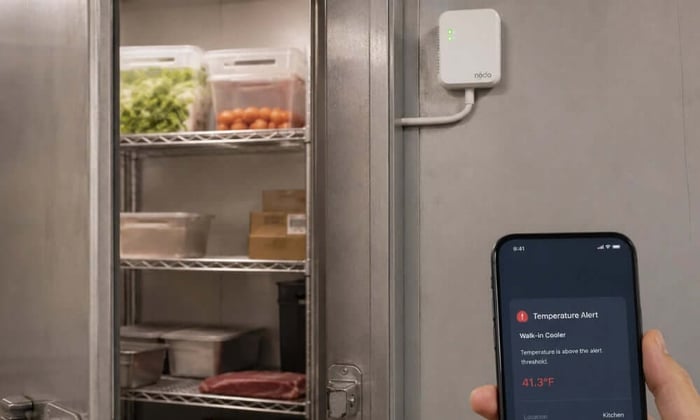
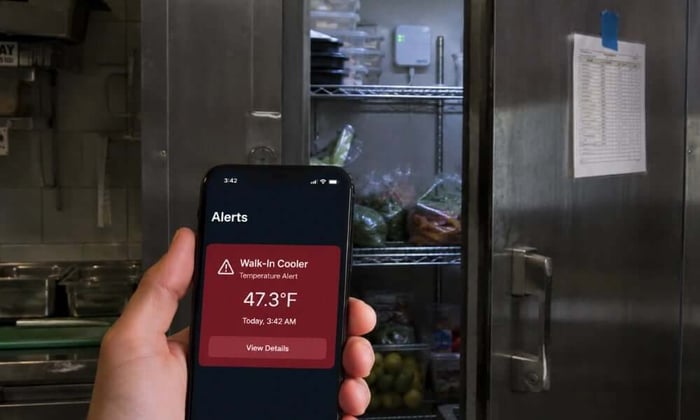
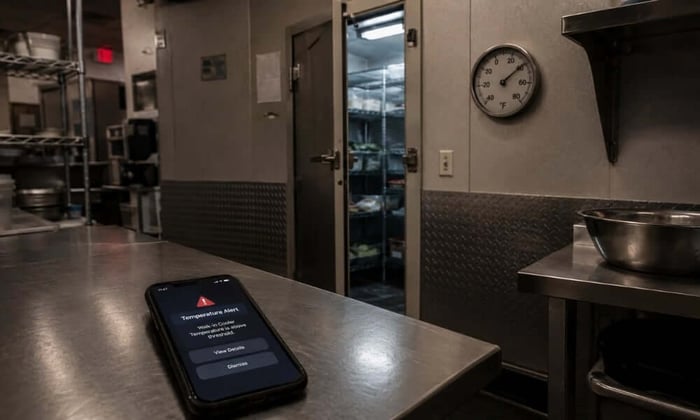
Automated sensors remove the dependency on someone remembering to check. A unit that reports every ten minutes catches a slow drift hours before it becomes a spoilage event, and an alert is sent the moment a threshold is crossed, reaching someone whether or not a staff member happens to be standing near that cooler. The gap between a manual check and the next one simply does not exist anymore.
Necto applies this directly to a working kitchen. It is a 4G cellular sensor that tracks temperature, humidity, and power status on its own schedule, without relying on the restaurant's Wi-Fi or a staff member's memory. It sends an alert the instant a cooler, freezer, or hot-holding unit drifts outside a set range, and another alert once it returns to normal, so a manager knows both when a problem started and when it was handled. A year of readings is stored automatically and downloads as a CSV, which gives a kitchen a record that holds up under a health department question in a way a handwritten log never can.
Making the Switch Without Adding Work
The irony of manual logging is that it takes more staff time than the automated version while delivering less actual coverage. A sensor that reports on its own removes a task from someone's shift checklist rather than adding one, and it keeps reporting through nights, closed days, and busy rushes when a clipboard entry would otherwise get skipped.
Ready to stop relying on a clipboard that only checks twice a day? Buy the Necto monitor now by clicking here.
FAQs
How often should restaurant temperature checks happen?
Manual logs typically get checked twice a shift, but that leaves long unmonitored gaps. Automated sensors report every ten minutes, which catches problems hours before a scheduled manual check would.
Can a cooler drift out of range between two manual checks without anyone noticing?
Yes. A unit can climb from a safe temperature into the danger zone and even partially recover before the next scheduled check, leaving no record that anything happened.
What do health inspectors expect to see for temperature monitoring records?
Inspectors increasingly look for consistent, ongoing records rather than a couple of daily entries. A digital log with continuous readings and an alert history gives a clearer picture of actual conditions over time.
Does automated monitoring replace the need for any manual checks?
It removes the dependency on manual checks for catching problems, though most kitchens still do a quick visual check as part of their normal routine. The sensor's job is to catch what happens in between those checks.
Is automated temperature monitoring more work for kitchen staff?
No. It removes a task from the shift checklist instead of adding one, since the sensor reports on its own schedule without anyone needing to walk over and write down a number.