Table of Contents
You already know the food temperature danger zone number. What you might not know is how fast a walk-in cooler can cross into it once the compressor fails, or how little warning you get when it happens overnight with nobody in the building. A health inspector can fail you on a single bad reading, but the bigger risk is the spoilage event nobody catches until the morning shift opens the door to a wall of warm air. This article covers what the danger zone actually means in practice, what to monitor besides the thermometer on the wall, and the failure pattern most kitchens are not set up to catch.
The food temperature danger zone is 40°F to 140°F, the range where bacteria like Salmonella and Listeria multiply fastest. Food cannot sit in that range for more than two hours, or one hour above 90°F, before it becomes unsafe. The risk is highest overnight or during a power outage, when nobody is in the kitchen to take a manual reading.
What the Danger Zone Actually Means for a Working Kitchen
Forty degrees is not a buffer. It is the point where the clock starts. The FDA Food Code sets the danger zone at 40°F to 140°F because that range covers the temperatures most foodborne pathogens need to grow, and growth does not wait for someone to notice. A pan of cooked chicken pulled from the oven and left on a prep counter is already inside the danger zone the moment it drops below 140°F, and the two-hour countdown begins immediately, not when someone happens to check.
The math changes above 90°F. Ambient kitchen temperatures near a flat-top or during a summer delivery run can push food into that upper band, where the safe window shrinks to one hour instead of two. A line cook who assumes the full two hours applies to a tray sitting near the grill is working from the wrong number. That detail rarely makes it into general food safety guides, but it is the difference between a compliant cooling log and a violation.
The Three Failure Points Most Kitchens Underestimate
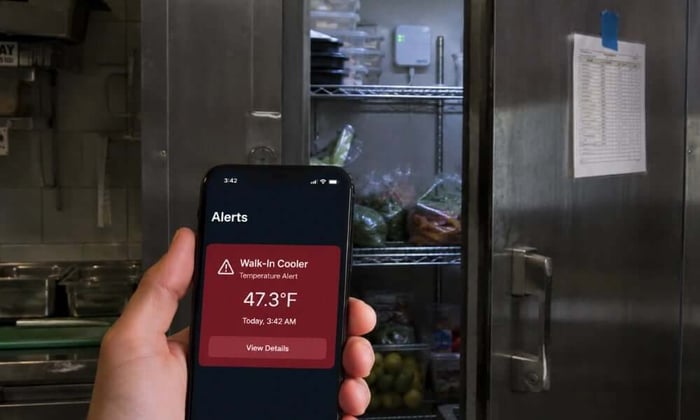
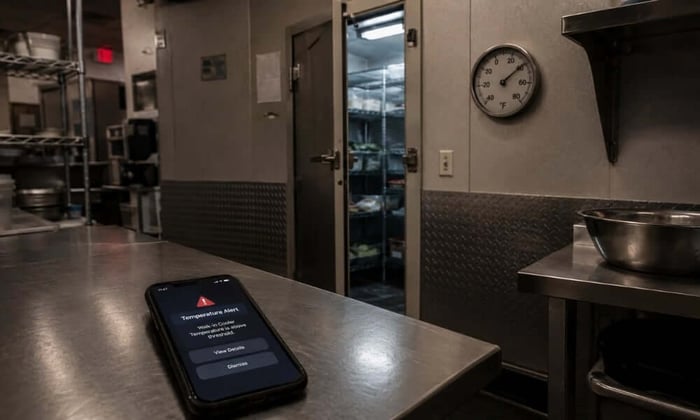
Walk-in coolers usually fail from a stuck door or a failing compressor, not anything dramatic, and the failure is quiet. A worn gasket, a door that does not seal, or a compressor cycling longer than it used to can let a walk-in drift from 38°F into the 50s over several hours without an alarm, because most commercial refrigeration is not built to alert anyone outside the room.
Hot holding has the opposite problem. Steam tables and warmers are easy to set and forget, and a unit that drops from 140°F to 130°F during a slow lunch service can sit there for the rest of the shift if nobody is assigned to check it on a schedule. The FDA Food Code requires hot-held food to stay at 140°F or above, and a five or ten-degree drift is not always obvious by touch or sight.
Power loss turns a minor issue into a full inventory loss. A breaker trip, a utility outage, or a tripped GFCI on a walk-in's circuit cuts cooling immediately, and a fully stocked walk-in can drift out of safe range within four to six hours, depending on door traffic and how well it is packed. The FDA Food Code's two-hour and four-hour windows are not theoretical once the compressor stops running.
Why Manual Checks and Wi-Fi Gateways Both Miss the Same Window
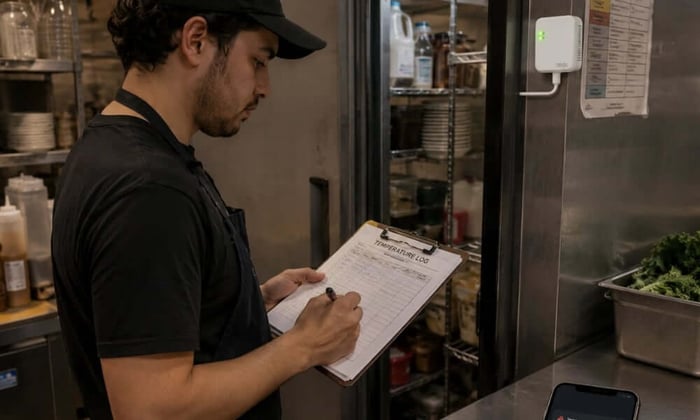
A manual temperature log is only as good as the person checking it, and most kitchens check walk-ins once or twice a shift, not continuously. That leaves long unmonitored stretches overnight, on closed days, and before staff arrive. A compressor that fails at 2 a.m. on a closed night will not get caught until someone opens up, by which point the food has likely been in the danger zone for most of the night.
Wi-Fi-connected sensors solve the continuous monitoring problem but create a new blind spot. If a walk-in loses power, there is a real chance the same electrical event also affects the router or the modem feeding that sensor, especially in older buildings on a single panel. A sensor that depends on the restaurant's own Wi-Fi to send an alert can go silent at the exact moment the cooler does, and a silent sensor looks no different from a working one until someone checks the app and finds no recent reading.
A cellular connection sidesteps that problem because it does not share infrastructure with the equipment it is watching. A 4G sensor sends its alert over the cell network, not the restaurant's router, so a power event that takes down the Wi-Fi also does not take down the warning. For a walk-in or a hot-holding unit, that independence is what closes the gap between a breach happening and someone finding out about it.
What Documentation Actually Needs to Show
Health inspectors are not just checking whether food was in the danger zone. They are checking whether the restaurant has a system that would have caught it if it had been. A paper log with two checkmarks a day shows effort, not proof. A digital record with timestamped readings every ten minutes, plus an alert history showing when thresholds were crossed and when they were corrected, gives an inspector something closer to an audit trail than a guess.
That kind of record also matters after the inspection, if a customer ever reports getting sick or a supplier dispute comes up over spoiled product. Being able to pull a year of temperature history and show exactly when a unit was in range and when it was not turns a disputed claim into a documented fact.
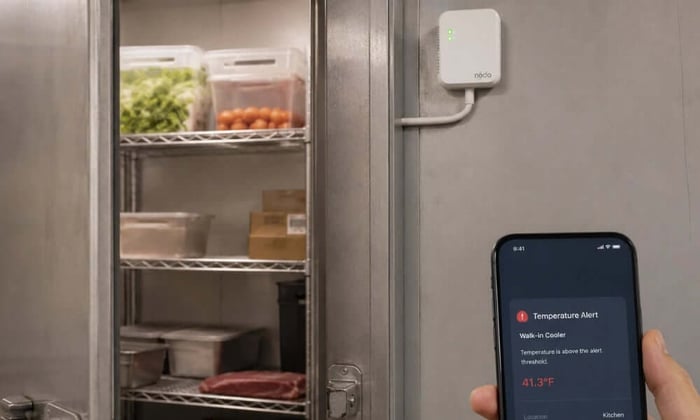
Necto fits directly into this gap. It is a 4G cellular sensor that tracks temperature, humidity, and power status without needing the restaurant's Wi-Fi network, so a breaker trip or an internet outage does not also take down the alert. It sends a notification the moment a walk-in, freezer, or hot-holding unit drifts outside a set range, and sends another the moment conditions return to normal, so staff know both when a problem starts and when it is resolved. The 72-hour backup battery keeps it reporting through an extended outage, and a year of stored readings can be pulled as a CSV for inspections or insurance claims. For a kitchen relying on a clipboard and a thermometer, that is a meaningful upgrade in what can actually be proven.
Closing the Gap Before the Next Shift
The danger zone itself is not complicated. What trips kitchens up is the assumption that someone will notice in time, whether that is a cook checking a steam table, a manager walking past a walk-in, or a Wi-Fi sensor that quietly went offline along with the power. The kitchens that avoid expensive spoilage events and failed inspections are the ones that treat continuous monitoring as part of the equipment, not an extra step someone has to remember.
Ready to stop guessing about overnight temperature swings? Buy the Necto monitor now by clicking here.
FAQs
How long can food stay in the danger zone before it is unsafe?
Food can stay in the 40°F to 140°F danger zone for up to two hours before it should be discarded. Above 90°F, that window drops to one hour. Past that point, the FDA Food Code treats the food as unsafe even if it looks and smells fine.
What is the safe temperature range for cold holding?
Cold-held food needs to stay at 41°F or below under most state adoptions of the FDA Food Code. A walk-in or reach-in that drifts above that, even briefly, starts the danger zone clock on everything inside it.
Can a walk-in cooler fail without any obvious warning?
Yes. A worn door gasket, a door that does not fully latch, or a compressor nearing the end of its life can let temperatures climb gradually over hours without tripping any alarm on the unit itself, since most commercial refrigeration is not built to notify anyone outside the room.
Does a restaurant need Wi-Fi for a temperature monitoring system to work?
Not with a cellular system. A 4G sensor like Necto reports over the cell network instead of the restaurant's Wi-Fi, so a power outage or router failure that would normally silence a Wi-Fi sensor does not affect the alert.
What records do health inspectors actually want to see for temperature monitoring?
Inspectors look for consistent, timestamped temperature records, not just a daily checkmark. A digital log showing readings every ten minutes, along with a history of any threshold breaches and corrections, gives a clearer picture than a paper log. Most kitchens fill out from memory at the end of a shift.