Table of Contents
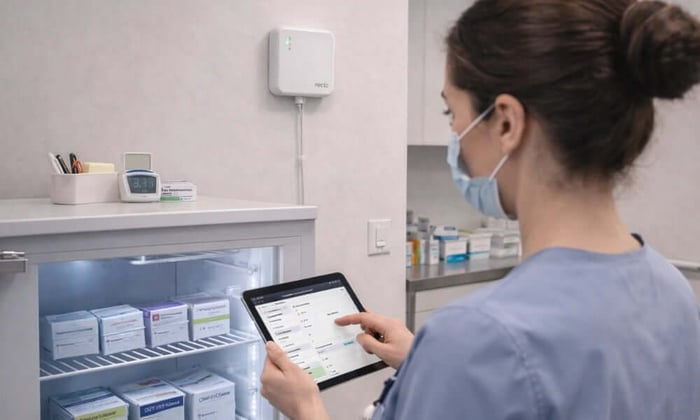
Picture this: a nurse arrives at the clinic on a Tuesday morning, checks the temperature log, and sees nothing unusual. The numbers look fine. No red flags, no missed entries. She opens the refrigerator door and immediately knows something is wrong, the air is not cold enough.
Sometime overnight, the unit stopped working. No one noticed. No alert fired. By the time she discovered it, every dose inside had been sitting at an unsafe temperature for hours. That is the problem real-time vaccine monitoring was built to solve, and it is exactly why clinics that still depend on manual checks are taking on more risk than most of them realize.
The Gap That Manual Checks Cannot Close
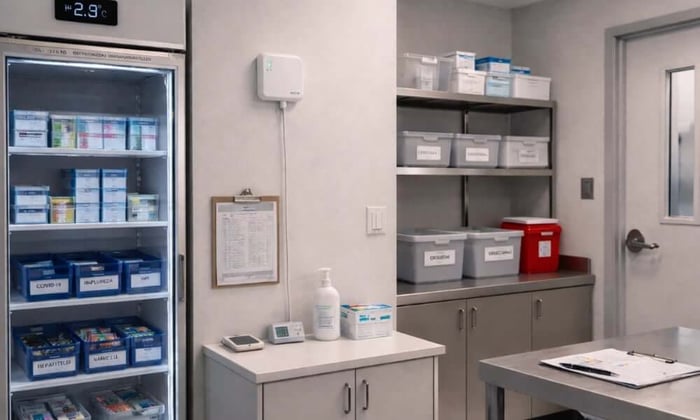
Twice-daily temperature logs made sense when they were the only option available. They still fulfill a basic documentation requirement, but they have a structural flaw that no amount of diligence can fix: they only capture two moments in a 24-hour day.
Everything in between is invisible.
Temperature excursions tend to happen outside working hours. A compressor is struggling on a warm weekend afternoon. A power interruption at 2 AM. A door that did not latch properly after the last patient visit on Friday. None of these gets caught by a morning and evening check. Staff are doing exactly what they were trained to do, and the system still fails them.
Human error adds another layer of risk. Logs get missed during busy clinic days. Readings get estimated rather than recorded precisely. A complete-looking paper trail can still have gaps that only become apparent during an audit or, worse, after a loss.
What Real-Time Vaccine Monitoring Actually Means
The term gets used loosely, so it is worth being specific. Real-time vaccine monitoring means the system is tracking temperature continuously, every few minutes, around the clock, and sending alerts the moment readings leave the acceptable range. Not a summary of the next morning. Not a flag the next time someone checks the app. An immediate notification while the situation can still be addressed.
That distinction matters more than it sounds. A temperature spike caught in 15 minutes is a recoverable event. The same spike discovered six hours later is likely a write-off.
Automated monitoring also creates a complete, timestamped data record without anyone having to maintain it manually. Every reading is logged. Every excursion is documented. Historical data is accessible whenever an auditor asks for it. The administrative burden that comes with manual log management largely disappears.
Why This Is a Bigger Deal Now Than It Was Five Years Ago
Vaccine storage requirements have not gotten simpler. Several newer products, particularly mRNA vaccines, require tighter temperature control than older formulations. The margin for error is narrower, and the cost of losing a batch is higher.
At the same time, regulatory scrutiny of storage practices has increased. Inspectors today want more than a completed temperature log. They want continuous records, documentation of any excursions and how they were handled, and evidence that the monitoring system itself is calibrated and reliable.
You see, manual systems were always a workaround, a practical compromise when better tools did not exist or were not affordable. That calculation has shifted. Reliable monitoring technology is no longer expensive or complicated to deploy, which means the old justifications for skipping it carry less weight with regulators and with risk management teams.
The Financial Argument Is Straightforward
A single serious excursion can cost a clinic anywhere from several thousand to tens of thousands of dollars in discarded inventory, depending on what was affected. That does not include the cost of rescheduling patients, managing the compliance documentation, and the staff time spent on the response.
Real-time monitoring systems typically cost a fraction of that per year. The math is not complicated. Prevention is cheaper than recovery, and the gap between the two widens every time vaccine prices increase.
There is also the less visible cost of near-misses. A clinic running on manual checks may have experienced minor excursions it never knew about - ones that fell between log entries and resolved before the next check. Those events do not show up on a balance sheet, but they represent real exposure every time they happen.
What Auditors Are Asking For
Compliance expectations have become more specific. Auditors reviewing vaccine storage programs now look for continuous temperature records rather than periodic spot checks. They want to see documentation of how excursions were identified and what corrective action was taken. Equipment calibration records are expected, and gaps in monitoring data raise questions even when no excursion occurred.
All things considered, a continuous electronic monitoring system answers most of these requirements automatically. The records are complete, timestamped, and available on demand. There is no scrambling to compile logs before an inspection or explaining why there is no entry for a particular shift.
That is one of the practical reasons clinics that have made the switch tend to find audits far less stressful than they used to be.
The Early Warning Advantage
The most concrete benefit of real-time vaccine monitoring is the ability to act before a situation becomes unrecoverable. A refrigerator that starts to fail does not typically collapse from normal to broken instantly, it drifts. Temperatures creep upward. A system tracking continuously will catch that drift early, while there is still time to move inventory or call for service.
The same applies to simpler issues. A door that did not close fully. A unit running warmer than usual after a particularly busy afternoon of openings. These are the kind of low-level problems that manual logs miss entirely but that continuous monitoring surfaces as an alert before they escalate.
For clinics managing multiple storage units or multiple locations, this kind of visibility becomes especially practical. Checking every unit manually is time-consuming and still does not provide coverage between checks. Remote, continuous monitoring handles the whole picture without adding to staff workload.
Setting Up Monitoring That Holds Up
Not every monitoring system is built the same way, and clinics should think carefully about a few specific requirements before committing to one.
The system needs to work when the clinic's primary network goes down. A monitoring setup that relies entirely on the same internet connection it is supposed to protect against losing is a design flaw, not a feature. Cellular connectivity, independent of the local network, is the standard that makes sense for anything patient-safety-related.
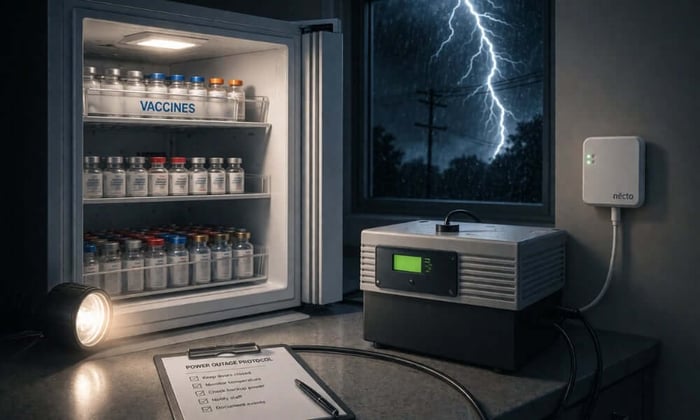
Backup power is equally non-negotiable. A monitor that stops working when the power goes out is not useful for detecting power outages, which are one of the most common causes of temperature excursions in the first place.
Alert delivery matters too. Alerts that only appear in an app are less useful than ones that also go out as texts or emails to multiple contacts. The goal is to make sure the right person sees the notification quickly, regardless of what they happen to be doing or what device they have in hand.
For clinics looking at cellular-connected options, Necto temperature monitor tracks temperature continuously using built-in 4G LTE, no Wi-Fi required, and includes a 72-hour backup battery so monitoring continues even during power outages. Alerts go out via app, text, and email, and historical data is accessible anytime for compliance purposes. It is a practical example of what modern temperature monitoring looks like when it is designed for real-world clinic conditions rather than ideal ones.
Where the Responsibility Actually Sits
Real-time monitoring does not replace staff judgment or good storage practices. Vaccines still need to be stored in appropriate units, organized to allow airflow, and handled according to protocol. A monitoring system is not a substitute for training or properly maintained equipment.
What it does is close the visibility gap that manual checks cannot address. It gives staff the information they need to act quickly when something goes wrong and the documentation they need to demonstrate control when auditors ask.
That combination, earlier detection, faster response, cleaner records is why real-time vaccine monitoring has moved from a nice-to-have to a standard expectation in well-run clinics.
The question is not really whether it is worth doing. It is whether the cost of the next undetected excursion is worth waiting to find out.
If your clinic is still relying on manual temperature checks, now is a practical time to reassess. Contact Necto today to learn how continuous, cellular-connected monitoring can protect your vaccine inventory.
FAQs
What is real-time vaccine monitoring?
Real-time vaccine monitoring is a system that continuously tracks vaccine storage temperatures 24/7 and sends instant alerts when conditions go outside the safe range, allowing immediate action.
Why are manual temperature checks no longer enough?
Manual checks only capture temperatures at specific times, usually twice a day. They miss excursions that happen in between, especially overnight or during off-hours.
What risks come with relying on manual logs?
Manual logs can miss critical temperature changes, rely on human input, and often contain gaps or inaccuracies. This increases the risk of undetected vaccine spoilage and compliance issues.
How does real-time monitoring prevent vaccine loss?
It detects temperature changes immediately and sends alerts in real time, allowing staff to respond before vaccines are exposed to unsafe conditions for too long.
What happens if a vaccine refrigerator fails overnight?
Without real-time monitoring, failures may go unnoticed for hours, leading to spoiled vaccines. With monitoring, alerts are triggered instantly, allowing for quick intervention.
Why is real-time monitoring more important today than before?
Modern vaccines, especially newer formulations like mRNA, have stricter temperature requirements. This makes continuous monitoring essential to avoid costly losses and maintain efficacy.
What do auditors expect from vaccine storage systems today?
Auditors now expect continuous temperature records, documented excursions, calibration logs, and proof of proper response procedures, not just manual logs.