Table of Contents
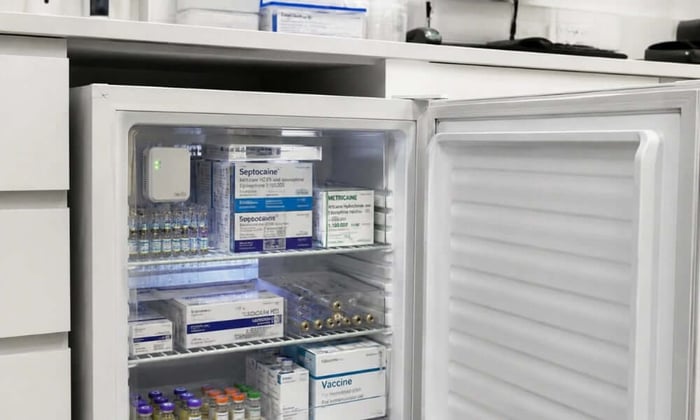
If the small refrigerator in your dental supply room lost power at 6 p.m. on a Friday, you would likely find out Monday morning when someone opens the door. Dental office refrigerator temperature monitoring is the difference between catching that failure in time to move product and arriving to find two days of heat damage in a box that still looks fine from the outside. This article covers what that fridge actually holds, the temperature range it needs to stay in, and why the gap nobody plans for is the weekend.
Most dental office refrigerators need to stay between 36 and 46 degrees Fahrenheit (2 to 8 degrees Celsius). A typical unit holds vaccines, local anesthetic cartridges, epinephrine, and refrigerated dental materials. A power failure pushes most compact units out of range within two to four hours, and temperature-compromised products rarely show visible signs of damage.
What a Dental Fridge Actually Holds
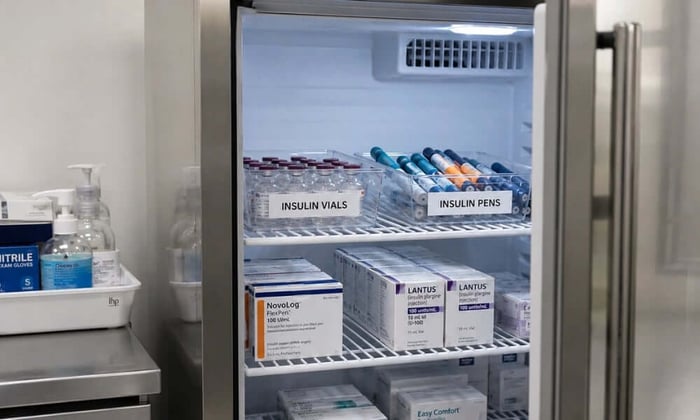
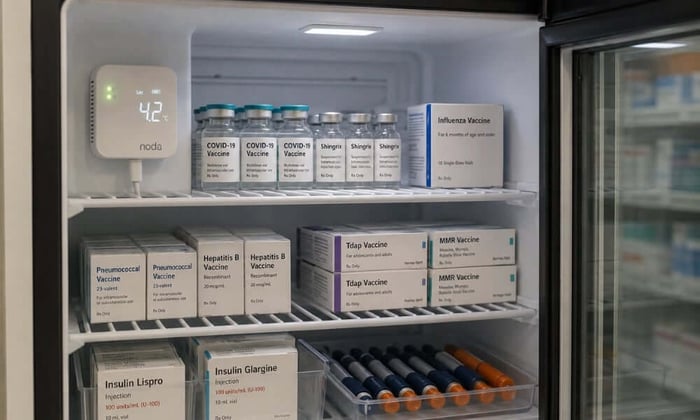
The contents of a dental office refrigerator vary by practice, but most units hold more than one category of temperature-sensitive product. Hepatitis B vaccines and flu shot stock are common, especially in practices that administer them in-house. Local anesthetic cartridges, including lidocaine and articaine, are typically refrigerated before use to extend shelf life. Epinephrine, which appears both as a standalone emergency medication and as an additive in anesthetic formulations, is also refrigerated and has a narrower stability window than most practitioners assume. Some bonding agents, provisional cements, and polyether impression materials carry refrigeration requirements in their manufacturer instructions for use.
That mix matters because each product has its own sensitivity profile. Epinephrine oxidizes when exposed to heat, and a degraded concentration means an unpredictable dose in an emergency. Anesthetic cartridges stored above their recommended range may still deliver a dose but with reduced duration. Neither type of damage is visible at the point of use.
The Temperature Rules and What Breaks Them
The 36 to 46 degrees Fahrenheit range that applies to most refrigerated medications comes from the same storage standards used across human-use pharmaceutical products. The CDC Vaccine Storage and Handling Toolkit uses this range for all refrigerated vaccines, and most dental product manufacturers specify it on the label or in their product documentation.
What makes dental offices different from pharmacies is the equipment. Most dental practices use a compact under-counter or dorm-style refrigerator rather than a purpose-built pharmaceutical unit. These have smaller thermal mass, which means they lose temperature faster when the compressor stops. They also tend to sit in rooms near sterilizers or autoclaves that radiate heat, which puts the unit under constant load. Door opening during a busy clinical day, several times per hour in an active operatory supply room, also drives temperature variation that a wall-mounted thermometer will never capture.
The most common failure mode is not equipment age or malfunction during business hours. It is a compressor problem, a tripped breaker, or a utility outage that happens after hours and stays undetected until the practice reopens.
Why the Weekend Is the Highest-Risk Period
A dental practice that closes Friday evening and reopens Monday morning leaves a refrigerator unmonitored for roughly 60 to 65 hours. A power event during that window, a tripped breaker, a utility outage, or a compressor failure, can push a compact refrigerator to room temperature within two to four hours under normal ambient conditions. Saturday morning, the unit could be sitting at 70 degrees. Come Monday, everything inside has been out of range for more than two days.
The financial exposure is real. A mid-size dental practice might hold $800 to $2,000 in vaccines, anesthetics, and refrigerated materials. The harder scenario is when power comes back Saturday night, the unit returns to range, and staff arrive Monday with no way to know how long the excursion lasted or how warm it got. Without a recorded temperature history, the call is to discard everything.
A continuous monitor that logs readings every 10 minutes and sends an alert when temperature or power goes out of range closes that gap entirely. For dental offices, the goal is not a complex compliance system. It is knowing within minutes when something goes wrong, on any day, at any hour.
Dental Office Refrigerator Temperature Monitoring Without Wi-Fi Dependency
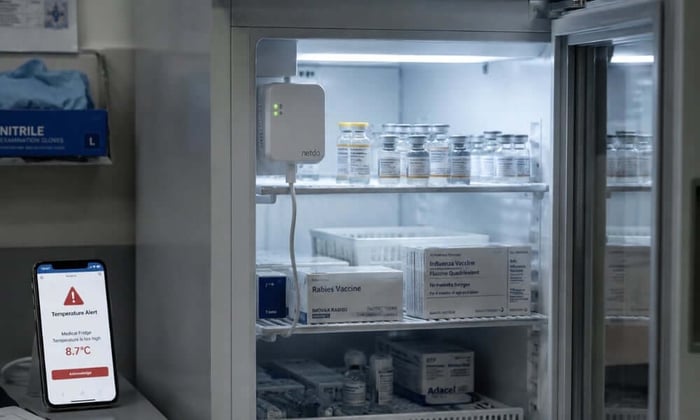
Most small dental practices have a single office router. That router shares a circuit with the rest of the building, and in many cases it draws from the same breaker as the operatory equipment. When power cuts, the router goes down with everything else. Any monitor that reports over Wi-Fi goes silent at the same moment the refrigerator stops cooling, which is exactly when the alert matters.
A cellular monitor keeps its own independent path open. It runs on 4G and does not share infrastructure with the building network, so a power outage does not break the alert chain. The sensor stays on its own backup battery, the connection stays live, and the alert leaves the building whether the lights are on or off.
Necto is a 4G cellular temperature and power monitor that works without any on-site Wi-Fi. It tracks temperature inside the refrigerator in real time, updates every 10 minutes under normal conditions, and switches to continuous reporting the moment an alert condition develops. When power goes out, it sends an alert immediately, not after a polling interval, and it sends a second alert when power returns so staff know the situation has resolved and can assess how long the unit was down.
The built-in rechargeable lithium battery runs for 72 hours, which covers any realistic power outage a dental practice would face. The SIM card connects automatically to AT&T, T-Mobile, and Cellular One with no separate cellular contract needed. Up to five contacts receive text and email alerts, and Necto's -4 to 140 degree Fahrenheit range covers the full refrigerated target. There is no Wi-Fi configuration and no IT setup required.
You can read more about how cellular monitoring applies across medical cold storage in our complete guide to medical refrigerator temperature monitoring.
Before the Next Long Weekend
Dental offices are not pharmacies and most do not face the same certification or logging requirements that come with VFC enrollment. That is not a reason to skip monitoring. The fridge in the back room holds products that patients depend on and that cost real money to replace. A power failure that happens Thursday night before a holiday weekend can go undetected for four days, and everything in that unit looks identical whether it has been stored at 40 degrees or 75.
The fix does not require an enterprise monitoring platform. It requires a monitor that alerts the right people within minutes of a power loss or temperature excursion, runs independently of the building network, and keeps a record of every reading so there is no guessing about what happened or for how long.
If you want a dental office refrigerator temperature monitor that sends alerts through a power outage and requires no Wi-Fi to work, contact the Necto team today to get the right setup for your practice.
FAQs
What temperature should a dental office refrigerator be set to?
The target range for most refrigerated dental products, including vaccines, local anesthetics, and epinephrine, is 36 to 46 degrees Fahrenheit (2 to 8 degrees Celsius). Check the manufacturer instructions for use on each specific product, as some materials carry narrower ranges.
Do dental offices need a certified data logger for their refrigerator?
Most general dental practices are not required to use a certified digital data logger unless they participate in a VFC program for pediatric vaccines. VFC-enrolled practices must meet CDC-specified monitoring requirements. Non-VFC practices are not bound by those requirements but should maintain some form of continuous temperature monitoring to protect refrigerated stock.
What happens to local anesthetic cartridges if they get too warm?
Local anesthetic cartridges stored above their recommended temperature range may deliver a shorter duration of effect and reduced potency. The change is not always visible in the cartridge itself. Most manufacturers specify refrigerated storage before use to maintain shelf life and consistent performance.
How long can a dental fridge hold temperature during a power outage?
A compact under-counter refrigerator typically holds safe temperatures for two to four hours after power loss, depending on ambient room temperature, how full the unit is, and how often the door is opened. A purpose-built pharmaceutical unit performs better. Either way, a power outage that lasts through a weekend will push any unit out of range.
Can a cellular temperature monitor replace the manual temperature log in a dental office?
For non-VFC dental practices, a cellular monitor with a downloadable data history covers what a manual log is meant to capture, with the added benefit of real-time alerts and no gaps from missed manual checks. Necto stores one year of readings downloadable as a CSV file. VFC-enrolled practices still need to meet CDC-specified logging requirements.