Table of Contents
- What Temperature Should a Medical Refrigerator Hold?
- Why Manual Temperature Logs Miss What Actually Happens
- How Medical Refrigerator Temperature Monitoring Works
- What Happens When the Power and the Network Fail Together
- Cold Storage Across Different Medical Settings
- Getting Medical Cold Storage Right
- FAQs
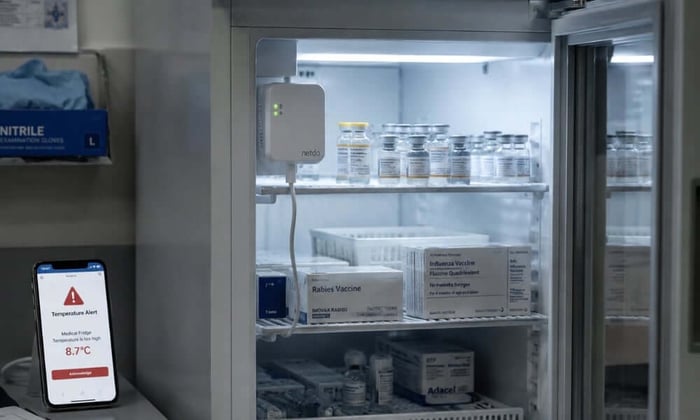
If your medical refrigerator drifts out of range overnight, the vaccines and medications inside can lose potency before anyone opens the door in the morning. Medical refrigerator temperature monitoring is what stands between a quiet equipment fault and a full inventory loss you have to report and replace. This guide covers the temperature rules, the monitoring methods, the records you are expected to keep, and the failure most facilities never plan for: what happens when the cooling and the network go down at the same time.
Medical refrigerator temperature monitoring keeps vaccines and refrigerated medications inside the safe 36°F to 46°F window, which is 2°C to 8°C. The CDC recommends a continuous digital data logger with a buffered probe, records kept for at least three years, and alerts that reach staff the moment a temperature excursion begins, day or night.
What Temperature Should a Medical Refrigerator Hold?
Refrigerated vaccines and most temperature-sensitive medications belong between 36°F and 46°F, with 40°F as the target. Frozen vaccines sit far colder. A few degrees outside those windows, held long enough, can degrade a product without changing how it looks, which is what makes cold storage so unforgiving.
Storage type | Recommended range | Target |
Refrigerated vaccines and medications | 36°F to 46°F (2°C to 8°C) | 40°F (5°C) |
Frozen vaccines | -58°F to +5°F (-50°C to -15°C) | 0°F (-18°C) |
Controlled room temperature (reference) | 68°F to 77°F (20°C to 25°C) | varies by product |
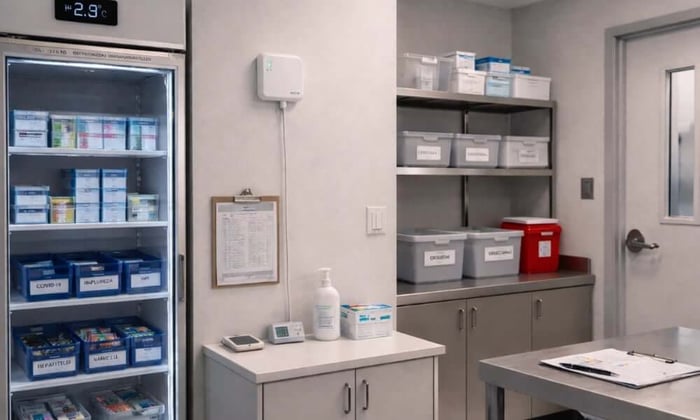
The number on a wall thermometer is not the number that matters. Air temperature swings the instant the door opens, so a reading taken at that moment tells you almost nothing about the product on the shelf. This is why the CDC recommends a buffered probe, a sensor sitting inside a vial of glycol or glass beads that changes temperature at the same slow pace as a filled vaccine vial. The probe tracks what the medication is actually experiencing and holds steady while the surrounding air spikes and settles.
Cumulative exposure is the part people underestimate. A vaccine does not have to freeze or cook to be ruined. Repeated short trips above 46°F add up over weeks, and by the time potency drops there is no visible sign. The vial looks fine. That is exactly why continuous readings beat spot checks.
Why Manual Temperature Logs Miss What Actually Happens
A staff member writing down two readings a day catches almost none of what happens inside the unit. Research using simulation models found that twice-daily current-temperature checks, without min and max, detected only about 5 to 6 percent of the temperature excursions that actually occurred. The unit can swing out of range at 9 p.m. Friday and back by 6 a.m. Monday, and a paper log would show three normal mornings in a row.
The gaps are predictable. Overnight, weekends, and holidays are when a compressor quits or a door gets left ajar, and those are the exact hours no one is standing there with a clipboard. A manual log only captures the handful of moments someone was at the unit with a pen. The refrigerator spends the rest of its time unwatched.
To be fair, manual logs still have a place as a compliance backstop and a daily habit. They just cannot be the only thing watching a unit full of product worth thousands of dollars. The math does not work in their favor.
How Medical Refrigerator Temperature Monitoring Works
A digital data logger records the temperature at set intervals, and the CDC recommends intervals no longer than every 30 minutes. It tracks minimum and maximum readings, stores a running history, and needs a current certificate of calibration to stay accurate over time. Facilities are generally expected to keep those temperature records for at least three years, sometimes longer depending on state rules.
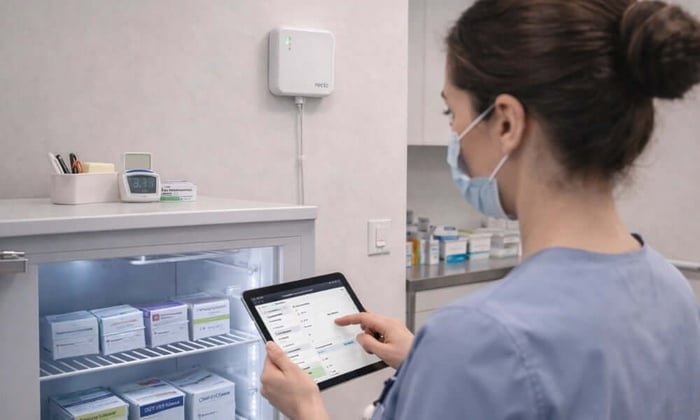
Here is where the equipment splits into two camps. A basic data logger records everything faithfully but only speaks up when someone plugs it in and reads it. If the fridge failed at midnight, you learn about it when you download the data the next morning, long after the product is gone. A connected monitor does the same recording and adds the part that actually saves inventory: it sends an alert the moment a reading crosses the line, while there is still time to move product or fix the unit.
Come to think of it, that difference is the whole reason a separate cluster article on data loggers versus cellular monitors exists. Recording and alerting are two different jobs, and a device that only handles the first leaves you finding out about failures after they have already cost you.
What Happens When the Power and the Network Fail Together
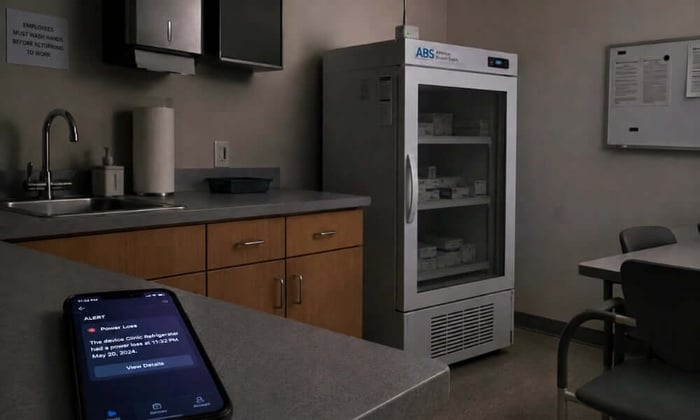
This is the failure most monitoring setups are not built for. Cooling failures are usually triggered by power events, a tripped breaker or a utility outage. In that same moment, the building Wi-Fi or the network your monitor reports through often goes down too. If your sensor sends its alerts over the same infrastructure that just lost power, you get silence at the precise moment you need a warning.
A monitor that reports over its own cellular connection sidesteps the problem. It does not share a fate with the building network, so when the power drops and the router goes dark, the alert still leaves the building and lands on a phone. For a single-fridge clinic, a satellite pharmacy, or a med spa without IT staff on site, that independence is the difference between catching a problem at 11 p.m. and discovering a ruined shelf the next morning.
Think about the timing. A breaker trips at 10 p.m. on a holiday weekend. The compressor stops, the office router loses power, and any monitor tied to that network goes quiet. A cellular monitor keeps its own line open, so the first out-of-range reading still triggers a text before the temperature inside has climbed far. That head start is often enough to move product to a backup unit or get someone on site while the vaccines are still good.
Cold Storage Across Different Medical Settings
The core rules stay the same, but the pressure points shift depending on where the refrigerator lives. A hospital pharmacy answers to strict log requirements and audit trails. A clinic or a patient storing insulin at home cares about a much smaller unit with much higher personal stakes. A dental office runs a compact fridge that rarely gets a second look until something spoils. A small lab protects reagents and samples that took weeks to prepare. A med spa holds Botox and dermal fillers worth thousands of dollars on a single shelf.
Each of these settings carries its own thresholds and paperwork, which is why this guide anchors a set of focused articles on pharmacy log requirements, insulin storage at home and in the clinic, dental office refrigerators, storing refrigerated medication at home, small-lab monitoring, and Botox and filler storage for med spas. The one thread running through all of them is simple. The product on the shelf only survives if something is watching the temperature when no one else is.
Necto was built for that gap. It is a 4G LTE cellular temperature, humidity, and power monitor that runs without any Wi-Fi at the site, using a built-in SIM that auto-connects to AT&T, T-Mobile, and Cellular One across the United States, Canada, and Mexico. For a medical fridge, that means the alert path does not depend on the same network a power outage tends to take down. When a reading crosses your set threshold, the monitor sends a text and email alert to as many as five contacts, so the warning reaches whoever is on call rather than sitting in a log until Monday.
Under normal conditions it reports every 10 minutes and switches to real-time updates the instant an alert condition starts, so a developing problem does not hide between readings. It covers a temperature span of -4°F to 140°F, which spans standard refrigerated and room-temperature storage, and it stores a full year of readings you can download as a CSV for your records. The power side matters as much as the temperature side here. Necto sends an alert when power is lost and again when it comes back, and its 72-hour rechargeable battery keeps the unit reporting straight through an outage instead of going dark alongside the fridge it is watching.
Getting Medical Cold Storage Right
Medical cold storage runs on a short list of rules, and the distance between following them casually and following them properly is wider than most facilities assume. A wall thermometer read twice a day misses the overnight swings that ruin product. A data logger that records without alerting tells you what went wrong only after it already did. Any monitor that reports over the building network cannot warn you when that network is part of the failure. Get the placement right, add real-time alerting, and make sure at least one alert path does not share power or wiring with the room it protects. That covers most of the job.
If a refrigerator full of vaccines or medications loses cooling and the network drops at the same time, you need a monitor that keeps alerting anyway. Contact Necto today for a cellular temperature and power monitor that watches your cold storage around the clock, no Wi-Fi required.
FAQs
What temperature should a medical refrigerator be kept at?
Refrigerated vaccines and most temperature-sensitive medications should stay between 36°F and 46°F (2°C to 8°C), with 40°F as the target. Frozen vaccines are stored much colder, between -58°F and +5°F. Always check the manufacturer's product information, since some medications have their own tighter requirements.
How often should medical refrigerator temperatures be recorded?
The CDC recommends a continuous digital data logger that records at intervals no longer than every 30 minutes, plus a manual check at least once each workday. Continuous recording catches the swings that happen overnight and on weekends, which twice-daily manual checks almost always miss.
How long do I need to keep temperature logs?
Keep temperature records for at least three years, though your state or program may require longer. A running history also helps you spot a unit that is slowly starting to fail before it costs you a full shelf of product.
What is a temperature excursion, and what should I do about one?
A temperature excursion is any reading outside the safe range for that product. Do not throw the product out or use it right away. Mark it "do not use," move it to a working unit if needed, record how long it was out of range, and contact the manufacturer or your immunization program to find out if it is still viable.
Can I monitor a medical refrigerator without Wi-Fi?
Yes. A cellular monitor like Necto reports over 4G using a built-in SIM, so it needs no Wi-Fi or network setup at the site. That also means it keeps sending alerts during a power outage, when building Wi-Fi usually goes down along with the fridge.