Table of Contents
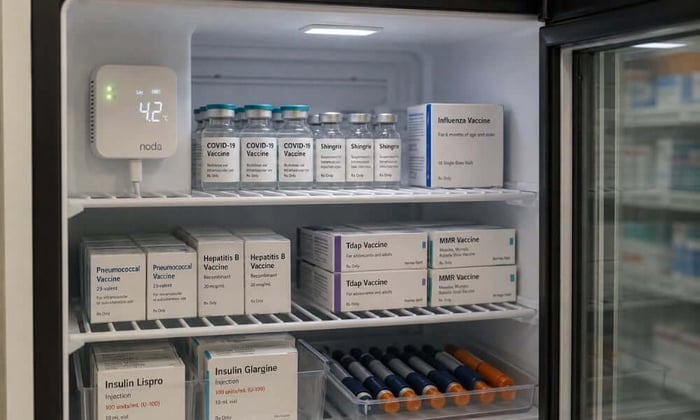
If your pharmacy refrigerator runs warm overnight and nobody notices until the morning shift, what you find in the temperature log tells the story, or it tells you the story was never recorded. Pharmacy refrigerator temperature log requirements exist because a gap in the record and a gap in cold chain protection are often the same event. This article covers what the regulations actually say, where the federal baseline ends and state rules begin, and the part of the log that manual entries cannot fill on their own.
Pharmacy refrigerator temperature logs must record readings at least twice daily at intervals of at least eight hours, and many states require more. The target storage range is 36 to 46 degrees Fahrenheit (2 to 8 degrees Celsius), with 40 degrees Fahrenheit as the operating target. Logs must document the date, time, reading, and who reviewed them. Most state boards require records to be kept for at least two years. Oregon sets the minimum at three. Any excursion outside the acceptable range must be documented along with the corrective action taken.
What the Federal Baseline Actually Requires
The federal floor for pharmacy temperature logging comes from 21 CFR 205.50, which covers prescription drug distribution and storage. It requires that temperature-sensitive drugs be stored under appropriate conditions but leaves most specifics to state boards and product labeling. USP Chapter 659 fills in the practical gaps: it defines refrigerated storage as the range between 36 and 46 degrees Fahrenheit and sets expectations for monitoring equipment and documentation practices.
For pharmacies participating in the Vaccines for Children program, the CDC requirement is more specific. VFC providers must have certified, calibrated Digital Data Loggers (DDLs) in every storage unit holding publicly funded vaccines. The CDC Vaccine Storage and Handling Toolkit specifies that DDLs be set to record temperatures at intervals of no more than 30 minutes, which produces a continuous data record rather than two manual readings per day. That distinction matters: twice-daily manual entries capture two data points out of 1,440 minutes. A DDL captures a minimum of 48.
Where State Boards Set the Real Standard
Federal requirements define the floor. State boards define what pharmacies actually live with. New Jersey, for example, requires temperature monitoring and recording no less than twice daily with a minimum eight-hour interval between readings. Documentation must be kept for two years. If a temperature excursion lasts 24 hours or more, the pharmacist-in-charge must notify the state board within 48 hours of becoming aware of it. If the excursion reaches 72 hours, no medications may be dispensed until the manufacturer confirms they remain safe and effective.
Oregon goes further, requiring records retained for three years and mandating that temperature excursions be documented with the date, the personnel involved, and the corrective actions taken. New York State VFC providers must use stand-alone refrigerator units and DDLs that meet specific calibration and data export requirements. Most state boards require that DDLs be calibrated on a regular schedule according to manufacturer specifications and that calibration certificates be available for inspection.
The pattern across states is consistent even when the specific numbers vary: logs must be current, must document who reviewed them, and must include any response to out-of-range readings. A temperature log that shows steady 40-degree readings with no record of who checked them is a compliance vulnerability at most state inspections.
What a Complete Temperature Log Entry Contains
A temperature log entry that satisfies most state board requirements includes the current temperature reading, the current date and time, the minimum and maximum temperatures recorded since the last check (from the DDL), the name or initials of the staff member reviewing the log, and any notes about excursions or corrective actions taken. For VFC providers, the DDL data download itself becomes part of the record.
The minimum and maximum temperatures matter more than the spot reading. A refrigerator that reads 39 degrees at 9 a.m. may have dipped to 32 degrees at 3 a.m. if the thermostat cycled poorly or the compressor ran long. The spot reading looks fine. The min-max from the DDL shows the problem. That is why the CDC recommends logging both the current reading and the min-max values each time a manual check is performed.
Log Entry Component | Why It Matters |
Current temperature (F) | Confirms in-range condition at time of check |
Minimum temperature since last check | Catches overnight cold events and freezing risk |
Maximum temperature since last check | Catches warm events from door openings or equipment issues |
Date and time of check | Demonstrates twice-daily compliance with required intervals |
Reviewer name or initials | Documents accountability per most state board rules |
Excursion notes and action taken | Required for NJ 48-hour reporting and Oregon documentation rules |
The Gap Manual Logs Cannot Cover
Manual twice-daily checks meet the regulatory minimum for most states, but they leave a large monitoring window uncovered. A compressor failure at midnight, a door left ajar during a busy afternoon shift, a power interruption that lasted 40 minutes. None of those events appear in a twice-daily log unless the refrigerator has already recovered by the time the next check happens.
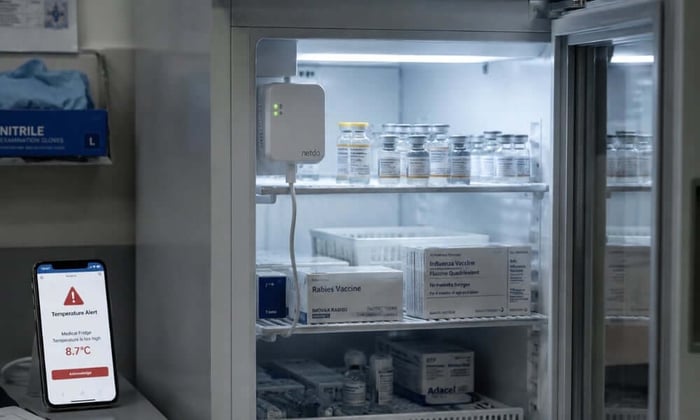
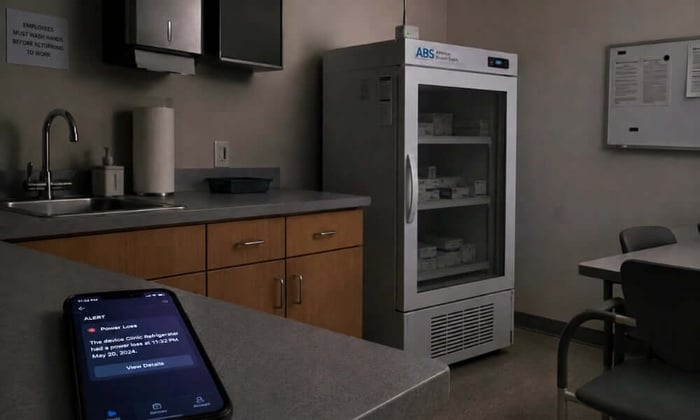
This is where the correlated failure problem becomes real. Pharmacy refrigerators, like most temperature-sensitive environments, face their highest risk during power events. A power failure can take down the refrigerator, the local Wi-Fi network, and any cloud-connected monitoring system at the same time. If the only alert path runs through the building network that just went offline, there is no alert. What shows up in the morning is a log gap and a warm refrigerator.
Out-of-band monitoring over 4G cellular closes that gap without depending on the same infrastructure that went down. An alert sent over cellular reaches the pharmacist's phone, whether the building has power or not.
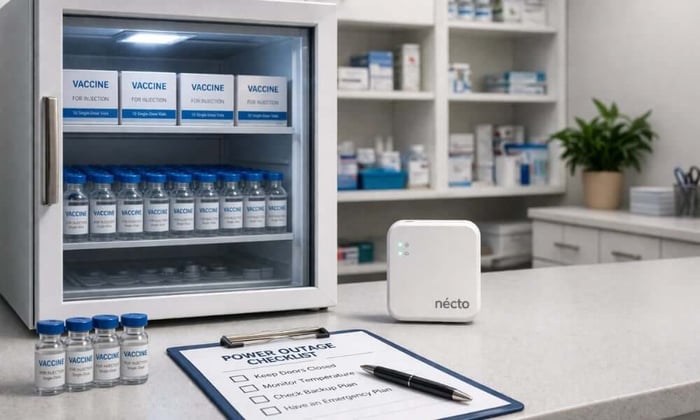
Necto gives pharmacies a cellular monitoring option that operates independently of the building network. It tracks temperature and power status in real time, sends alerts via text and app when readings move outside the thresholds you set, and keeps monitoring on its 72-hour battery through a power outage. For a pharmacy refrigerator holding vaccines, biologics, or insulin, that combination covers the failure scenarios a twice-daily manual log cannot.
What to Do When a Temperature Excursion Happens
Do not discard medications based on the temperature reading alone. The correct first step is to quarantine and label the affected product, then contact the manufacturer or a pharmacist trained in drug stability assessment to determine whether the product remains safe to dispense. Document the excursion in the log immediately: the temperature reached, the estimated duration, the time discovered, and the corrective action taken.
For VFC vaccines, the immunization program in your state should be contacted before any decision is made about whether to use or discard affected stock. The CDC Vaccine Storage and Handling Toolkit includes specific guidance on managing vaccine temperature excursions, including how to communicate with your state immunization program and what documentation is required for any doses that were administered from potentially compromised stock.
Keeping Your Pharmacy Log Audit-Ready
State boards look at temperature logs during routine inspections, and a log that shows consistent documentation is the fastest way through an inspection. Logs with unexplained gaps, missing reviewer names, or no record of excursion responses are the items that generate follow-up questions and potential citations. Building a routine where the twice-daily check includes reviewing the DDL min-max values and noting them in the log closes most of the gaps inspectors find.
Continuous monitoring with a cellular backup alert adds the layer that manual logs cannot: real-time notification when something goes wrong, even when the building's network and power infrastructure are both down.
Contact Necto today and get a cellular temperature and power monitor that keeps your pharmacy refrigerator records continuous, even through a power failure.
FAQs
What temperature range does a pharmacy refrigerator need to stay within?
The standard range is 36 to 46 degrees Fahrenheit (2 to 8 degrees Celsius), as defined by USP Chapter 659 and required by most state boards of pharmacy. The target operating temperature most facilities use is 40 degrees Fahrenheit to maintain a buffer against minor fluctuations.
How often do pharmacy temperature logs need to be checked and recorded?
Most state boards require at least two readings per day with a minimum of eight hours between checks. Pharmacies participating in the Vaccines for Children program must also use a Digital Data Logger recording at intervals of 30 minutes or less, which produces a continuous record alongside the manual log.
How long do pharmacies need to keep temperature log records?
The most common requirement is two years, but this varies by state. Oregon requires a minimum of three years. Always confirm the specific retention period with your state board of pharmacy, as it is one of the first things inspectors ask about during a compliance review.
What happens if a temperature excursion is not documented?
An undocumented excursion creates both a compliance problem and a patient safety risk. Most state boards require that excursions be documented with the date, duration, staff involved, and corrective action taken. In New Jersey, an excursion lasting 24 hours or more must be reported to the state board within 48 hours.
Can a cellular temperature monitor replace a Digital Data Logger?
A cellular monitor like Necto tracks temperature and sends real-time alerts over 4G, but it is not a certified DDL with VFC-compliant calibration documentation. For VFC-funded vaccine storage, a certified, calibrated DDL remains the required primary monitoring device. A cellular monitor works alongside it as an out-of-band alert system, particularly during power failures when the DDL may not be able to send alerts through a network that is down.