Table of Contents
If you manage a clinic dispensary or store insulin at home, the temperature rules are not optional and they are not the same for every situation. Insulin storage temperature requirements split depending on whether a vial or pen is still sealed or already opened, and most people who get this wrong do not find out until a patient notices their blood glucose is not responding the way it should. This article covers the correct ranges for both settings, what goes wrong when those ranges break, and the one failure scenario most guides never address.
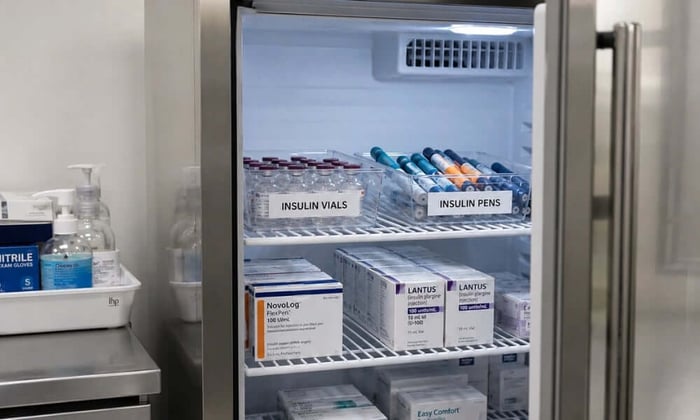
Unopened insulin should be stored at 36 to 46 degrees Fahrenheit (2 to 8 degrees Celsius) in a dedicated medical refrigerator. Once opened, most insulin types can remain at room temperature, up to 77 degrees Fahrenheit (25 degrees Celsius), for 28 to 30 days before disposal. Freezing destroys insulin permanently. Heat above 86 degrees Fahrenheit degrades it silently, and degraded insulin looks identical to a good vial.
Why the Rules Split Between Opened and Unopened Insulin
Insulin is a protein-based hormone, and proteins are sensitive to temperature at both ends of the scale. The 36 to 46 degrees Fahrenheit refrigeration range keeps unopened stock stable for the full duration of the manufacturer's printed expiration date. Take it below 32 degrees Fahrenheit and ice crystals form inside the solution, rupturing the protein structure. That damage is permanent and invisible to the eye.
Once you open a vial or cartridge, the storage equation changes. Refrigerating in-use insulin actually increases the risk of lipohypertrophy, a localized skin thickening reaction caused by injecting cold insulin repeatedly. Most manufacturers specify that an opened vial of standard human insulin, insulin analogs like glargine or aspart, and prefilled pens can be kept at room temperature, between 59 and 77 degrees Fahrenheit, for 28 days. Some formulations, notably insulin detemir, carry a 42-day room-temperature window. The cutoff is not about convenience. It is a documented stability limit based on the manufacturer's own degradation testing.
The most dangerous version of this error is heat exposure above 86 degrees Fahrenheit. Unlike freezing, which changes the visual appearance of insulin in some cases, heat degradation leaves the solution looking completely normal. A patient injecting from a vial that sat in a warm car or near a heat vent will see reduced glucose control without any obvious sign that the insulin has lost potency.
How Home Refrigerators Create Risks That Clinic Units Do Not
A standard household refrigerator introduces temperature variability that a pharmaceutical-grade unit is specifically designed to prevent. The door shelf is the worst place to store insulin. Door shelves cycle through a wider temperature swing every time the refrigerator opens, and that location sits farthest from the cooling coil. In a busy household refrigerator, door shelf temperatures can briefly spike 10 to 15 degrees above the interior set point during repeated openings.
Frost-free home refrigerators run a defrost cycle, typically one to three times per day, that briefly raises internal temperatures. Most home units do not have a continuous alarm or logging system, which means a compressor failure at 11 p.m. on a Friday goes undetected until someone reaches in Saturday morning and finds a warm shelf. For a single patient storing a month's supply, that is a real inventory loss. For a small clinic running on a residential-grade refrigerator, it is also a compliance problem.
The FDA recommends storing insulin away from the freezer compartment and away from the refrigerator walls, where cooling coils can cause localized freezing even when the thermostat reads within range. The correct location is a middle shelf toward the back, in a unit with a stable, monitored temperature.
Insulin Storage Temperature Rules for Clinics and Pharmacies
For clinics, pharmacies, and any facility dispensing refrigerated insulin to patients, the 36 to 46 degrees Fahrenheit range applies to all unopened stock, and it is not simply a best-practice recommendation. Most state boards of pharmacy require documented temperature logs as a condition of licensure. The expectation in most states is a minimum of two temperature checks per day, recorded with the time, reading, and initials of the staff member who checked.
When a temperature excursion occurs, the correct response is not to simply move the product to a different unit. An excursion protocol requires stopping dispensing from the affected unit, contacting the manufacturer or wholesaler for excursion guidance, and documenting the event including the duration, the temperature reached, and the corrective action taken. The manufacturer is the authoritative source on whether product exposed to a specific excursion is still usable. Clinics that skip that step and continue dispensing are carrying legal and patient-safety exposure.
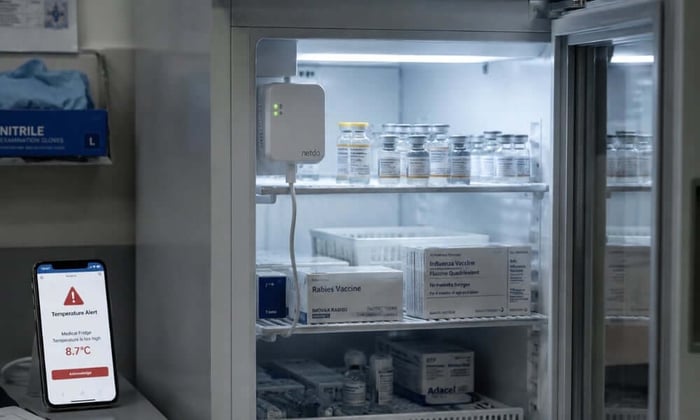
The gap in most small clinic setups is the period between a temperature event and when a staff member physically checks the log. A manual twice-daily check misses everything that happens between readings. A continuous monitoring system that alerts in real time closes that gap.
What Happens When Power Goes Out During Off Hours
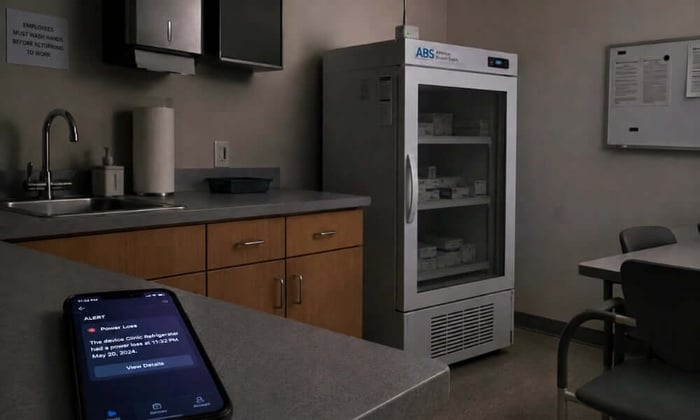
This is the scenario the twice-daily manual log does not cover. Power failures during evenings, weekends, and holidays are the highest-risk period for temperature excursions, because they are the periods with the fewest eyes on the equipment. A medical refrigerator with no power loses its safe temperature range in roughly two to four hours under normal ambient conditions, faster in a warm room or if the door is opened after power cuts.
If your monitoring setup relies on a Wi-Fi-connected sensor, a power outage that takes down the building network also takes down your alert. You lose power and monitoring at the same time, which is the exact scenario where an alert matters most.
Cellular monitoring solves this directly. A sensor that reports over 4G cellular sends an alert the moment the unit loses power or temperature climbs above threshold, independent of building Wi-Fi. The alert goes out whether the network is up or not.
Necto is a 4G cellular temperature and power monitor built for exactly this use case. It tracks temperature in real time, alerts up to five contacts by text and app the moment readings move outside set thresholds, and sends a separate alert when power is restored so staff know the situation has resolved. For insulin storage in a small clinic, pharmacy, or home health setting, Necto's temperature range of -4 to 140 degrees Fahrenheit covers the full refrigerated range with room to spare.
Its 72-hour rechargeable lithium battery keeps it running through a power outage, which is the period when a temperature alert is most likely to matter. No Wi-Fi is required. The built-in SIM card auto-connects to AT&T, T-Mobile, and Cellular One. For a small practice or pharmacy without an IT team, there is no network configuration involved. You can read more about how it works in our complete guide to medical refrigerator temperature monitoring.
Before the Next Power Failure Puts Your Insulin Supply at Risk
Getting insulin storage temperature right is a combination of the right equipment, the right placement, and a monitoring system that does not go quiet when the power does. Home users storing insulin on the door shelf of a household refrigerator are one compressor failure away from a silent loss. Clinic staff relying only on twice-daily manual logs are covered during business hours and unprotected after them. The fix is not complicated, but it requires knowing where the gaps are.
If your clinic or home refrigerator stores insulin and you want real-time power and temperature alerts that work through an outage, contact Necto today to get a cellular monitor that keeps watch when no one else can.
FAQs
Can insulin be stored in a regular home refrigerator?
Yes, but with specific precautions. Store unopened insulin on a middle interior shelf, away from the freezer compartment and away from the door. Avoid door shelves, which see wider temperature swings. A home refrigerator does not log temperatures or send alerts, so a compressor failure after hours can go undetected for hours.
What temperature destroys insulin?
Freezing at or below 32 degrees Fahrenheit causes permanent damage by forming ice crystals in the solution. Heat above 86 degrees Fahrenheit degrades insulin silently. The vial looks normal but potency is reduced. Discard any insulin that has been frozen or exposed to sustained heat above 86 degrees.
How long can insulin stay at room temperature after opening?
Most insulin types, including rapid-acting analogs and long-acting formulations, can remain at room temperature, up to 77 degrees Fahrenheit, for 28 days after opening. Insulin detemir carries a 42-day window. Check the specific product prescribing information for the exact limit, as it varies by formulation.
What should a clinic do if its refrigerator temperature goes out of range?
Stop dispensing from the affected unit immediately. Document the excursion with the time it was discovered, the temperature reading, and the duration if known. Contact the insulin manufacturer or wholesaler for guidance on whether the affected product is still viable. Do not redispense based on visual inspection alone.
How does a cellular temperature monitor protect stored insulin differently than a standard fridge alarm?
A standard refrigerator alarm requires someone nearby to hear it. A cellular monitor sends a text and app alert to up to five contacts the moment temperature or power goes out of range, from anywhere with cell coverage. During a power outage, most Wi-Fi-connected monitors go offline with the network. A cellular monitor on a backup battery keeps alerting regardless.