Table of Contents
- What the FDA Food Code Requires for Restaurant Temperature Monitoring
- Temperature Requirements by Storage and Holding Equipment
- HACCP and Restaurant Temperature Monitoring
- Where Restaurant Temperature Monitoring Fails in Real Kitchens
- After-Hours Restaurant Monitoring: The Scenario That Costs the Most
- Multi-Unit Restaurant Temperature Monitoring
- Food Temperature Logs: What Documentation Actually Requires
- How Necto Fits Into Restaurant Temperature Monitoring
- What a Complete Restaurant Temperature Monitoring Program Looks Like
- FAQs
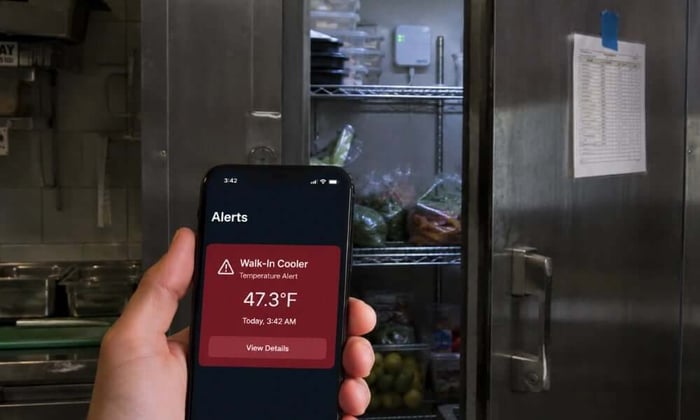
You find out the walk-in ran warm overnight when the morning prep cook opens it, and the produce is soft. Restaurant temperature monitoring is not just a regulatory checkbox. It is the only thing standing between a normal Tuesday and a $10,000 food loss event, a health department citation, or a foodborne illness incident that makes the news. This guide covers every temperature zone a restaurant has to manage, what the FDA Food Code actually requires, how HACCP fits in, and the monitoring gap most operators do not close until it costs them.
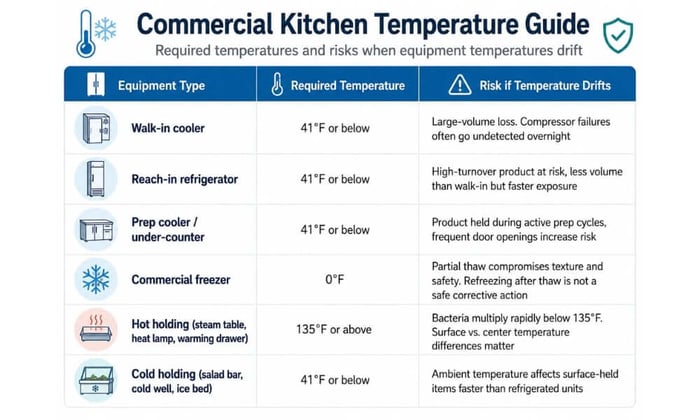
Effective restaurant temperature monitoring means tracking cold storage at 41°F or below, hot holding at 135°F or above, and commercial freezers at 0°F or below, in real time, around the clock. The FDA Food Code sets these limits. Walk-ins, prep coolers, reach-ins, and hot holding equipment all require regular temperature checks, and any monitoring system needs to alert staff before food reaches the danger zone between 41°F and 135°F.
What the FDA Food Code Requires for Restaurant Temperature Monitoring
The FDA Food Code requires restaurants to hold cold food at 41°F or below and hot food at 135°F or above. Everything between those two numbers is the temperature danger zone, where bacterial growth accelerates to the point that food becomes unsafe. Under the 2022 FDA Food Code, food left in the danger zone for more than four cumulative hours must be discarded. That four-hour clock does not reset. It accumulates across every point in the food's handling history where the temperature was not controlled.
For cold holding, the four-hour rule is not the only limit. If a temperature excursion is caught early, most jurisdictions allow a two-hour correction window. If the food temperature has been above 41°F for less than two hours and can be brought back down immediately, it may be salvageable. Beyond two hours, the corrective action is disposal. That two-hour window is why monitoring frequency matters. A system that checks temperatures once an hour can miss the entire correction window before anyone knows there is a problem.
Health departments in most states adopt the FDA Food Code as their baseline, then add state-level requirements on top. Some require manual temperature checks every two hours for hot and cold holding. Others require documentation of every check in a written or digital log. The federal floor is the minimum. Local requirements are often stricter, particularly for high-volume operations, school foodservice, and healthcare foodservice. Restaurant operators need to know both layers.
Temperature Requirements by Storage and Holding Equipment
Different equipment in a restaurant has different temperature requirements, but the underlying logic is the same across all of them: keep food out of the danger zone.
Walk-in coolers carry the most risk not because they fail more often than reach-ins, but because of volume. A reach-in losing temperature overnight puts a shelf of product at risk. A walk-in losing temperature puts thousands of dollars of inventory at risk, all at once, in a single event. That difference in consequence is why walk-in temperature monitoring deserves its own alert strategy, not just a manual check at opening.
Commercial freezers present a different kind of problem. A walk-in cooler failure shows up in product quality relatively quickly. A freezer running at 15°F instead of 0°F may not show obvious signs for days. Product maintains its frozen appearance while the safety margin erodes. For seafood and meat in particular, partial thaw and refreeze cycles cause both quality and safety degradation that is not visible to the eye.
HACCP and Restaurant Temperature Monitoring
HACCP, which stands for Hazard Analysis and Critical Control Points, is the food safety framework the FDA and USDA use as the basis for commercial food handling requirements. Most independent restaurants are not formally HACCP-certified, but health departments expect operators to follow HACCP principles, and those principles are baked into the FDA Food Code.
The seven HACCP principles are: conduct a hazard analysis, identify critical control points, establish critical limits, establish monitoring procedures, establish corrective actions, establish verification procedures, and establish record-keeping. Temperature is central to most of them. The critical control points in a typical restaurant that involve temperature include receiving, cold storage, cooking, hot holding, cooling, and reheating.
Critical limits are the specific temperature numbers the operation commits to hitting at each CCP. For cold storage, the critical limit is 41°F or below. For hot holding, it is 135°F or above. Cooking critical limits depend on the protein. Whole fish, steaks, and chops must reach 145°F. Ground meat must reach 155°F. Poultry and reheated food must reach 165°F. Every critical limit needs a corresponding monitoring procedure that specifies what gets measured, how often, and who is responsible.
The record-keeping piece is where most small restaurants have gaps. Written temperature logs are the primary documentation tool for demonstrating HACCP compliance during a health inspection. An inspector who asks for cold storage temperature records from the past 30 days needs to see actual data, not a blank form and an assurance that checks were done. Digital monitoring systems that store historical data and generate downloadable reports close that gap automatically.
The corrective action requirement is often misunderstood. HACCP does not just require operators to notice a temperature problem. It requires a predetermined plan for what happens when the critical limit is breached. For cold storage, the corrective action plan answers three questions: What do you do with the affected food? How do you fix the equipment or process? How do you document what happened and what you did about it?
Where Restaurant Temperature Monitoring Fails in Real Kitchens
Most restaurant temperature monitoring programs have the same three gaps. Each one is fixable, but they require knowing where to look.
The first gap is relying entirely on manual checks during business hours. A walk-in cooler compressor that starts failing at 9 p.m. gets noticed at 7 a.m. when the kitchen opens. That is a 10-hour window where temperature climbed unchecked. Manual checks work during service. They leave a long blind spot every night.
The second gap is Wi-Fi-dependent monitoring that goes offline when the power goes out. This is the same correlated failure problem that shows up in server room monitoring: the power event that kills the walk-in cooler compressor also kills the wireless router the temperature sensor reports through. A sensor that goes silent is not the same as a sensor reading a safe temperature, but if no alert is configured for a lost connection, the result is identical. No notification reaches anyone.
The third gap is single-point monitoring in a walk-in with uneven airflow. A single sensor mounted near the door of a walk-in cooler may read 38°F while the back corner of the unit is running at 45°F because of a blocked evaporator coil or a failing fan motor. Placement matters as much as the equipment itself.
After-Hours Restaurant Monitoring: The Scenario That Costs the Most
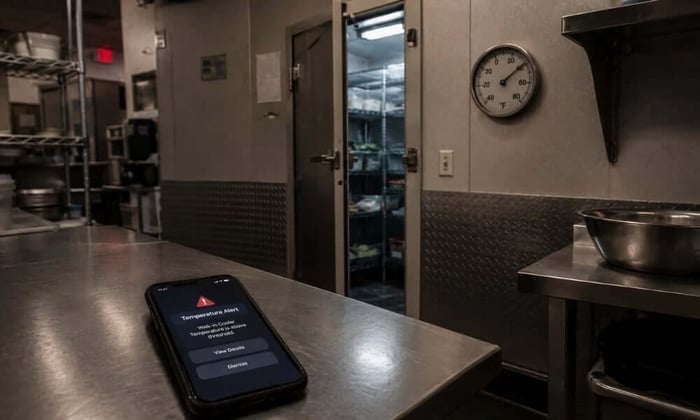
A walk-in that starts climbing in temperature at 11 p.m. on a Saturday gives the problem six or seven hours to develop before anyone with keys to the restaurant is within reach. Come 6 a.m. Sunday, the interior may have been above 50°F for four hours. At that point, the product is gone and the decision is how much to throw away.
The financial math on a single walk-in loss event makes after-hours monitoring look inexpensive in comparison. A full walk-in of mixed proteins, produce, and dairy at a mid-volume restaurant represents $3,000 to $8,000 in product. A monitoring system that catches the problem at 11:30 p.m. and alerts the manager's phone gives the operation a chance to move product, call a refrigeration tech, or at minimum document the event for an insurance claim.
Power outages add another layer to the problem. When utility power fails, the compressor stops. If the monitoring system runs over the same circuit or the same Wi-Fi network that just lost power, it goes offline at the same moment the equipment stops working. The alert that should go out immediately never fires. A monitor with a built-in battery backup and cellular connectivity solves this directly: it keeps sending alerts regardless of what happened to the building's power and internet.
Multi-Unit Restaurant Temperature Monitoring
Running temperature monitoring across three locations is not three times the work of running it at one. It is a different operational problem. The failure mode at a single location is missing a temperature event. The failure mode at multiple locations is not knowing which location had the problem.
For multi-unit operators, the key questions are: Who gets the alert when a walk-in at Location 3 runs warm at 2 a.m.? Is that the district manager, the location manager, or both? If the on-call person does not respond within 30 minutes, is there a secondary contact? How does the operator pull temperature history across all locations for a health inspection or an insurance claim?
Effective multi-unit restaurant temperature monitoring needs centralized visibility, a single dashboard or app that shows the current status of every monitored unit across every location, combined with location-specific alert routing. The district manager may want a notification for any event. The location manager needs to be the first call for their own unit. Both should have access to historical data.
The documentation benefit at scale is worth noting. Multi-unit operators with digital temperature monitoring can pull a compliance report for any location, for any date range, in minutes. That is a different experience from calling each location manager and asking them to fax their paper logs before a health department audit.
Food Temperature Logs: What Documentation Actually Requires
Temperature logging requirements come from two directions in a restaurant: the health department's inspection standards and the operation's own HACCP plan. Most jurisdictions require restaurants to maintain temperature records for a minimum of 30 to 90 days, depending on state rules.
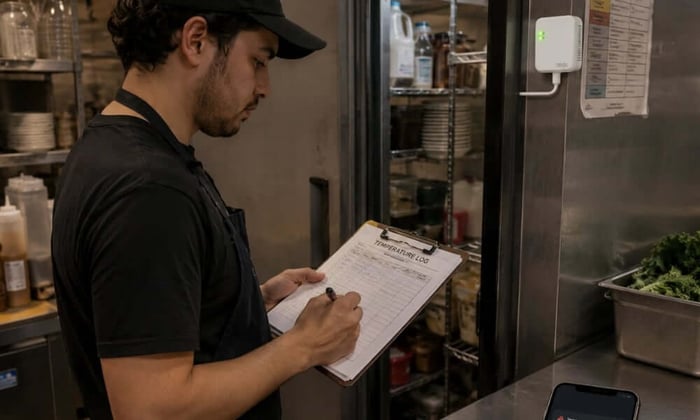
A compliant temperature log for cold storage needs to capture the date and time of the check, the unit being monitored, the temperature reading, the name of the person who took the reading, and any corrective action taken if the temperature was outside the acceptable range. A log that shows temperatures were checked but omits the corrective action column leaves the operation exposed during an inspection.
Digital monitoring systems change the documentation burden significantly. A system that checks temperature every 10 minutes and stores 12 months of data generates more documentation than any manual log program, with less labor. The tradeoff is that the data is only as useful as the alerting setup that triggers a response when something goes wrong. A log full of temperature readings that climbed past 50°F with no corresponding alert or corrective action documented is not a compliance asset. It is a liability.
The one area where manual checks still matter even with continuous monitoring is the cooking CCP. No automated sensor monitors the internal temperature of a grilled chicken breast or a burger on the line. Cooking temperature verification is a manual step that requires a calibrated probe thermometer and a trained staff member using it correctly every time.
How Necto Fits Into Restaurant Temperature Monitoring
The monitoring gap that causes the most expensive events in restaurants is not a gap during service hours. It is the gap between closing and opening, when no one is in the building and the equipment that keeps food safe runs unattended.
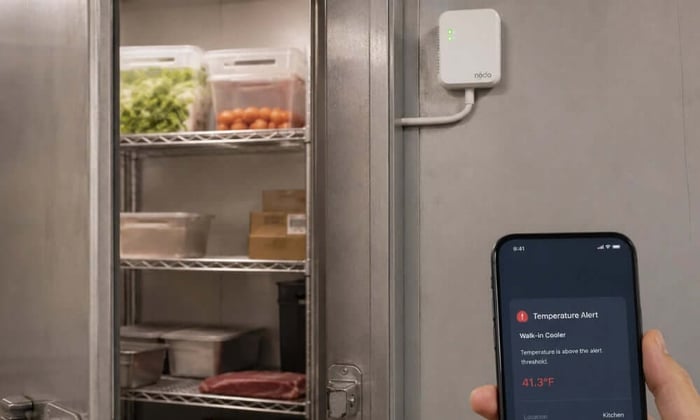
Necto is a 4G LTE cellular temperature, humidity, and power monitor that sends alerts directly to a phone via text and app the moment conditions move outside the thresholds the operator sets. It does not depend on the restaurant's Wi-Fi to send those alerts. If the power goes out and the router goes down, Necto keeps reporting over its cellular connection, auto-selecting the strongest available network from AT&T, T-Mobile, and Cellular One. Its 72-hour rechargeable battery means it stays online through a full power outage without any intervention.
For restaurants, the power monitoring feature matters as much as the temperature sensor. Necto sends an alert the moment power is interrupted, before the walk-in temperature has had time to climb, and sends a second alert when power is restored. That two-alert sequence gives operators a precise record of when the power event happened, how long it lasted, and when the equipment came back online. That documentation matters for insurance claims and health department inquiries.
Necto supports up to five alert contacts per device, so the walk-in alert can go to the manager's phone, the owner's phone, and the on-call maintenance line at the same time. For multi-unit operators, multiple devices can be managed from a single account. Enterprise pricing is available for operations with 10 or more units. The app is available on Google Play, and setup takes minutes: plug in, activate through the app, set the temperature thresholds, and the monitor starts reporting.
One year of temperature data is stored and downloadable as a CSV file, which means every temperature reading from every monitored unit is available for health inspections, insurance documentation, or internal audits without any manual log reconciliation.
What a Complete Restaurant Temperature Monitoring Program Looks Like
A complete restaurant temperature monitoring program covers four things: the right equipment in the right locations, alert thresholds set to trigger before food reaches the danger zone, a documented corrective action plan for when an alert fires, and records that satisfy both the health department and the operation's own HACCP plan.
The equipment question starts with identifying every unit where temperature failure puts food safety at risk. That list should include every walk-in cooler and freezer, any reach-in unit holding high-risk product, and hot holding equipment used for extended service periods. Each unit needs a monitoring point positioned where the temperature reading reflects actual product conditions, not just ambient air near a sensor mounted on a wall.
Alert thresholds should be set conservatively. A walk-in cooler alert at 40°F gives staff time to respond before product reaches 41°F. An alert set at 45°F may already be too late for the shortest-shelf-life items in the unit. The same logic applies to freezers: an alert at 5°F above the target gives a response window. An alert at 20°F above the target is nearly a loss notification.
The corrective action plan is the piece most operations write once and never revisit. It should answer specifically: who is called and in what order at what time of day, what happens to affected product pending a temperature assessment, and how the event is documented. A plan that lives in a binder in the manager's office is less useful than one that is part of the onboarding for every manager and shift lead.
/Restaurant temperature monitoring covers more than cold storage, but cold storage failure after hours is where the largest preventable losses happen. The FDA temperature requirements are clear. The HACCP framework for documenting compliance is well established. The equipment to monitor continuously and alert in real time exists and is not expensive relative to the cost of a single loss event.
The gap is not information. The gap is usually coverage: a monitoring setup that works during service but goes quiet after closing, or a system that reports over Wi-Fi and goes offline the moment the power does. Closing that gap means having at least one alert path that does not depend on the building's infrastructure. For a restaurant, that means the monitor keeps working even when the compressor has stopped and the router has rebooted three times.
If your walk-in cooler lost power tonight and your current monitoring system sent no alert until morning, contact Necto today and get a cellular temperature and power monitor that works independently of your building's network and keeps your team informed from the moment a problem starts.
FAQs
What temperature should a restaurant walk-in cooler maintain?
Walk-in coolers must hold food at 41°F or below under the FDA Food Code. Most operators set monitoring alerts at 40°F to allow a response window before food reaches the regulatory limit. Freezer units must maintain 0°F.
What is the temperature danger zone for food?
The temperature danger zone is 41°F to 135°F. Bacteria multiply rapidly within this range. Food held in the danger zone for more than four cumulative hours must be discarded under FDA Food Code guidelines.
How often do restaurants need to check food temperatures?
Most health jurisdictions require temperature checks every two to four hours for hot and cold holding during service. After-hours monitoring requires a continuous or automated system since manual checks are not possible when the restaurant is closed.
Do restaurants need continuous temperature monitoring or just manual checks?
Manual checks meet health code requirements during operating hours, but they leave a blind spot after closing. Continuous monitoring with automated alerts is the only way to catch equipment failures overnight, on weekends, or during holidays when no staff are on-site.
What happens if a walk-in cooler temperature goes above 41°F?
If the temperature has been above 41°F for less than two hours, food may be salvageable if the temperature is corrected immediately. Beyond two hours in the danger zone, the FDA Food Code requires disposal. Continuous monitoring with early alerts gives operators the best chance of staying within the two-hour correction window.
What should a restaurant temperature log include?
A compliant temperature log should record the date and time of each check, the unit monitored, the temperature reading, the name of the person who took the reading, and any corrective action taken for out-of-range readings. Digital monitoring systems automate most of this documentation.
Does Necto work in restaurants without reliable Wi-Fi?
Yes. Necto runs entirely on 4G LTE cellular and does not require a Wi-Fi connection at the restaurant. It alerts over cellular even when the building's internet is down, and its 72-hour backup battery keeps it running through a power outage.