Table of Contents
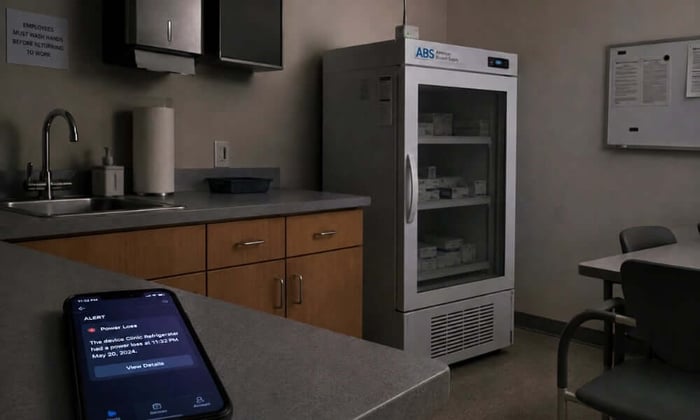
The fridge in your exam room is not damaged. The compressor is fine. The door sealed properly. But the power went out at 10 p.m. on Friday, the router went down with it, and the Wi-Fi sensor stopped reporting. When your staff walked in Monday morning, the insulin and biologics inside had been sitting at 58 degrees for 61 hours. Medical cold storage monitoring only works when the alert actually reaches someone, and most small clinic setups go silent at the exact moment they should be loudest.
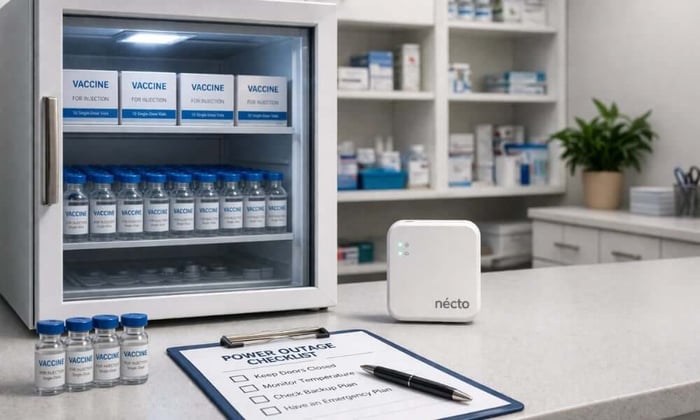
Medical cold storage monitoring needs to catch three things: power loss to the fridge, temperature excursion inside it, and power restoration. A Wi-Fi sensor cannot alert during a power outage because the router goes down at the same time. A cellular monitor with battery backup keeps sending alerts through the entire event, which is the window that decides whether thousands of dollars in inventory can be saved or has to be discarded.
What Medical Cold Storage Monitoring Actually Needs to Catch
Three failure modes drive financial loss in small healthcare facilities, and most monitoring setups only catch one of them. The first is power loss to the fridge. The moment a circuit trips or utility power goes out, the fridge loses power and the clock starts running. Temperature inside may not move for 30 to 45 minutes depending on how full the fridge is and how well it is insulated. That window is when an alert matters most, before any temperature damage has occurred. A power loss alert is the early warning. A temperature alert is often already too late.
The second failure mode is temperature excursion with power intact. A door left ajar overnight, a failing door seal, a thermostat that drifted out of calibration, or a fridge overloaded past its cooling capacity can all push internal temperatures above the 46 degree Fahrenheit threshold while the unit remains powered. This scenario is slower and more common than a full power failure, and it requires continuous temperature monitoring to catch.
The third is power restoration. Knowing when power came back tells you exactly how long the fridge was without power, which is the number that drives every discard-or-keep decision for the medications inside. Without a restoration alert, staff are left guessing at the outage window from memory or checking thermostat logs. With one, the decision is documented and defensible.
The Real Cost of a Missed Alert
The equipment survives a power outage. The inventory usually does not. Insulin vials must be discarded after any uncontrolled temperature excursion above 77 degrees Fahrenheit or after sustained exposure above 46 degrees, even if they look normal. A 5-pack of analog insulin runs between $300 and $600 at acquisition cost for a practice. Vaccine stock varies widely, with some childhood vaccines running $20 to $30 per dose and combination vaccines exceeding $100 per dose. A full fridge stocked for a busy week can hold $3,000 to $6,000 in temperature-sensitive inventory at any given time.
The replacement cost for a single missed weekend outage can exceed the price of a cellular monitoring subscription for several years. That math is straightforward for any practice manager who has written the purchase order. What is harder to account for is the downstream cost: cancelled appointments while replacement inventory is ordered, the time spent documenting the loss for supplier returns, and the staff hours spent on the discovery and cleanup on a Monday morning that was supposed to be a normal clinic day.
Why the Monitoring System Goes Offline When the Fridge Does
A Wi-Fi temperature sensor reports through the building's router. When building power fails, the router goes down. When the router goes down, the sensor loses its connection to the cloud and stops sending alerts. The fridge and the monitoring system both go offline at the same moment, which is the exact moment you need an alert. No error message appears, no alarm fires, and nobody gets notified because the system has no path to send anything.
This is the same blind spot that affects any in-band monitoring setup, whether it is a server room sensor or a medication fridge. The monitoring infrastructure depends on the same power and network as the thing it is watching. When one fails, both fail. For a solo practice with one router and one internet connection, there is no redundancy and no fallback.
A cellular connection solves this because it operates on a separate path entirely. A sensor with a built-in SIM card connects to the cellular network the same way a cell phone does. It does not need the router to be running. As long as there is a cell signal, alerts go out. For a clinic that closes Friday evening and does not reopen until Monday morning, that independence covers the entire gap.
What to Look for in a Cold Storage Monitor for a Small Facility
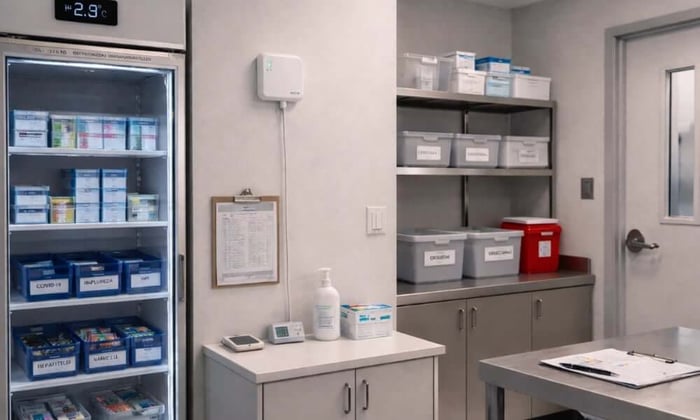
For a practice manager without IT staff, the right monitor comes down to five criteria. First, it needs to run on cellular, not Wi-Fi, so alerts continue through a power event. Second, it needs to alert on power loss AND power restoration as separate events, not just temperature thresholds. Third, the battery backup needs to be long enough to cover a full weekend, at minimum 48 to 72 hours. Fourth, it needs to support multiple alert contacts so the owner, the office manager, and an on-call staff member all receive notifications. Fifth, setup should not require a network engineer or a facilities management contract.
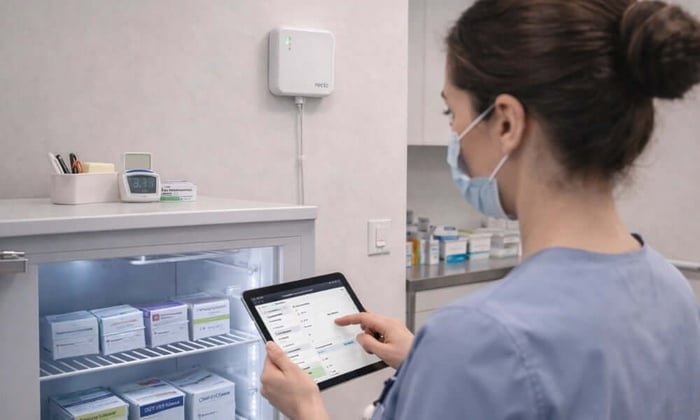
Necto covers all five. It monitors temperature, humidity, and power status over 4G cellular using a built-in SIM card that connects automatically to AT&T, T-Mobile, and Cellular One. No Wi-Fi setup, no router configuration, no IT involvement required. It alerts on both power loss and power restoration via text and email to up to five contacts, and its 72-hour rechargeable battery keeps it running through a full weekend outage. For a small clinic with no dedicated IT infrastructure and real inventory at stake, it is a straightforward option. Learn more at getnecto.com.
The Monday Morning Problem
Every cold storage failure in a small clinic follows the same pattern. The event happens overnight or over a weekend. Nobody is in the building. The monitoring system that was supposed to catch it went offline with the power. Staff discovers the problem when they walk in, the fridge is warm, and the decision about what to discard has already been made by the clock.
A cellular monitor with a 72-hour battery backup does not change the physics of a power outage. It changes who finds out about it first, and when.
If your clinic stores temperature-sensitive medications and you want to know the moment the power goes out, not the moment your staff walks in on Monday, contact Necto today. A cellular cold storage monitor with battery backup and automatic power loss alerts puts that notification on your phone within minutes of the event, not days after it.
FAQs
How long can medications stay in a fridge without power before they need to be discarded?
It depends on the medication. Insulin must be discarded after sustained exposure above 46 degrees Fahrenheit, which can occur within 2 to 4 hours in a warm room with the door sealed. Vaccines follow CDC storage guidelines that vary by type. The key variable is how long power was out, which is why a monitor that alerts on both power loss and power restoration is more useful than one that only tracks temperature.
Do I need a compliance-certified monitor for my clinic's medication fridge?
Compliance requirements vary by state, facility type, and the specific medications you store. A cellular monitor like Necto is not a CDC-certified VFC logger and does not replace a formal compliance program. What it does cover is the power-outage gap that most compliance setups leave open, which is the window between an outage and when someone discovers it.
What is the difference between a temperature excursion alert and a power loss alert?
A temperature excursion alert fires when the measured temperature inside the fridge crosses a threshold you set. A power loss alert fires the moment the monitor detects that AC power has been cut, before temperature has had time to change. For cold storage, the power loss alert is the earlier and more useful warning. By the time the temperature alert fires, the window for intervention may already be narrowing.
Can a cellular temperature monitor work in a clinic with no IT staff or dedicated network?
Yes. A cellular monitor uses a built-in SIM card to connect directly to the cellular network. There is no Wi-Fi setup, no router configuration, and no network infrastructure required. Plug it in, download the app, set your thresholds, and it runs independently of anything else in the building.