Table of Contents
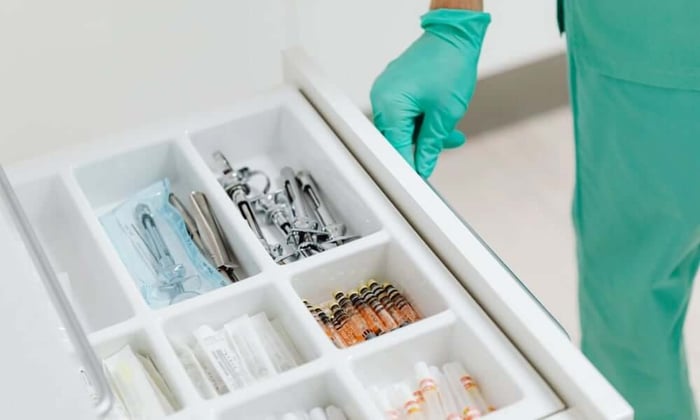
Your clinic closes at 6 p.m. on a Friday. Sometime overnight, a circuit trips, the router goes dark, and the medication fridge starts warming. When Monday morning arrives, the insulin and biologics inside have spent 36 hours outside safe temperature range, and nobody got a single alert because the Wi-Fi sensor went offline with the router. Temperature monitoring in healthcare facilities is only as reliable as the connection it runs on, and for most small clinics, that connection shares the same power strip as everything else.
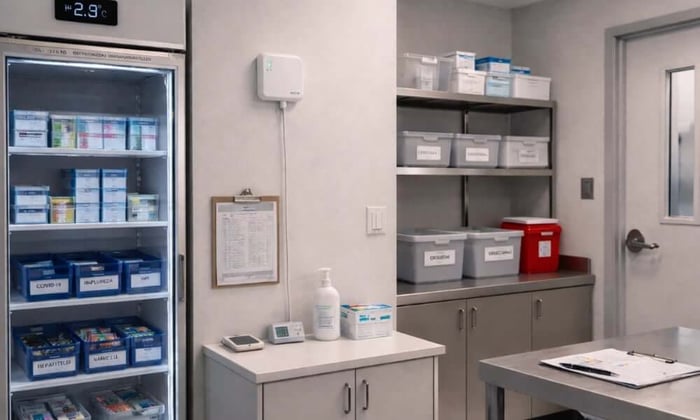
Small healthcare facilities need to monitor medication storage temperature, ambient room temperature, and power status. Medication fridges should stay between 36 and 46 degrees Fahrenheit per CDC guidance. A cellular monitor that alerts over 4G, independent of the building's Wi-Fi and router, keeps sending notifications even when local power infrastructure fails, which is exactly when the risk is highest.
What Healthcare Facilities Actually Need to Monitor
Three measurements cover most of the risk in a small clinic or care facility: medication storage temperature, room temperature, and power status. The CDC recommends refrigerated vaccines and medications stay between 36 and 46 degrees Fahrenheit, with most facilities targeting around 40 degrees as a practical midpoint. Drifting above 46 degrees for even a few hours can compromise the potency of insulin, biologics, and vaccines, products that show no visible sign of damage until a patient receives an ineffective dose.
Room temperature matters too, though it gets less attention than storage. Assisted living facilities and outpatient clinics maintain ambient temperatures in the 68 to 75 degree range for patient comfort and basic infection control. A room that climbs above 80 degrees overnight, because an HVAC unit lost power or a thermostat failed, creates conditions that are uncomfortable at best and medically risky for vulnerable residents at worst.
Power status is the measurement most small facilities leave out entirely. A temperature sensor that stops reporting is not the same as one reporting a normal reading. If power to a fridge or HVAC unit cuts out, you need an alert within minutes, not after the temperature has already climbed past the damage threshold.
Why Wi-Fi Monitoring Fails at the Worst Possible Moment
The problem with Wi-Fi-dependent temperature sensors in small healthcare facilities is not accuracy. It is that they stop communicating the moment the local network goes down, which happens most often during the same power events that put medications at risk.
A typical small clinic runs on a single internet connection through one router. When building power fails, that router goes down. Any sensor reporting over Wi-Fi loses its path to the cloud and sits silent while conditions inside a medication fridge deteriorate. The monitoring system appears operational from the outside, no error, no alarm, because it simply has nothing to report.
A cellular connection that operates independently of the building network solves this directly. A sensor reporting over 4G does not care whether the router is on. It connects to the cellular network and sends alerts regardless of what is happening to local infrastructure.
The Facilities Most at Risk
The healthcare facilities most exposed to this gap share a common profile. They are small: a solo medical practice, an independent dental office, a residential assisted living home, a rural satellite clinic, or a physical therapy practice with a medication cabinet and a vaccine fridge. They have one internet connection, no dedicated IT staff, and nobody on site after hours.
These facilities carry real financial risk in their storage. A single fridge stocked with biologics, vaccines, or compounded medications can hold thousands of dollars of inventory. A weekend power event that goes undetected until Monday is a financial loss and a patient safety issue that cannot be undone. A large hospital has facilities staff and backup systems. A two-room medical practice has a fridge, a router, and whoever checks the building first on Monday morning.
What a Cellular Monitor Catches That Wi-Fi Cannot
A cellular temperature monitor running on 4G with a built-in battery backup covers four scenarios that matter in a small healthcare facility.
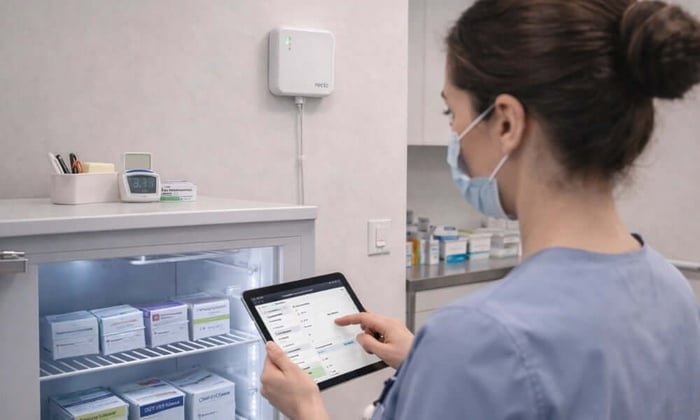
Power loss: the moment a fridge or the building loses power, a cellular monitor with battery backup keeps running and sends an alert immediately, by text to the owner's phone and by email to up to five contacts. That alert arrives whether the router is up or not.
Power restoration: knowing when power comes back is as useful as knowing when it went out. A monitor that alerts on both events tells you exactly how long equipment was without power, the number you need to decide whether stored medications are still viable.
Temperature excursion: if a fridge door was left open, a seal failed, or a thermostat drifted, temperature climbs even with power intact. A monitor checking every 10 minutes under normal conditions catches that drift before it crosses the damage threshold.
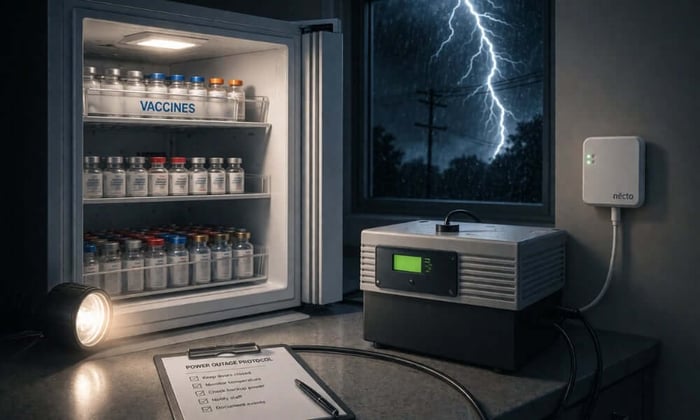
Extended outage coverage: a 72-hour backup battery means the monitor keeps running through a prolonged power event. For a facility that closes Friday evening and reopens Monday morning, that window covers the entire gap.
Necto gives small healthcare facilities a cellular monitoring option that does not depend on the same network and power infrastructure it is meant to protect. It tracks temperature, humidity, and power status around the clock, sends alerts via text and app the moment conditions move outside set thresholds, and runs on its 72-hour backup battery when building power fails. For a small clinic or care facility with no IT staff and real inventory at stake, that kind of coverage is worth having. Visit getnecto.com to learn more.
Before the Next Power Event
Small healthcare facilities carry medication and equipment risk that most enterprise monitoring platforms are not built for, and are not priced for. The gap is not compliance documentation or audit trails. It is whether someone gets a text alert at 11 p.m. on a Saturday when the clinic's power goes out. A cellular monitor that works independently of local Wi-Fi answers that question without an IT team, a dedicated network, or a facilities management contract.
If your clinic or care facility stores temperature-sensitive medications and you want alerts that reach you even when the power is out, contact Necto today. A cellular temperature and power monitor with a 72-hour backup battery covers the exact gap most small facilities do not know they have.
FAQs
What temperature should a medical office refrigerator stay at?
The CDC recommends refrigerated medications and vaccines stay between 36 and 46 degrees Fahrenheit. Most facilities target around 40 degrees as a practical midpoint. Temperatures above 46 degrees for a sustained period can compromise the potency of insulin, biologics, and vaccines, often with no visible sign of damage.
What happens to Wi-Fi temperature sensors during a power outage?
A Wi-Fi temperature sensor loses its connection to the cloud the moment the local router goes down. It stops sending alerts and sits silent until power and network connectivity are restored. In a power outage scenario, this means the sensor goes offline at exactly the moment alerting matters most.
Do small clinics need compliance-grade temperature monitoring?
Compliance requirements vary by facility type, state, and the specific medications stored. Compliance aside, any facility storing temperature-sensitive medications or vaccines has a direct financial and patient-safety reason to monitor those conditions continuously. A cellular monitor does not replace a compliance program, but it covers the power-outage gap that most compliance setups leave open.
How does a cellular temperature monitor work without an internet connection?
A cellular temperature monitor like Necto uses a built-in SIM card to connect directly to the cellular network, the same way a cell phone works without Wi-Fi. It does not need a router, a local network, or any on-site IT infrastructure. As long as there is a cell signal, it sends alerts.