Table of Contents
- What "Out-of-Band" Actually Means in a Server Room
- How In-Band Monitoring Fails During the Events That Matter Most
- What Out-of-Band Server Room Monitoring Covers That In-Band Misses
- Where Out-of-Band Monitoring Fits in an IT Monitoring Stack
- What to Look for in a Cellular Out-of-Band Monitor
- Before the Next Power Event
- FAQs
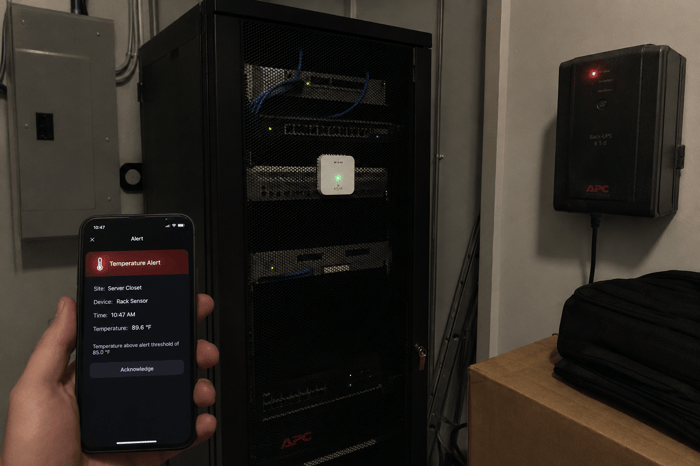
If the monitoring system watching your server room runs on the same network as the equipment inside it, you have a single point of failure dressed up as a safety net. When a power event takes out the cooling, the switch, and the monitoring path all at once, you find out about the thermal problem the next morning. Out-of-band server room monitoring exists to break that dependency, and this article covers where in-band setups fall short and what to look for in a cellular alternative.
Most server room monitors depend on the local network, which means they go silent during the exact events that cause cooling to stop, like power failures and switch outages. Out-of-band server room monitoring uses an independent path, typically 4G cellular, to keep alerts flowing when the building network is down. That independence is what separates a tool that works most of the time from one that works when it counts.
What "Out-of-Band" Actually Means in a Server Room
Out-of-band monitoring is any alert path that does not share infrastructure with the systems being monitored. The sensor sends temperature and power data over a connection completely separate from the LAN, WAN, or building network. If every switch in the building lost power, an out-of-band monitor would still get an alert to your phone.
SNMP polling, IP-based sensor platforms, and cloud dashboards that report through the same WAN connection your servers use are all in-band. They work well under normal conditions, but the conditions under which you most need an alert are rarely normal.
How In-Band Monitoring Fails During the Events That Matter Most
The failure chain is predictable. Utility power drops. The UPS holds for a while, then runs out. The network switch loses power. The CRAC unit stops. And the IP-based monitoring platform goes dark at the same moment temperatures start climbing.
In a small server room, inlet air temperatures can reach the ASHRAE A1 upper limit (80.6 degrees Fahrenheit) within 10 to 20 minutes of cooling loss. It happens fast, and the tool that was supposed to catch it is already offline.
"No alerts" on the dashboard reads exactly the same as "everything is fine." For branch offices, edge locations, and remote IDFs with no on-site staff, that blind spot can stretch from hours to days.
What Out-of-Band Server Room Monitoring Covers That In-Band Misses
The first gap out-of-band monitoring closes is power loss detection. A sensor that alerts on both power loss and restoration tells you the moment the grid goes down and confirms when it comes back. That beats waiting for temperatures to drift upward and hoping the monitoring platform is still online.
The second gap is network-independent alerting. A sensor reporting over 4G cellular delivers text and app alerts even when every piece of network hardware in the building is off. There is no dependency on the LAN and no delay between the event and the notification.
The third gap is battery-backed continuity. A monitoring device with a 72-hour rechargeable battery keeps reporting through extended outages, well past the point where a UPS-backed network sensor would have gone silent. For weekend power failures, that runtime is the difference between catching a developing problem and walking into thermal shutdowns on Monday.
Where Out-of-Band Monitoring Fits in an IT Monitoring Stack
Out-of-band monitoring does not replace SNMP, DCIM, or building management platforms. Those tools handle granular, in-band visibility when the network is up. Out-of-band is the last line of defense, covering the one scenario those systems cannot: the moment the network they depend on is part of the failure.
The best fit is any site where the network path is a single point of failure. Edge locations with one switch and one ISP link. Remote IDFs sharing a circuit with the HVAC. Branch offices with no on-site staff. ASHRAE TC 9.9 Thermal Guidelines provide the threshold baseline for configuring alerts: 64.4 to 80.6 degrees Fahrenheit for A1-class servers. Setting thresholds a few degrees below those ceilings gives the team time to respond before hardware starts throttling.
What to Look for in a Cellular Out-of-Band Monitor
A built-in SIM card that auto-connects to multiple carriers removes the friction of a separate cellular contract. Battery backup should outlast a real outage, not a 15-minute blip. Alert routing to multiple contacts through text and email makes sure someone who can act gets the message. Historical data logging with a full year of stored readings gives the team post-incident records and trend data.
Setup should take minutes: plug in, download the app, activate, and set thresholds. If the device needs network configuration or firewall rules, it adds the same dependencies you are trying to avoid.
Necto gives IT teams a cellular-based, out-of-band monitoring option that does not rely on the network it is meant to protect. It monitors temperature and power status around the clock, sends alerts via text and app when conditions go beyond safe limits, and continues running on its 72-hour battery through a power outage. For edge locations, remote IDFs, or data closets without reliable network access, it is a straightforward option.
Before the Next Power Event
The monitor watching your server room should not depend on the infrastructure inside it. If the cooling and the network share a failure mode, and in small rooms they almost always do, an in-band tool will go silent at the worst possible moment. Out-of-band server room monitoring on its own cellular connection and battery is the layer that stays awake when everything else goes down.
If your server room loses cooling and the network goes down at the same time, you need a monitor that keeps alerting regardless. Contact Necto today to get a cellular temperature and power monitor that works independently of the network it is watching.
FAQs
What is out-of-band monitoring in a server room?
Out-of-band monitoring uses a communication path completely independent of the network being monitored, typically 4G cellular instead of the building LAN. If the network goes down, alerts still reach the IT team
Why do network-based server room monitors fail during power outages?
Most sensors connect through the local network, which loses power during the same events that knock out cooling. When the switch goes offline, the sensor cannot send alerts, leaving the team blind to rising temperatures.
Does out-of-band monitoring replace SNMP or DCIM platforms?
No. Out-of-band works alongside existing tools. SNMP and DCIM handle granular data and trend analysis when the network is healthy. Out-of-band covers the gap when the network itself is part of the failure.
What temperature range should trigger an out-of-band alert?
ASHRAE recommends server inlet temperatures between 64.4 and 80.6 degrees Fahrenheit for A1-class equipment. Setting the alert a few degrees below 80.6 gives the team response time before hardware begins throttling.
How long does a cellular monitor keep running during a power outage?
Necto runs on a 72-hour rechargeable lithium battery, covering a full weekend outage. It sends alerts on both power loss and power restoration, so the team knows the moment something changes.