Table of Contents
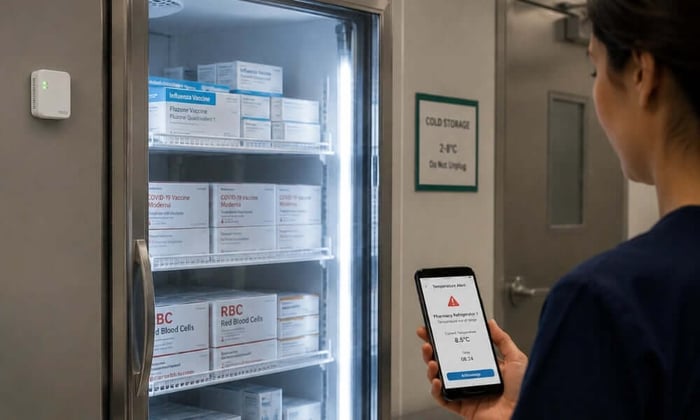
You walk in Monday morning, check the data logger, and find a refrigerator that drifted out of range Saturday night while nobody was on the floor. The vaccines inside might be fine. They might be a total loss. Temperature monitoring for hospitals is supposed to catch that excursion the moment it starts, not log it for you to find two days later. This article covers the ranges you have to hold, why blood banks and biologics need tighter watching than a standard pharmacy fridge, and the gap most monitoring setups never plan for: the outage that takes the network down at the same moment the cooling stops.
Hospital temperature monitoring tracks refrigerators, freezers, and storage units against fixed ranges and alerts staff the instant a unit drifts out of bounds. Pharmacy and vaccine storage runs 2 to 8 degrees Celsius. Whole blood is held at 1 to 6 degrees. Frozen biologics and plasma go far colder. The monitoring layer matters as much as the equipment, because an excursion nobody hears about is the same as no monitoring at all.
What Temperature Ranges Hospitals Have to Hold
Each type of storage has its own range, and what counts as a crisis depends on what sits inside the unit. Refrigerated vaccines and most pharmacy stock are held at 2 to 8 degrees Celsius, which is 36 to 46 degrees Fahrenheit. Whole blood and red cells sit in a tighter band of 1 to 6 degrees Celsius. Platelets are stored warmer, around 20 to 24 degrees, and need checking every four hours if they are not in a continuously monitored incubator. Frozen plasma and many biologics drop below minus 15 degrees Celsius, and some mRNA products require ultra-cold storage down toward minus 80.
The narrow windows are the hard part. A pharmacy fridge has a few degrees of slack before stock is at risk. A blood bank refrigerator does not. Staff often set the alarm thresholds inside the safe range, say an alert at 2.2 degrees on the low side and 5.8 on the high side, so there is time to act before blood actually reaches an unsafe point. That buffer only works if someone gets the alert.
Why Blood Banks and Biologics Need Tighter Monitoring Than Pharmacy Fridges
Blood and biologics warm toward an unsafe condition faster than most pharmacy stock, and the cost of a miss is higher. A unit of whole blood that crosses 6 degrees Celsius and stays there cannot be safely returned to inventory. Reagents and packed red cells stored together force the refrigerator into an even narrower combined range, often 2 to 6 degrees, with no room for a slow drift to go unnoticed.
AABB standards require continuous monitoring with alarms that reach a responsible party 24 hours a day, including weekends and holidays. If a facility is not staffed around the clock, the alarm still has to find someone. That requirement is where a lot of setups quietly fall short. An alarm that beeps in an empty room at 2 a.m. on a Sunday meets the letter of nothing. The alert has to travel to a phone, and it has to travel even when the building is having a bad night.
The Monitoring Gap Most Hospitals Do Not Plan For
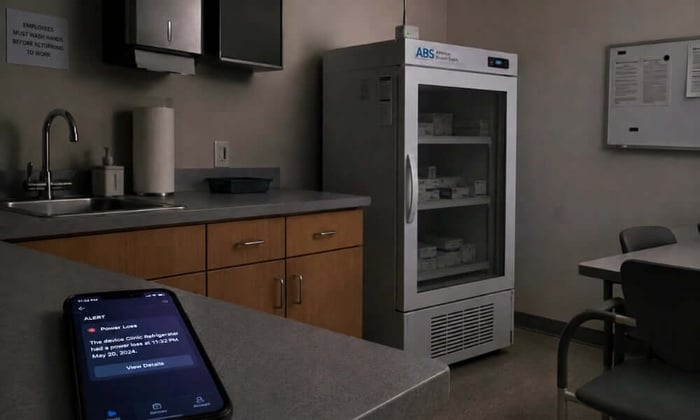
Here is the scenario almost no monitoring plan accounts for: the power goes out, and the network goes down with it. Cooling failures and power events tend to arrive together. A breaker trips, a UPS gives out, or utility power drops across the block. In that moment, the refrigerator compressor stops, and the Wi-Fi or wired monitoring system that watches it can lose power at the same time. If your sensors report over the building network that just died, you get silence at the exact moment you need an alarm.
Out-of-band monitoring solves this by reporting over a cellular connection that does not share infrastructure with the building. A sensor running on 4G keeps sending alerts even when local power and the network are both down. The unit's own battery keeps the monitor alive through the outage, so the alert path stays open while staff decides whether to move inventory to a backup unit or fire up a generator. Power restoration alerts close the loop, confirming when conditions return to a safe range so nobody has to guess.
Monitoring Satellite Clinics and Off-Site Storage
The exposure is rarely the main hospital pharmacy with IT staff down the hall. It is the satellite clinic across town, the standalone outpatient pharmacy, the off-site overflow freezer in a leased unit with thin network coverage. Those locations store real inventory and often have no reliable Wi-Fi and no on-site technician to notice a problem.
A cellular monitor fits these sites because it needs nothing from the building. It does not depend on a guest network, an IT closet, or a router that may not survive a storm. One account can watch a refrigerator at the main campus, a freezer at a satellite clinic, and an off-site unit, all reporting independently. For a facility spread across several addresses, that coverage closes the blind spots competitors skip past.
How Necto Fits Hospital Cold Storage
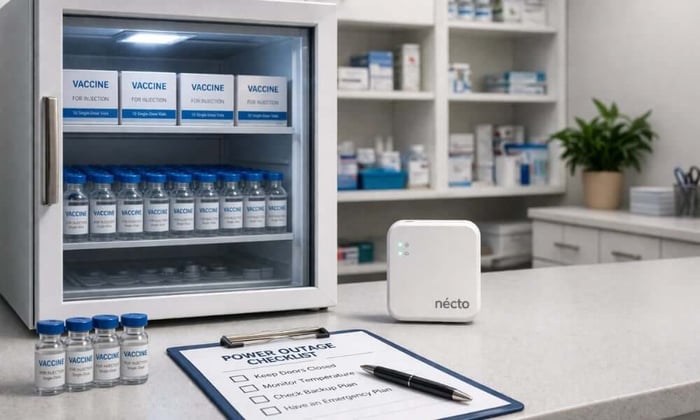
Necto gives clinical teams a way to watch cold storage without leaning on the facility network. It runs on 4G cellular through a built-in SIM, so a refrigerator in a satellite clinic with no usable Wi-Fi still reports the same as one at the main campus. The networks switch automatically across AT&T, T-Mobile, and Cellular One, which keeps a single unit working across different sites and signal conditions.
The product tracks temperature from minus 4 to 140 degrees Fahrenheit, humidity from 0 to 95 percent, and power status, updating every 10 minutes and switching to real-time reporting when a reading crosses a threshold. Alerts reach up to five phone numbers and email addresses by text and email, which lines up with the 24/7 responsible-party requirement for blood storage. When power drops, the 72-hour backup battery keeps the monitor alerting through the outage, and a separate alert fires when power comes back so staff can confirm the unit recovered. A year of readings is stored and downloadable as a CSV file, which turns pulling audit records into a short task.
Hospital cold storage monitoring comes down to three things: hold the right range for each unit, catch a drift early enough to act, and make sure the alert reaches a person even when the building is failing. The first two are well understood. The third is where most setups break, because a monitor wired to the same power and network as the refrigerator goes dark at the worst time.
Your blood and biologics are most exposed during the after-hours power event, nobody is on-site to catch. To get a cellular temperature and power monitor that keeps alerting through an outage, click here to protect your cold storage today.
FAQs
What temperature ranges do hospital refrigerators have to hold?
Refrigerated vaccines and most pharmacy stock hold at 2 to 8 degrees Celsius, which is 36 to 46 degrees Fahrenheit. Whole blood and red cells sit at 1 to 6 degrees Celsius. Frozen plasma and many biologics drop below minus 15 degrees, and some products need ultra-cold storage near minus 80.
How often should hospital storage temperatures be checked?
Continuous monitoring is the standard, with automated readings rather than manual spot checks. Platelets stored outside a continuously monitored incubator should be recorded every four hours. A cellular monitor like Necto reads every 10 minutes and shifts to real-time during an alert.
What counts as a temperature excursion?
An excursion is any reading outside the set range for that unit, even a brief one. Brief excursions can still compromise vaccines, blood, and biologics, which is why alarm thresholds are often set just inside the safe range to give staff time to respond.
Does hospital temperature monitoring need facility Wi-Fi?
Not with a cellular monitor. Necto reports over 4G through a built-in SIM, so it works in satellite clinics and off-site storage with no usable Wi-Fi, and it keeps alerting when a power event takes the building network down.
What happens if the power goes out during an alert?
A cellular monitor with battery backup keeps running through the outage. Necto's 72-hour battery keeps the alert path open, and a power restoration alert confirms when the unit returns to a safe range so staff are not left guessing.