Table of Contents
When shore power fails at an RV park, campground Wi-Fi goes offline at the same time. Any RV pet monitor that depends on that connection goes silent before a single alert fires. Inside a parked RV with no AC running, temperatures can hit dangerous levels in under 20 minutes. A cellular monitor keeps sending alerts through the outage, because it runs on its own network and its own battery.
You did everything right. The dog is settled, the AC is running, your Wi-Fi temperature monitor is connected, and your phone has alerts turned on. You hit the trail feeling like you have it handled. What most RV owners do not realize until it is too late is that the one scenario they are most afraid of, the AC cutting out, is the exact scenario that takes their monitoring offline, too.
Shore power failures and campground Wi-Fi failures are not separate problems. They are the same problem. And the pet monitors that most RV content recommends are not built to survive it.
What Happens to Campground Wi-Fi When Shore Power Fails
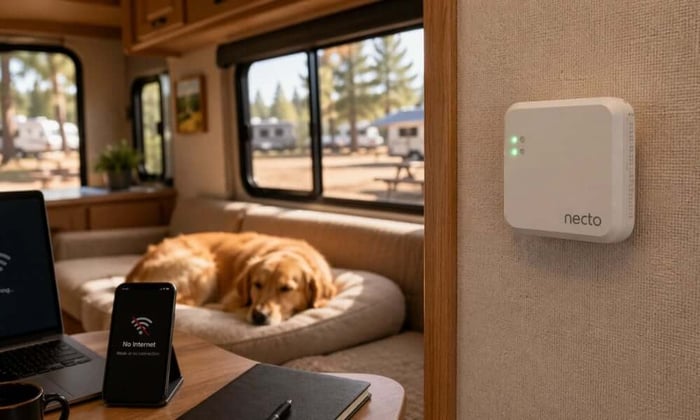
Campground Wi-Fi routers, switches, and access points run on electricity. When a pedestal trips or the park loses grid power, the campground network does not switch to backup power, it just goes down. Most campground operations are not running the kind of infrastructure that includes uninterruptible power supplies on their Wi-Fi access points.
The result: the moment shore power cuts out at your site, or at the equipment closet serving your section of the park, campground Wi-Fi disappears. This is not a partial outage where your signal gets weak. The network goes offline entirely.
Your Wi-Fi temperature monitor, which was sitting happily on that network, loses its connection at the same second. It can no longer send data to the cloud. It cannot push an alert to your phone. From your perspective in the parking lot three miles up the trail, nothing happens. No message. No notification. No warning that the AC just stopped.
This is the fundamental problem with Wi-Fi-dependent monitors in an RV environment, and it is almost never discussed in the articles recommending them.
How Fast Temperatures Climb After the AC Stops
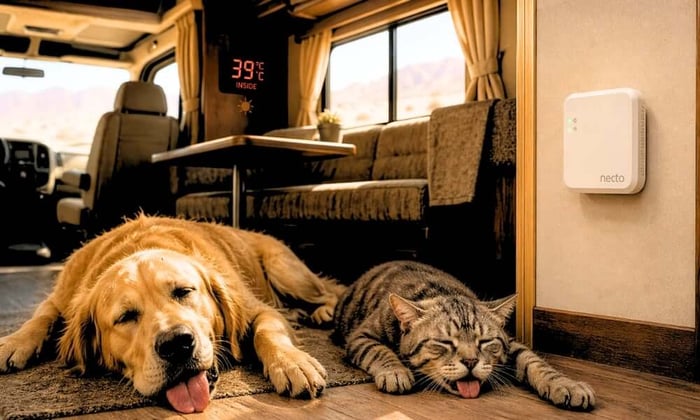
A parked RV in 80-degree weather with no ventilation and no air conditioning will typically reach dangerous interior temperatures within 15 to 25 minutes. On a hot summer day, 90 degrees or above, that window shrinks. Black or dark-colored rigs absorb heat faster. Sun angle matters. Humidity matters. But the basic physics do not change: a metal box with glass windows is an oven when the cooling stops.
Dogs begin showing signs of heat stress between 103 and 106 degrees Fahrenheit. Heat stroke sets in above that. Cats hit their limit around 105 degrees. Neither will show visible distress until they are already in trouble.
The 20-minute window between "AC stops" and "conditions are dangerous" is not a comfortable buffer. It is barely enough time to get an alert, understand what it means, and start moving back. If the alert never fires because the Wi-Fi went down with the power, that window closes without you knowing it opened.
Why This Problem Is Worse Than People Expect
Three things tend to happen at the same moment during a shore power failure:
The pedestal trips or the grid goes down, which kills the AC in your rig. The campground Wi-Fi loses power along with everything else on that circuit. And the interior of the RV starts heating up while the monitoring device quietly goes offline.
The timing is not coincidental. Shore power and campground Wi-Fi come from the same infrastructure. Lose one, and you tend to lose both. A monitor that depends on Wi-Fi to report a power failure is the equivalent of a smoke alarm that only works when there's no fire.
RV parks are also not like home networks. Campground Wi-Fi is shared infrastructure built for guests browsing the web, not for reliable, low-latency device connectivity. Signal quality varies by site location, number of users, and how recently the park invested in its setup. Even when the grid is up, campground Wi-Fi can be patchy, congested, or simply out of range for a rig parked at the edge of the property.
What Out-of-Band Monitoring Actually Means for an RV
The term "out-of-band" comes from IT infrastructure, but the concept applies directly to RV pet safety. Out-of-band means the monitoring system operates on a completely separate channel from the thing it is watching.
In a server room, that means a temperature monitor that does not depend on the network it is protecting. In an RV, it means a pet monitor that does not depend on campground power or campground Wi-Fi.
4G cellular monitoring is out-of-band by design. It connects through the cellular network, the same one your phone runs on, not through the campground's infrastructure. When shore power fails and the campground Wi-Fi drops, a cellular monitor keeps transmitting because it is not connected to either of those systems. It runs on its own backup battery and its own SIM card.
This distinction is the difference between a monitoring system that works when conditions are normal and one that works when conditions are not.
The Backup Battery Problem
A Wi-Fi monitor that has power but no Wi-Fi is useless. A cellular monitor that has connectivity but no power is equally useless. Both scenarios happen during a shore power failure unless the monitor has its own battery.
This is the second thing to check when evaluating any RV pet monitor. Not just whether it connects over Wi-Fi or cellular, but what happens when the wall outlet loses power. A device with no backup battery goes offline the moment the pedestal trips, regardless of how it connects.
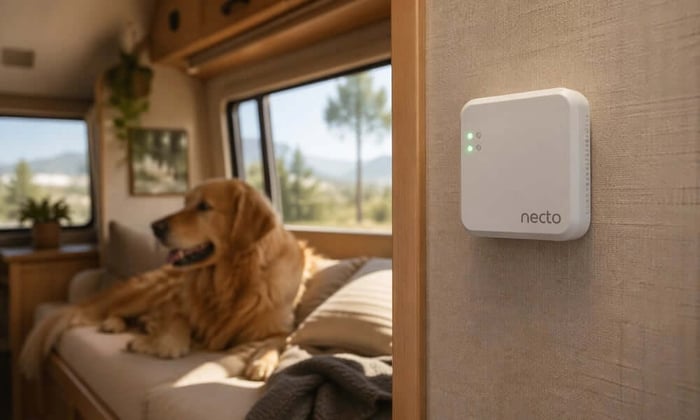
Necto is a cellular monitor with a 72-hour backup battery that handles both problems at once. Shore power fails, the device switches to battery, and keeps transmitting through the cellular network. An alert fires within minutes of the AC shutting down. You get the notification on the trail because your phone still has service, even if the campground does not.
What to Look for in an RV Pet Monitor
If you are evaluating options, these are the things that actually matter for an RV environment:
Cellular connectivity. Not Wi-Fi with cellular fallback, true cellular primary, so there is no dependency on campground networks at any point.
Built-in SIM. Monitors that require you to source your own SIM card and data plan add complexity and potential points of failure. A built-in SIM that auto-connects is one less thing to troubleshoot at 7 am in a campground.
Backup battery. Specifically, a battery rated for at least 24 hours of continuous operation. 72 hours is better. It needs to outlast a serious power event, not just a brief flicker.
Power restoration alerts. You want to know when shore power comes back, not just when it fails. Some monitors only alert on failure. Both events matter for understanding what happened to the conditions in the rig while you were out.
Temperature range. The sensor needs to cover the full range of conditions a pet might encounter, from a warm summer afternoon to the cold that creeps in overnight if the heat stops during a shoulder-season trip.
Necto was built for exactly this situation. It is a 4G cellular temperature, humidity, and power monitor that works anywhere a cell signal exists, no campground Wi-Fi required. The moment conditions inside the RV go outside the safe range, it sends an alert directly to your phone via text or the app. The 72-hour backup battery keeps it running even if shore power cuts out. For any RV owner who leaves a pet in the rig, it is one of the more practical pieces of gear to carry. More at getnecto.com.
FAQs
What temperature is dangerous for a dog left in an RV?
Dogs are at serious risk above 103 degrees Fahrenheit, and heat stroke begins above 106 degrees. An RV without AC running on a warm day can reach those temperatures in 15 to 25 minutes, depending on outdoor heat, direct sunlight, and rig color and construction.
Does a temperature monitor work without campground Wi-Fi?
Wi-Fi monitors do not work without campground Wi-Fi, they lose their connection and stop sending alerts. A cellular temperature monitor connects over 4G and does not use campground Wi-Fi at all, so it keeps working through power failures and Wi-Fi outages.
How quickly does an RV heat up when the AC stops?
In 80-degree weather, a parked RV can reach 100 degrees inside in about 20 minutes. In 90-degree heat with direct sun, it can happen faster. The more important number is how long you have to respond once you get an alert, which is why alert speed matters as much as the monitoring itself.
What should I do if my shore power trips while I'm away from the campsite?
Get back to the rig as fast as possible. Check on your pet first. If your monitor sent an alert with a timestamp, you can judge how long conditions have been elevated. If temperatures reached 104 degrees or above, contact a veterinarian, even if the pet appears okay.
Can I monitor my RV temperature if I'm in an area with no campground Wi-Fi?
Yes, if you are using a cellular monitor. 4G cellular coverage covers most campgrounds, national parks, and developed recreation areas in the United States. In truly remote areas with no cell signal, no monitor of any kind will transmit alerts, which is a real limitation worth planning around.