Table of Contents
- What Temperature Should a Lab Refrigerator Be Set To?
- What CLIA and CAP Require for Laboratory Refrigerator Temperature Monitoring
- What Happens When a Lab Refrigerator Fails After Hours
- Signs a Lab Refrigerator Is Losing Reliability
- Closing the Overnight and Weekend Monitoring Gap
- Before the Next Weekend Shift
- FAQs
If your lab runs on one or two refrigerators holding reagents, controls, and patient specimens, you already know there is no facilities team checking on them at 2 a.m. Laboratory refrigerator temperature monitoring is not optional for small and independent labs, but the requirements are easy to get wrong because CLIA does not hand you one universal number to hit. This article covers what the actual temperature range should be, what CLIA and CAP expect you to document, and what happens when a fridge fails on a night or weekend nobody is in the building. For the broader picture across healthcare settings, see our complete guide to medical refrigerator temperature monitoring.
CLIA (42 CFR Part 493) requires daily monitoring and documentation of temperature dependent lab equipment, but sets no single universal number. The correct range comes from the manufacturer's instructions for each reagent or specimen, commonly 36 to 46 degrees Fahrenheit for refrigerated items. A once a day manual check satisfies the minimum but misses failures that happen overnight or over a weekend.
What Temperature Should a Lab Refrigerator Be Set To?
There is no single CLIA-mandated refrigerator temperature. CLIA and CAP both point back to the manufacturer's instructions for each reagent, control, or specimen type, so the package insert is the actual source of truth, not a general rule of thumb. In practice, most reagents and refrigerated specimens fall into the 36 to 46 degree Fahrenheit range, with 40 degrees as a common target, which is the same range used across most clinical cold storage.
That range matters because reagents and antibody-based test components lose activity outside it, and a refrigerator running even a few degrees warm for an extended period can shift results without anyone noticing until a control fails or a proficiency test comes back off.
What CLIA and CAP Require for Laboratory Refrigerator Temperature Monitoring
CLIA's quality system rules under 42 CFR Part 493 require labs to monitor and document the condition of temperature dependent equipment and correct problems when they are found. For labs that are CLIA-waived only, following the manufacturer's instructions is the requirement in full. For labs performing nonwaived testing, CAP accreditation adds real weight: continuous monitoring with an alarm system is increasingly expected, and any monitoring device used for compliance needs to be calibrated against a traceable standard, not just plugged in and trusted.
This is the gap most small labs run into. A calibrated, continuously monitored device satisfies both a CLIA daily check and a CAP inspector's questions. A sticky note with a thermometer reading from yesterday morning satisfies neither.
What Happens When a Lab Refrigerator Fails After Hours
Small and independent labs are rarely staffed around the clock. A physician office lab or a small reference lab might have one person checking the fridge each morning, which means a compressor failure at 9 p.m. Friday is not discovered until Monday. At that point, reagents worth hundreds or thousands of dollars may be compromised, and any specimens stored for repeat testing or referral are gone.
The CDC's self-assessment checklist for waived testing sites specifically flags this scenario, recommending labs have an emergency plan for moving refrigerated items during a power outage and a way to know when the unit approaches its maximum allowed temperature, not just after it has already exceeded it. A once-daily check, similar to the documentation habits covered in our pharmacy refrigerator temperature log requirements article, cannot deliver that kind of warning.
Signs a Lab Refrigerator Is Losing Reliability
A few warning signs are worth checking during routine rounds, not just when something already seems wrong.
Frost or ice buildup inside the unit, often a sign of a failing door seal
Readings that drift a degree or two higher each time they are checked, even before an outright failure
A compressor that runs constantly without cycling off
Condensation collecting around the door gasket
Any unexplained gap in the daily log, which is itself a finding during a CAP inspection
Catching these early is usually the difference between a maintenance call and a lost batch of reagents.
Closing the Overnight and Weekend Monitoring Gap
A manual daily log satisfies the CLIA baseline, but it only tells you the temperature at the single moment someone looked. It says nothing about the eighteen hours before that check, which is exactly when most refrigerator failures actually happen. Continuous monitoring closes that gap by tracking the unit around the clock and flagging a problem the moment it starts, rather than the next time someone happens to walk by.
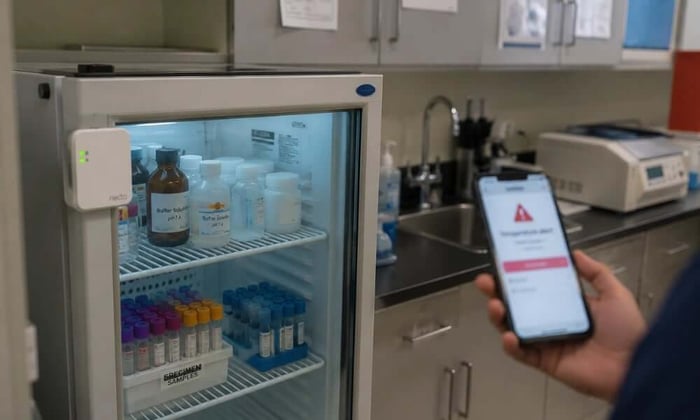
Necto fits this gap directly for small and independent labs. It is a 4G cellular temperature, humidity, and power monitor that reports over cellular rather than the lab's internal network, which matters in labs where IT access is restricted or segmented. If a reagent or specimen refrigerator drifts out of range or loses power, Necto sends a text and app alert to whoever is on call, and another alert once the unit is back to normal, so a Friday night failure gets a response before Monday morning. The 72 hour backup battery keeps it reporting through the outage itself. For labs performing CAP-accredited nonwaived testing, Necto is not a substitute for the calibrated, traceable monitoring device your accreditation requires. It is the after-hours alert layer on top of it, and for CLIA-waived labs, it can serve as the primary monitor.
Before the Next Weekend Shift
Laboratory refrigerator temperature monitoring comes down to three things: knowing the actual range your reagents and specimens need, documenting it the way CLIA and CAP expect, and having a way to catch a failure before the next scheduled check. The first two are a matter of following the package insert and keeping a clean log. The third is where most small labs have a real gap, since nobody is walking past the fridge at midnight on a Saturday.
That gap is exactly where the next lost batch of reagents comes from if it stays open.
If your lab depends on a refrigerator holding reagents or specimens overnight and on weekends, Necto's cellular monitor sends an alert the moment something changes, with no dependence on your lab's internal network. Contact Necto today to see how it fits into your lab's monitoring setup.
FAQs
What temperature should a lab refrigerator be set to?
There is no single CLIA number. The correct range comes from the manufacturer's instructions for each reagent, control, or specimen stored inside, though most refrigerated items fall between 36 and 46 degrees Fahrenheit.
Does CLIA require continuous temperature monitoring?
CLIA requires daily monitoring and documentation as a baseline. CAP accreditation for nonwaived testing goes further, increasingly expecting continuous monitoring with a calibrated device.
How often should lab refrigerator temperatures be logged?
At minimum, once daily to meet CLIA's baseline requirement, though many CAP-accredited labs log more frequently or use continuous monitoring to close the gaps between manual checks.
What happens to reagents or specimens after a temperature excursion?
It depends on the specific reagent or specimen, so the manufacturer's instructions or the lab director should determine whether it is still usable. Guessing in either direction risks either wasting usable material or reporting results from compromised reagents.