Table of Contents
- Why One Storage Rule Does Not Work Across Your Injectable Inventory
- Botox and Filler Storage Temperature by Product
- What a Temperature Excursion Actually Means for Your Inventory
- The Weekend and After-Hours Problem
- How Necto Fits Into a Med Spa Monitoring Setup
- Building a Storage Program That Holds Up Under Pressure
- FAQs
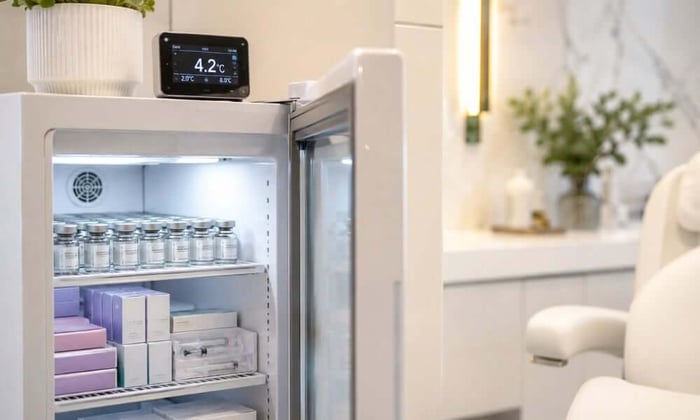
If you came back Monday morning to find your refrigerator had been running warm all weekend, you would need to know two things immediately: how warm it got, and for how long. For a med spa carrying BOTOX Cosmetic, Dysport, or any dermal filler, that window of uncertainty is the difference between injectable inventory you can use and product you have to discard. This article covers what the Botox and filler storage temperature requirements actually are for the most common products, where med spas most often go wrong, and what a weekend power failure means for your inventory.
Botox and filler storage temperature requirements vary by product and cannot be applied as one general rule across your inventory. BOTOX Cosmetic, Dysport, and JEUVEAU require refrigeration at 36 to 46 degrees Fahrenheit both before and after reconstitution. XEOMIN and DAXXIFY offer room-temperature storage before reconstitution. Most dermal fillers, including JUVÉDERM VOLBELLA XC and Restylane Contour, store at room temperature up to 77 degrees Fahrenheit and must not be frozen. Always verify the current prescribing information for the exact product in your inventory.
Why One Storage Rule Does Not Work Across Your Injectable Inventory
The most common storage mistake in med spas is treating every neurotoxin like BOTOX Cosmetic. XEOMIN, for example, does not require refrigeration before reconstitution. It can stay at or below 77 degrees Fahrenheit in its sealed vial. Put it in the refrigerator, and you have not made it safer. Accidentally place it against the freezer wall, and you may have created an excursion.
Dermal fillers run the other direction. Many products in the JUVÉDERM and Restylane lines are room-temperature products that must not be frozen. A cabinet near an HVAC vent, a delivery area on a cold morning, or a shelf beside a cold pack can push a filler below its labeled limit just as surely as heat can push a neurotoxin above its limit.
The product-specific rules matter because an excursion is defined by the product's approved labeling, not by a general sense of whether a temperature seems fine. FDA prescribing information for each product includes the exact temperature range, light-protection requirements, and post-reconstitution time limit that apply to that specific formulation.
Botox and Filler Storage Temperature by Product
The table below reflects current manufacturer guidance for commonly used products. Storage requirements and approved labeling can be updated, so verify the current prescribing information before relying on any reference chart.
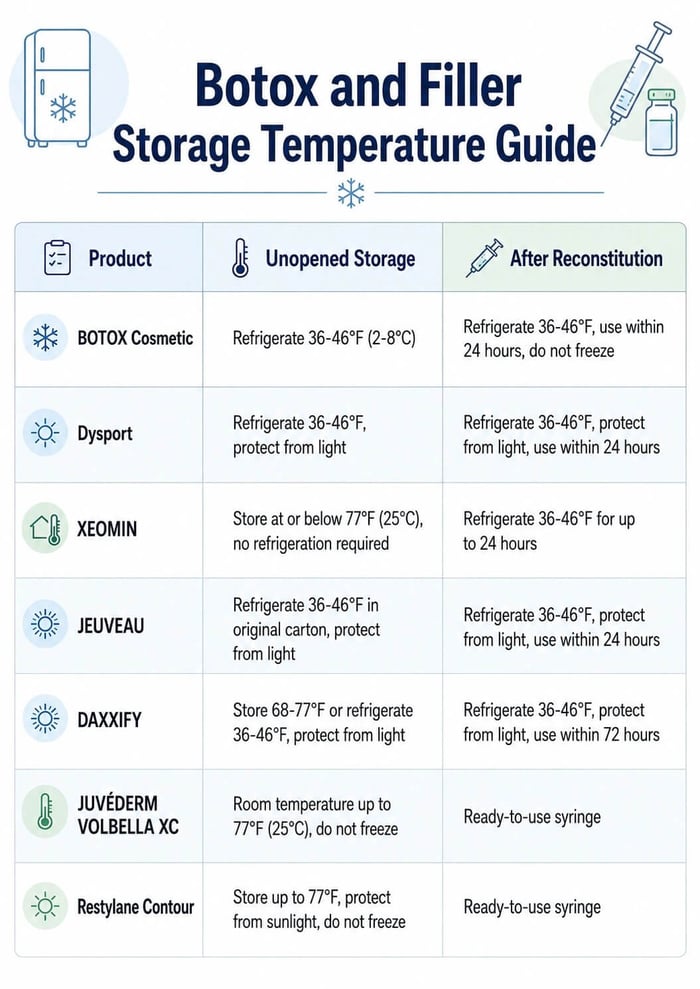
Two things stand out in that table. First, DAXXIFY is the only neurotoxin with a 72-hour post-reconstitution window. The rest are 24-hour products. Second, XEOMIN is the only neurotoxin that does not require refrigeration before reconstitution. Applying BOTOX Cosmetic rules to every product in your inventory will create errors in both directions.
What a Temperature Excursion Actually Means for Your Inventory
An excursion is not a failed product. It is a product that was outside its labeled storage range for some period of time, which is why duration matters as much as peak temperature. A refrigerator that spiked to 50 degrees Fahrenheit for 20 minutes during a defrost cycle is a different situation from one that sat at 55 degrees from Friday night to Monday morning.
The standard response to a suspected excursion is to isolate the affected inventory immediately, label it clearly as quarantined and not for use, and restore the correct storage conditions. Then document everything you know: the product name, lot number, expiration date, the temperature range the product was exposed to, and your best estimate of how long the exposure lasted. That information is what the manufacturer or supplier will ask for when you contact them for product-specific guidance.
One thing not to do: do not move refrigerated products to a backup cooler with ice packs without first checking whether that backup method is appropriate for the specific product. An ice pack environment can fall below 32 degrees Fahrenheit, and products with "do not freeze" instructions cannot go there.
The Weekend and After-Hours Problem
Most temperature excursions in med spas happen when nobody is there. A refrigerator compressor fails on Saturday afternoon. An HVAC unit goes offline during a long weekend. A circuit trips and a room-temperature filler cabinet sits in an 85-degree room for 36 hours before anyone opens the door Monday morning.
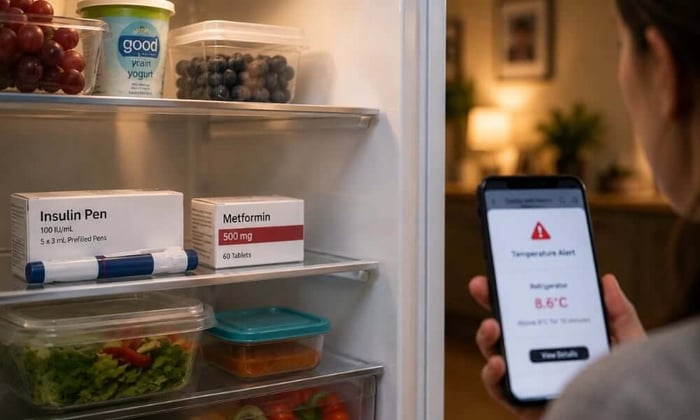
This is the scenario that continuous monitoring addresses. A system that records conditions around the clock and sends an alert to a phone when temperature moves outside a set threshold gives staff the chance to respond the same day instead of discovering the problem days later. The difference between a 4-hour excursion and a 40-hour one often comes down to when you found out.
The alert path matters as much as the sensor itself. A monitoring system that relies on the same internet connection tied to the building's power can go offline during the exact event it is supposed to catch. Cellular monitoring bypasses that dependency. If the refrigerator fails during a power event that also takes down the building network, a cellular-connected sensor keeps reporting and keeps sending alerts. CDC guidance on cold chain management reinforces that continuous temperature monitoring with real-time alerts is a best practice for any setting managing temperature-sensitive healthcare products.
How Necto Fits Into a Med Spa Monitoring Setup
Necto gives med spas a cellular monitoring option that does not depend on a Wi-Fi connection or building network. It tracks temperature and power status continuously, sends text and app alerts when conditions move outside the thresholds you set, and keeps running on its 72-hour backup battery through a power outage. For a more detailed look at how cellular monitoring works across healthcare storage scenarios, see the complete guide to medical refrigerator temperature monitoring. For a med spa monitoring a Botox refrigerator and a room-temperature filler cabinet, that covers the two most common failure points. When a refrigerator compressor fails overnight or an HVAC unit shuts down over a holiday weekend, the alert reaches whoever is on call before the excursion becomes a full inventory loss. Visit getnecto.com to learn more.
Building a Storage Program That Holds Up Under Pressure
The med spas that handle temperature events well are not the ones with the most expensive equipment. They are the ones with written procedures that staff actually follow. That means a separate labeled storage area for each product category, a reconstitution log with date and time on every vial, and an after-hours response plan that names more than one person to receive alerts.
Continuous temperature monitoring is a tool, not a substitute for those procedures. A sensor that alerts at 3 a.m. is only useful if someone knows what to do when the alert arrives. The goal is a system where a temperature event prompts a documented response, not a panic decision made without records. For a parallel example of how healthcare facilities structure after-hours monitoring, see how dental office refrigerator monitoring handles the same overnight gap.
If your med spa carries refrigerated neurotoxins or room-temperature fillers and you do not have continuous temperature monitoring with after-hours alerts, that gap is worth closing before the next long weekend. Contact Necto today and get a cellular temperature and power monitor that keeps watching your injectable storage even when the building network goes down
FAQs
Does unopened BOTOX Cosmetic need to be refrigerated?
Yes. Unopened BOTOX Cosmetic should be stored between 36 and 46 degrees Fahrenheit. It should not be used after the expiration date on the vial and should not be frozen.
How long is BOTOX good after reconstitution?
The prescribing information states reconstituted BOTOX Cosmetic should remain refrigerated between 36 and 46 degrees Fahrenheit and be administered within 24 hours. The date and time of reconstitution should be recorded on the vial.
Do dermal fillers like JUVÉDERM and Restylane need refrigeration?
Most do not. JUVÉDERM VOLBELLA XC and Restylane Contour are stored at room temperature up to 77 degrees Fahrenheit. Both have "do not freeze" instructions, which means accidental freezing is a storage risk as well as excessive heat. Always verify the instructions for the specific product and formulation in your inventory.
What should a med spa do after a temperature excursion?
Isolate the affected product immediately and label it as quarantined. Document the product name, lot number, expiration date, estimated temperature range, and exposure duration. Contact the manufacturer or authorized supplier for product-specific guidance before deciding whether to use or discard the inventory.
Why does cellular monitoring matter for med spa refrigerators?
A monitoring system that relies on the building's internet connection can go offline during the same power event that affects the refrigerator or HVAC. Cellular-connected monitors keep reporting and sending alerts even when local network infrastructure is down, which is when after-hours alerts matter most.