Table of Contents
- What Temperature Should Refrigerated Medication Be Stored At?
- Where to Store Medication Inside a Home Refrigerator
- What a Power Outage Does to Refrigerated Medication
- Signs Your Home Medication Fridge Is Not Holding Temperature
- How Caregivers Can Know Without Being in the Room
- What This Means for the Next Power Outage
- FAQs
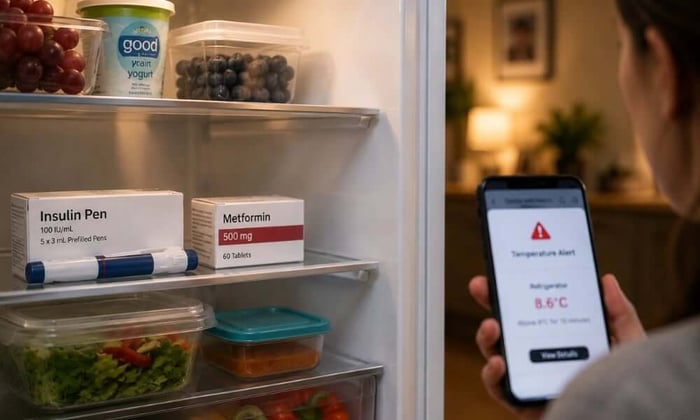
If someone in your house depends on a medication that has to stay cold, you already know the fridge that holds it is not a hospital-grade unit. It is the same fridge holding leftovers and milk, and it was not built to hold a steady temperature for something that cannot afford to drift. Storing refrigerated medication at home comes with a narrower margin for error than most people realize, and the risk usually shows up during a power outage, in a fridge that is quietly running warm, or in a bottle left in the door where the temperature swings the most. This article covers where to store it, what temperature range to aim for, and what to do when the power goes out. For more on the same principles outside the home, see our complete guide to medical refrigerator temperature monitoring.
Most refrigerated medications need to stay between 36 and 46 degrees Fahrenheit, with 40 degrees as the target. Store it on a middle shelf, never in the door or against the back wall, and check the temperature regularly rather than relying on how cold the fridge feels. A power outage is the most common cause of an unnoticed temperature excursion.
What Temperature Should Refrigerated Medication Be Stored At?
The CDC's Vaccine Storage and Handling Toolkit sets 36 to 46 degrees Fahrenheit as the safe refrigerated range for temperature-sensitive medications and biologics, with 40 degrees as the midpoint target. That range is not arbitrary. Insulin, certain biologics, and many injectable medications lose potency outside that window, and in some cases, freezing does more damage than a few degrees of warmth ever would, a principle covered in more detail in the CDC's Pink Book storage and handling chapter. A medication that has been frozen and thawed usually cannot be salvaged, even if it looks fine.
Most household refrigerators run colder than people assume, especially older units set without ever being checked with a separate thermometer. A fridge that feels cold enough can easily be sitting at 34 degrees near the back, cold enough to damage insulin or a biologic stored too close to the cooling element.
Where to Store Medication Inside a Home Refrigerator
The middle shelf, toward the front, holds the steadiest temperature in most refrigerators. The door is the least stable spot in the fridge. Every time it opens, the door shelves see a swing in temperature, and in a busy household with kids grabbing drinks and condiments, that can mean dozens of swings a day. The back wall, especially near the cooling vent, runs the coldest and is where medication is most likely to freeze without anyone noticing until it is too late.
Follow any specific placement instructions that came from a pharmacist. Without that guidance, the middle shelf is the safer default.
What a Power Outage Does to Refrigerated Medication
A closed refrigerator holds its temperature for a few hours during a power outage, but that window depends on how full the fridge is, how often the door opens, and the ambient temperature in the house. A refrigerator in a warm kitchen during a summer outage drifts out of range faster than one in a cool basement in winter.
The real danger is not a short outage while someone is standing in the kitchen watching the clock. It is the outage that happens while everyone is asleep, or at work, or on a trip, and nobody knows the power went out until the fridge is found running warm hours later. At that point, there is no way to know exactly how long the medication sat outside the safe range, which puts a caregiver in the position of guessing whether it is still usable.
If a temperature excursion happens, the medication's manufacturer or a pharmacist is the right source for whether it is still safe to use, since guessing wrong in either direction is not a good outcome for anyone.
Signs Your Home Medication Fridge Is Not Holding Temperature
A few signs are worth checking regularly, not just after something seems off.
Ice or frost building up inside the fridge compartment, which usually means it is running colder than the dial suggests
Condensation collecting on the inside walls or shelves
The fridge feels warm to the touch on the outside, particularly near the compressor
Food or drinks nearby spoiling faster than usual
The fridge running constantly without cycling off, often a sign of a door seal or thermostat problem
A basic refrigerator thermometer catches most of this, but the gap between checks is where the actual risk sits for a household managing a fragile medical situation.
How Caregivers Can Know Without Being in the Room
Checking a thermometer once a day tells you the temperature at that exact moment, not what happened at 3 a.m., or during the four hours someone was at work, or during an outage that resolved itself before anyone got home. For a caregiver managing an elderly parent's medication, or a parent managing a child's insulin, that blind spot is the actual problem, not the temperature range itself.
A monitored sensor closes that gap, tracking the fridge continuously and sending an alert the moment something moves outside the safe range, including a power loss, which a thermometer cannot detect.
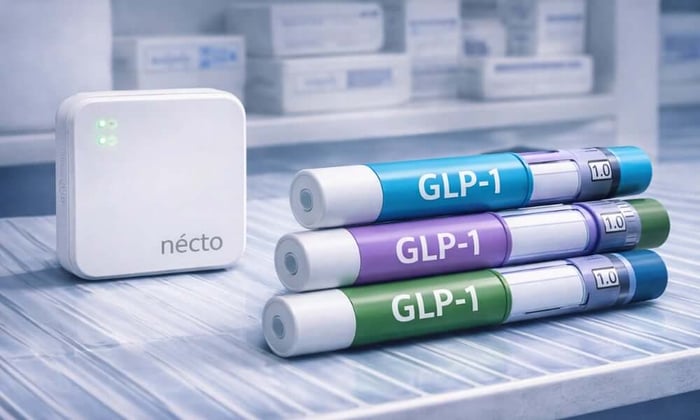
Necto was built for exactly this kind of situation. It is a 4G cellular temperature, humidity, and power monitor that clips inside a refrigerator and reports over cellular, not home Wi-Fi, so a router outage does not create a blind spot on top of the power outage. If the medication fridge drifts out of range or the power cuts out, it sends a text and app alert directly to a caregiver's phone, and another once conditions return to normal. The 72 hour backup battery keeps it reporting through the outage itself, the exact window a thermometer cannot cover. For a family managing insulin, a biologic, or any temperature-sensitive medication at home, it is a way to know what happened without having to guess. It does not replace a pharmacist's guidance on whether a specific medication is still safe to use after an excursion; it just makes sure that question gets asked before the medication is used rather than after.
What This Means for the Next Power Outage
Storing refrigerated medication at home comes down to three things: the right temperature range, the right spot in the fridge, and a way to know when something has gone wrong even when nobody is watching. The first two are simple enough to get right once. The third is where most households have a gap, because a fridge that is failing quietly does not announce itself until the milk goes bad or the medication is already ruined.
That gap matters more than it might seem on an ordinary day.
If your household depends on a refrigerator to keep medication safe, and you want to know the moment something changes even when you are not home, Necto's cellular monitor sends that alert directly to your phone with no Wi-Fi required. Contact Necto today to learn how it fits into your household's setup.
FAQs
How long can refrigerated medication be out of the fridge during a power outage?
It depends on the specific medication, so the manufacturer's instructions or a pharmacist is the right source for an exact answer. As a general rule, a closed refrigerator holds a safe temperature for a few hours during an outage, but that window shrinks in a warm room or a fridge that is opened frequently.
Can medication that got too warm be used safely?
Not always, and it is not something to guess about. Some medications tolerate brief excursions outside the 36 to 46 degree range without losing effectiveness, while others, particularly insulin and certain biologics, degrade quickly outside that range. Contact the prescribing pharmacist before using medication that may have been exposed to unsafe temperatures.
Do I need a special thermometer for a medication fridge at home?
A basic refrigerator thermometer works for spot checks and costs very little. The limitation is that it only shows the temperature at the moment you look, so it will not catch what happened overnight or while you were away.
What is the difference between a basic thermometer and a monitored sensor?
A thermometer requires someone to physically check it. A monitored sensor tracks the temperature continuously and sends an alert the moment something moves outside the safe range or the power goes out, without anyone needing to check it.