Table of Contents
If you have ever set up a certified data logger for VFC compliance and assumed the monitoring problem was solved, you are mostly right. If the power goes out on a Friday night, the logger is still recording, but it cannot reach you because the network it reports through just went down with the rest of the building. Understanding the difference between a digital data logger vs cellular monitor is not about picking one over the other. It is about knowing which problem each one actually solves.
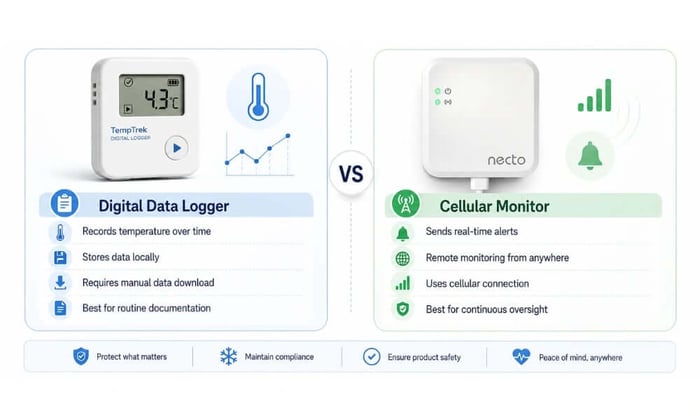
A digital data logger records temperature at set intervals, stores the data on-device, and produces the calibration-documented log that VFC-funded vaccine storage and other regulated settings require for compliance. A cellular monitor tracks temperature and power status in real time and sends alerts over 4G when conditions go outside safe limits, independent of the building's network or power grid. They do different jobs. In regulated settings, most facilities that take after-hours monitoring seriously end up running both.
What a Digital Data Logger Actually Does
A DDL records temperature continuously at programmed intervals, typically every 30 minutes for VFC compliance, and stores that data locally on the device. The record it produces is the foundation of a compliant temperature log: time-stamped, downloadable, and backed by calibration documentation that ties the device to a traceable standard.
The CDC Vaccine Storage and Handling Toolkit specifies that VFC-enrolled providers must use a DDL with a NIST-traceable calibration certificate, a current and valid certificate of calibration testing, and a recording interval of 30 minutes or less. A standalone min/max thermometer does not meet that standard. Neither does a cellular monitor. For VFC storage, the certified DDL is the required primary monitoring device, and that requirement is not flexible.
What a DDL does not do, in most configurations, is alert you while a problem is developing. Many basic DDLs have no network connectivity at all. You pull the data after the fact, or you check it manually. More advanced models can send alerts over Wi-Fi or LAN, but that alert path shares infrastructure with the building. When the power goes out and the refrigerator stops cooling, the same event that creates the problem also takes down the network the DDL uses to report it.
What a Cellular Temperature Monitor Does
A cellular monitor tracks temperature and power status in real time and sends alerts by text and app the moment conditions move outside the thresholds you set. The key difference from a network-connected DDL is where the alert travels: over 4G, on its own built-in SIM, with no dependency on the building's internet connection or power grid.
That independence matters most during the events most likely to cause temperature damage. A refrigerator compressor fails, a circuit trips, or utility power goes out, and the local network goes down at the same moment. A monitoring system that reports over that network goes silent exactly when you need it most. A cellular monitor keeps sending alerts because it is not using that network.
A cellular monitor also tracks power status directly. When the outlet loses power, an alert goes out immediately, not after a polling interval, not after someone checks the logger in the morning. For after-hours events at a pharmacy, a dental office, or a med spa with refrigerated injectables, that immediate alert is the difference between a short excursion and an inventory loss.
What a cellular monitor does not do is produce calibration-certified documentation for regulatory compliance. It tracks temperature accurately and stores up to a year of readings downloadable as a CSV, but it does not carry the NIST-traceable calibration certificate that VFC enrollment requires. For facilities that need to verify storage documentation requirements for specific products, FDA prescribing information for each product outlines the exact storage range and documentation expectations. A cellular monitor is not a DDL replacement in any regulated context.
Where Each One Falls Short
The clearest way to see the gap is side by side.
Digital Data Logger | Cellular Monitor | |
Compliance documentation | Yes, calibration certified | No |
VFC required primary device | Yes | No |
Real-time push alerts | Depends on model | Yes |
Alert path during power outage | Network-dependent, often fails | 4G independent, stays active |
72-hour battery backup | No | Yes |
Data history | Yes, on-device | Yes, 1 year, CSV download |
Works without Wi-Fi | Yes (stores locally) | Yes (4G cellular) |
The practical summary: a DDL tells you what happened. A cellular monitor tells you while it is happening. For the Friday night power failure scenario, only one of those is useful in the moment.
Why Some Facilities Run Both
VFC pharmacies need a certified DDL. That is the compliance requirement, and a cellular monitor does not change it. What a cellular monitor adds is an independent alert path for the events a DDL cannot cover: after-hours power failures, overnight temperature climbs, weekend refrigerator malfunctions.
A pharmacy running both has the compliant record the state board and VFC program require, and a separate system that calls someone's phone at 2 a.m. when the compressor stops. A dental office that is not VFC-enrolled still benefits from the same setup: the DDL for documentation and the cellular monitor as the after-hours alert layer. A med spa with refrigerated neurotoxins faces the same weekend and overnight blind spot, and the same solution applies.
The pairing works because the two devices are not redundant. They are covering different failure modes. The DDL covers the compliance record. The cellular monitor covers the alert gap that exists whenever the building's network and power are part of the failure.
For a closer look at how compliance logging and after-hours alert monitoring work together in pharmacy settings, see the complete guide to medical refrigerator temperature monitoring and the breakdown of pharmacy refrigerator temperature log requirements.
How Necto Fits Into This
Necto is the cellular monitoring side of that pairing. It runs on 4G over a built-in SIM that auto-connects to the strongest available network, with no Wi-Fi setup and no separate data plan. It monitors temperature and power status around the clock, sends alerts via text and app when conditions move outside set thresholds, and keeps running on its 72-hour backup battery through a power outage. For a closer look at how cellular monitoring handled a real power-outage scenario in a vaccine storage setting, see how to protect vaccine storage during power outages. For facilities that already have a certified DDL in place, Necto closes the one gap a DDL cannot cover on its own: the alert that reaches someone while the problem is still fixable. Visit getnecto.com to learn more.
Which One You Actually Need
If you have a VFC contract or operate in a setting where temperature documentation is a regulatory requirement, you need a certified, calibrated digital data logger. That is not negotiable, and no cellular monitor changes it. What a cellular monitor adds is the alert path that keeps working when the building's power and network go down together, which is exactly when a DDL cannot reach you.
For facilities that have already covered the compliance side and want real-time after-hours coverage, the two devices work as a pair. For non-regulated settings like dental offices, med spas, or small labs without strict DDL requirements, a cellular monitor alone may cover everything you need. The right answer depends on whether your setting has a compliance documentation requirement, and the answer to that question determines whether you need one device or both.
Contact Necto today to find out whether a cellular temperature and power monitor is the right fit for your facility and how it works alongside the monitoring system you already have in place.
FAQs
Does a cellular monitor replace a digital data logger for VFC compliance?
No. VFC-enrolled providers are required to use a certified digital data logger with a NIST-traceable calibration certificate recording at 30-minute intervals or less. A cellular monitor does not meet that requirement and is not a substitute for a compliant DDL in VFC-funded vaccine storage.
What is the difference between a data logger and a temperature monitor?
A data logger records temperature at set intervals and stores the data on-device for documentation and compliance purposes. A temperature monitor, especially a cellular one, is designed to send real-time alerts when conditions go outside safe limits. The logger produces the record. The monitor gets the alert to someone while the problem is developing.
Can a digital data logger send real-time alerts?
Some DDL models include Wi-Fi or LAN connectivity and can send alerts over the building's network. The limitation is that this alert path shares infrastructure with the building's power. During a power outage, a network-connected DDL may go silent at the same moment the refrigerator stops cooling.
What happens to a data logger during a power outage?
Most DDLs continue recording on internal battery backup during a power outage, so the temperature record stays intact. The gap is alerting. If the DDL's alert path depends on the building network, and the network goes down with the power, no alert goes out until the network comes back up or someone checks the device manually.
Do non-VFC facilities need a certified digital data logger?
Not all non-VFC facilities are required to use a certified DDL, but requirements vary by setting, state, and the type of product being stored. Dental offices, med spas, and small independent labs may not have the same DDL mandates as VFC pharmacies, though their storage documentation requirements still vary. A cellular monitor may cover the monitoring need in those settings without requiring certified calibration documentation.